
The Honesty Lesson Every Politician Should Learn - Former IAS
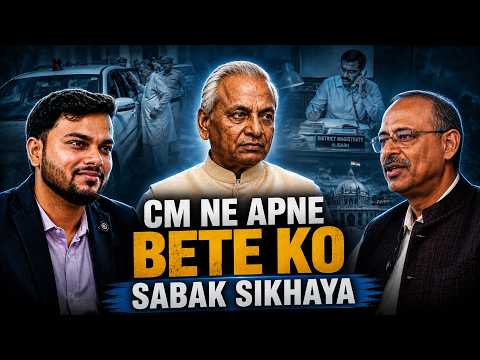
Look Anil, Kalyan Singh had said, if the kurta is clean, even one stain will show. If the kurta is dirty, stains will keep falling. So don’t let the first stain fall.
The retired IAS officer, who served 38 years in the Indian bureaucracy and worked under multiple Chief Ministers, was quoting the then Chief Minister of Uttar Pradesh. The teaching was direct. The framework was simple. The application, as Anil discovered, was profound.
The Setup
Anil was working closely with Kalyan Singh during his time as Chief Minister. This was before mobile phones, when field officers relied on landline calls and the schedules of senior officials were tight.
One morning, Anil was in the CM’s convoy, traveling to a meeting. His phone rang. It was the District Magistrate of Aligarh.
The DM was Anil’s own batchmate from the IAS. That relationship mattered. Junior officers do not normally call up the personal secretaries of Chief Ministers with sensitive information. But batchmates do call each other.
The message was specific. The CM’s son had taken the CDO’s official car. The CDO is the Chief Development Officer of a district - a senior IAS officer whose vehicle is state property, assigned for official duties. The son was using it.
This is the kind of story that most officers would decide not to escalate. The Chief Minister’s son doing something inappropriate is politically dangerous to raise. Most officers would pass the information along to someone else, or find a way to not know about it.
The Moment
Anil made a choice.
I casually mentioned it, he said. I said, “Sir, your son has taken the CDO’s car.”
The casualness is important. Anil did not present it as a scandal. He presented it as a fact worth knowing. He trusted Kalyan Singh to decide what to do about it.
The response was immediate.
Let’s go back home, Kalyan Singh said.
The Chief Minister of Uttar Pradesh, on his way to a meeting, turned the entire convoy around and went back to his residence.
Anil sat outside the residence. He did not go in. He could hear Kalyan Singh scolding someone. He did not know who.
They left again for the meeting.
By evening, Anil received a call back from the DM.
Boss, he returned the car, the DM said.
The Universal Lesson
Anil offered the takeaway in specific terms.
Look at this, he said. A Chief Minister making the effort that his own son should not misuse a government car. Something that is considered normal today.
The observation is worth pausing on. In the current political environment, official vehicles being used by family members of politicians is treated as unremarkable. It is not scandalous. It is not investigated. It is not even often discussed.
Kalyan Singh treated it as a moment requiring immediate action. Turn the convoy around. Discipline the family member. Ensure the car is returned. All by evening of the same day.
The Kurta Principle
That principle was what Kalyan Singh explained to Anil separately.
He would explain it to me, Anil said. He would say, “Look Anil, if the kurta is clean, even one stain will show. If the kurta is dirty, stains will keep falling. So don’t let the first stain fall.”
The metaphor is worth working through.
A clean kurta is a public reputation with no compromises. Every observer notices when something goes wrong because it stands out against the clean background. There is no camouflage.
A dirty kurta is a reputation that has already accepted some compromises. Additional compromises blend in. There is no clear signal that something has gone wrong because the background is already stained.
The strategy that follows is simple. Do not let the first stain fall. Not because the first stain itself is catastrophic. Because the first stain removes the clean-kurta advantage.
The Application Beyond Politics
The kurta principle applies well beyond political leadership.
Any professional building a reputation faces the same choice. The first compromise, once made, changes the observation baseline. A leader who has never taken a bribe is caught immediately if they ever do. A leader who has taken small bribes routinely is not caught when they take larger ones. The compromises become invisible against the background.
The founder who has always kept their commitments to employees is trusted when things get difficult. The founder who has occasionally broken commitments is less trusted, and the additional broken commitments do not damage them as much because the trust was already reduced.
The professional who has always attributed credit accurately is remembered as fair. The professional who has occasionally taken credit for others’ work is remembered as opportunistic.
In every case, the first stain is the most consequential. Not because it is the largest, but because it is the one that shifts the entire pattern of expectation.
The Cross-Party Reflection
Anil then reflected on the broader question of political leadership. Where are such leaders today?
His answer was measured.
It is not that such leaders do not exist, he said. Every leader has their own style.
He named specific figures across parties.
I had the good fortune of working with Oscar Fernandes, he said. With Mallikarjun Kharge. With Prakash Javadekar. All from different parties. Great to work with all of them.
The cross-party naming is important. Anil is not making a political argument. He is not claiming one party has all the integrity and the other has none. He is describing his own experience across a career that spanned multiple governments and multiple parties. In each of those contexts, he found leaders worth working with.
This is the kind of testimony that is rare in the current political discourse. Most retired officials, when discussing politicians they worked with, are either partisan critics or partisan cheerleaders. Anil is neither. His memory of good leadership is genuinely bipartisan.
The Arun Jaitley Reflection
Anil then offered a specific reflection on Arun Jaitley.
I did not work directly with Arun Jaitley, Anil said. But I learned a lot from him.
The specific skill Anil credited him with was consensus building.
How to build consensus, he said. How to talk to someone who disagrees with you. How to bring them to agreement. He was amazing at that.
Consensus building is a specific political skill. It is not persuasion in the ordinary sense. It is the ability to engage with someone whose position is fundamentally different from yours and, through the engagement, find a formulation that both sides can accept.
The skill requires patience. It requires respect for the person on the other side. It requires the willingness to change your own position enough that the other side can meet you.
Anil’s observation about the current absence of the skill is worth quoting.
The government misses him today, he said. Because he could talk to anyone.
The claim is not partisan. It is about a specific missing capability. When political systems lose their consensus builders, they become brittle. They can operate through majoritarian decision-making. They cannot operate through negotiation.
The Universal Insight
The Kalyan Singh moment has application beyond Indian politics.
Every leader, in every domain, faces the equivalent of the CDO’s-car moment. The moment when a family member, close friend, or trusted subordinate does something that ought to be checked. The default response is to look away, or to check quietly without visible action, or to rationalize why the specific instance is different.
The kurta principle rejects all three defaults. It requires visible action. It requires speed. It requires that the correction be strong enough that the behavior does not repeat.
The founders, executives, and professionals who apply this framework build reputations that last. The ones who do not, eventually accumulate stains that they can no longer distinguish from each other.
What This Reveals
Three things from this segment will stay with me.
The kurta principle. Do not let the first stain fall. This is a universal integrity framework that applies to any professional building a reputation.
The specific action test. Kalyan Singh did not just talk about integrity. He turned the convoy around and disciplined his son. The action itself is what made the principle credible. Leaders who articulate integrity but do not act on it are performing integrity, not practicing it.
The cross-party observation. Good leaders exist across parties. Anil’s cross-party appreciation is rare and worth remembering. Political discussion often reduces to partisanship. Real experience of working with leaders shows that quality is not confined to a party affiliation.
The Real Question For Professionals
The uncomfortable question the segment raises is what your own first-stain moment looks like.
Every professional has one. The moment when someone close to you asks for something that would compromise your integrity, but only slightly. The moment when a small favor would help a friend but cross a line. The moment when a small ambiguity in your record could be resolved in your favor if you allowed it to be.
The kurta principle says the first of these moments is the most important. Not because the specific compromise is large. Because accepting it changes what comes after.
Anil built a 38-year career on the observation that this principle, applied consistently, produces a reputation that survives every stress test. Kalyan Singh built a political career on the same principle. Whatever else those two figures were, they shared this understanding.
The question for the reader is whether they will build the same way.
Watch the full episode here:
More from the blog


Subscribe to our newsletter
The best new roles, resources and must-watch episodes — in your inbox every week. No spam, unsubscribe anytime.