
Why Manmohan Singh Succeeded as FM, Not PM? - Anil Swarup
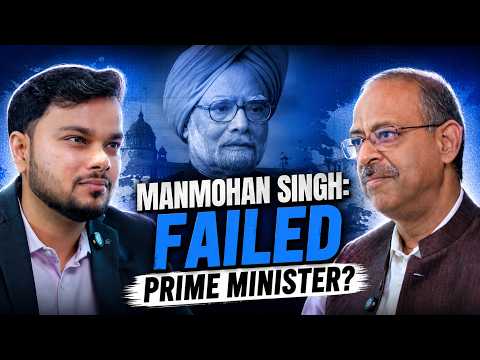
There is a sentence in our podcast with Anil Swarup that I have been carrying with me since the recording.
“Leadership cannot be appointed. A leader exercises power because of how he conducts himself. Nobody gives it to him. He has to take it himself. The qualities have to be there. Then the power follows.”
This is the single most important principle of executive leadership in two sentences. It applies to politics. It applies to business. It applies to academia, to non-profits, to the military, to every setting in which someone has been given a role that requires them to lead.
Most of us were never taught this. We were taught the opposite. We were taught that authority comes from the office, that the title confers the power, that the responsibility is matched by the autonomy. We were taught that if we earned the promotion, the rest would follow.
Anil Swarup, after 38 years inside the Indian government, is here to tell us this is structurally wrong.
The Floor And The Ceiling
The clearest way to understand the principle is to think of every executive role as having two boundaries.
The floor is what the office itself provides. The formal authority. The signing power. The reporting lines. The budget. The institutional machinery. This is what the appointment letter gives you. It is the minimum power you can exercise.
The ceiling is what the office holder produces. This is set by conduct, presence, decisiveness, willingness to act, willingness to be unpopular, willingness to make calls in the absence of complete information. It is the maximum power the role can support.
The gap between floor and ceiling is where leadership lives.
Two people can hold the same office, with the same formal authority, and exercise wildly different amounts of effective power. The one who has the leadership qualities will expand the role into its ceiling. The one who does not will contract the role into its floor.
This is true in every executive setting. The CEO who has the conviction of their position will direct the company. The CEO who waits for the board to approve every decision will be directed by it.
The Manmohan Illustration
Anil Swarup’s illustration came from the Indian Prime Minister’s office during the UPA decade.
“Manmohan Singh was good in his own way. That is why he succeeded as Finance Minister. As Prime Minister, the control that should have been there, the teamwork that should have been there, I did not see it.”
The same person who, as Finance Minister in 1991, made the most consequential economic decisions in modern Indian history, did not exhibit the same decisiveness in the office of Prime Minister twelve years later. The personal capabilities were the same. The office was different. The match between person and office was different.
The host pushed back. Perhaps Manmohan was constrained. Perhaps the power was not really in his hands. Perhaps he had been appointed by his party and was operating within constraints set by the party leadership.
Anil Swarup’s response was the principle itself.
“Power also depends on the individual. Whether he exercises it or not. How he conducts himself. A leader’s authority depends on his conduct. Nobody gives it to him. He has to take it himself.”
His eyewitness verdict on the Manmohan years, given that he was in the Cabinet Secretariat during them, was direct. “Many people say the government was being run from elsewhere. This is not correct. The power was in Dr. Manmohan Singh’s hands. It was plenty. There was no interference.”
This is the kind of eyewitness account that should reshape the public discussion of the UPA decade. Anil Swarup is not a partisan. He has nothing to gain from making this claim.
The implication is uncomfortable for everyone. The opposition narrative that Manmohan was a powerless figurehead is, by this account, wrong. The defence narrative that Manmohan was a constrained victim of his party’s leadership is, by this account, also wrong. The third narrative, that Manmohan had the power and chose not to exercise it the way a leader would, is what is left.
The Scholar Versus Leader Distinction
The conceptual framework Anil Swarup was working with deserves to be unpacked separately.
“Leadership qualities are different. He was a very fine personality. He was a very accomplished man. He was erudite. A scholar. But that has its own place. For leadership, you have to take the team along with you.”
This is a distinction that does not get drawn often enough in modern organisations. The qualities that make someone an exceptional specialist are not the same qualities that make someone an effective leader of a large organisation.
The exceptional specialist has depth of thought, care with detail, respect for evidence, reluctance to overclaim, willingness to admit uncertainty, mastery of complex technical material. These are scholarly virtues. They produce excellent work in roles that reward those virtues.
The effective leader has conviction in the absence of complete information, willingness to make decisions that disappoint constituencies, ability to inspire loyalty across diverse teams, comfort with the public performance of authority, tolerance for being criticised every day. These are leadership virtues. They produce effective work in roles that reward those virtues.
These are not opposite skill sets. They are different skill sets. Excellence in one does not produce excellence in the other.
Manmohan Singh, in Anil Swarup’s framing, had the scholar’s qualities and was placed in a role that required the leader’s qualities. The mismatch was not anyone’s fault. It was a structural feature of the appointment.
Every organisation does some version of this. We promote our best engineers to engineering management positions and wonder why some of them struggle. We elevate our best researchers to research leadership positions and wonder why some of them struggle.
Some do. Many do not. The ones who do not are usually not lazy or incompetent. They are people whose excellence in their previous role came from qualities that do not transfer to the new one.
The Modi Contrast
Anil Swarup’s comparison with the current Prime Minister was direct.
“That is the case with Modi. He is a fantastic leader. In terms of leadership, there is no parallel.”
This is a strong endorsement from a non-partisan veteran. The framework he used to assess Modi is the same framework he used to assess Manmohan. It is structural rather than ideological.
The Modi style is recognisably the style of someone who has taken power and is using it. Decisions are made and announced. Teams are assembled and directed. The Prime Minister’s authority is publicly visible.
You can agree or disagree with the substance of Modi’s leadership. You can support or oppose the policies that have come out of his style. The structural observation stands on its own. The same office, in different hands, looks like a fundamentally different institution.
The Conduct Principle
The deepest insight in the segment was about how conduct produces power.
“A leader’s authority depends on his conduct. The qualities have to be there. Then the power follows.”
This inverts most popular thinking about authority. We tend to assume that power produces conduct. The CEO acts a certain way because they are the CEO. The Prime Minister acts a certain way because they are the Prime Minister.
Anil Swarup’s framing is the reverse. Conduct produces power. The CEO who acts like a CEO becomes a CEO in fact. The CEO who acts like a careful committee member becomes a careful committee member, regardless of what the org chart says.
This is empirically correct. The most effective executives in any organisation are usually not the ones with the most formal authority. They are the ones whose conduct creates the impression of effective authority. The formal authority gets clarified around them rather than the other way around.
For anyone in an executive role, the implication is practical. The power you have is not what the appointment letter says. It is what you behave as if you have.
The Universal Application
The reason this segment matters beyond Indian political commentary is that the principle is universal.
If you are a founder, the same principle applies. The power of your role is defined by how you exercise it, not by the cap table.
If you are a corporate executive, the same principle applies. The reach of your authority is defined by your conduct, not by your title.
If you are running a non-profit, the same principle applies. The institutional weight of your role is defined by how you carry it, not by the bylaws.
This is why Anil Swarup’s principle deserves to travel beyond the Indian context that produced it. It is a leadership truth that has been hard-won over 38 years of close observation of how power actually works.
What I Took Away
Three things from this segment will stay with me.
The leadership cannot be appointed principle. This is the single most useful sentence I have heard about executive leadership in a long time. It applies in every domain.
The scholar versus leader distinction. The recognition that excellence in a specialist role does not produce excellence in a leadership role is one of the most underused frameworks in organisational design.
The eyewitness debunking of the remote control narrative. This is the political content most listeners will focus on, and it is genuinely significant. The Cabinet Secretariat is the institutional core of government coordination. Anil Swarup was there.
You may agree with Anil Swarup. You may disagree. The underlying leadership principles apply regardless of your view on the specific political illustration.
Watch the full episode here:
More from the blog

Subscribe to our newsletter
The best new roles, resources and must-watch episodes — in your inbox every week. No spam, unsubscribe anytime.