
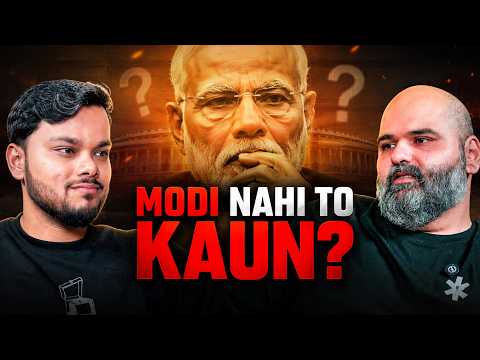
India Doesn't Have Young Leaders Anymore. It Has Loyalists: Kunal Kamra on Power, Dissent, and Democratic Decay
Every political system produces the leaders it is designed to produce.
That is not a cynical statement. It is a structural one. The incentives built into any political organisation shape the behaviours it rewards, the personalities it elevates, and the voices it marginalises. A system that rewards independent thinking produces independent thinkers. A system that rewards loyalty produces loyalists. The output reflects the design, whether the design was intentional or not.
In a recent conversation, Kunal Kamra made an observation that cuts through a great deal of political commentary about India's future.
"India doesn't have young leaders anymore. It has loyalists."
This is not primarily a criticism of any individual politician. It is a diagnosis of what the current structure of Indian politics systematically produces, and why that matters for anyone thinking seriously about what democratic governance in India looks like over the next two decades.
1. When Systems Discourage Independent Personalities
The conversation begins with a question that sounds simple and turns out to be deeply revealing: who emerges after Narendra Modi inside BJP?
The question is genuinely difficult to answer, and Kamra argues that the difficulty itself is the point. In a healthy political organisation, leadership pipelines are visible. Strong personalities develop their own constituencies, their own policy positions, their own relationships with the electorate. They occasionally disagree publicly with the central leadership on specific questions. They build identities that are not entirely derivative of the person at the top.
Inside highly centralised political structures, this process breaks down. The qualities that help a politician rise, demonstrated loyalty, alignment with central messaging, the absence of public positions that could create friction, are precisely the qualities that make someone a weak independent leader. The selection mechanism optimises for a specific profile. That profile is not the one that produces the next generation of genuinely autonomous political leadership.
Kamra's argument extends beyond BJP to Indian politics more broadly. The culture of internal party democracy has weakened across the political spectrum. Parties that once had genuine internal debate, competitive internal elections, and leaders who publicly held distinct positions have increasingly centralised decision-making in the hands of a small number of people at the top. The diversity of political voice that healthy parties once produced has narrowed.
The consequence is that the next generation of political leadership in India will largely consist of people who learned, during their formative political years, that independent thought is a liability and visible loyalty is an asset. That shapes not just their political style but their entire conception of what leadership means.
2. The Labelling Machine
One of the most specific and pointed sections of the conversation concerns how dissent is handled in the current political environment.
The mechanism Kamra identifies is labelling. Not engaging with criticism on its merits, not debating the substance of a position, but attaching a label that places the critic outside the bounds of legitimate discourse before the argument can be properly heard.
Farmers protesting agricultural policy become anti-national. Students raising questions about institutional practices become urban Naxals. Environmental activists questioning infrastructure projects become extremists. The label does specific work: it signals to the audience that the critic's position does not need to be taken seriously because the critic's loyalty is in question.
This is an old political technique. What has changed is the speed and scale at which it operates in a media environment that rewards emotionally charged content and an algorithm-driven social media landscape that amplifies conflict faster than it amplifies nuance.
The cumulative effect is a public discourse in which the threshold for acceptable criticism is constantly shifting and always shifting in one direction. What can be said safely narrows over time. The people willing to say things outside that narrowing band face costs that are visible to everyone considering whether to speak. And many people, rationally, decide that the cost is not worth it. The silence is not imposed through any single dramatic act of censorship. It accumulates through thousands of individual calculations about personal risk.
3. The Press Conference That No Longer Happens
The conversation's treatment of media control is worth examining closely because it identifies a specific and underreported mechanism of democratic erosion.
Kamra observes that press conferences, the institutional form through which political leaders make themselves available for direct questioning by journalists, have become increasingly rare from the central government. The format that once provided a structured opportunity for accountability, for journalists to ask difficult questions in a setting where evasion is visible, has been largely replaced by controlled communication: curated interviews, prepared statements, social media posts, and appearances in environments where the questioning can be managed.
This matters more than it might initially appear. The press conference is not just a media format. It is a democratic institution. It embeds the assumption that leaders owe the public direct answers to direct questions, that accountability is not something politicians can opt into only when it is convenient. When that institution atrophies, what replaces it is a political communication style that looks like transparency but functions as its opposite.
Television media, in Kamra's account, has largely accommodated rather than resisted this shift. Channels that might once have demanded access and pushed back against controlled communication have instead accepted the terms on offer. The result is a media ecosystem that provides enormous coverage of political activity while asking progressively fewer difficult questions about it.
4. Two People Selling, Two People Buying
The most controversial statement in the conversation is also the most direct.
"Two people are selling this country and two people are buying it."
The reference to Adani and Ambani is unmistakable, and the political charge is significant. What makes the statement worth examining beyond its provocation is the structural argument embedded within it.
Kamra's concern is not primarily about any individual business group's success. It is about the relationship between concentrated corporate power and political decision-making. When a small number of enormously powerful business interests are present across infrastructure, media, energy, ports, airports, and defence, their relationship with political power becomes qualitatively different from ordinary business-government interaction.
The question it raises is genuinely important for democratic governance: at what point does the concentration of corporate power in a democracy begin to shape the political agenda rather than respond to it? When the entities that control critical infrastructure, employ significant portions of the workforce, and own significant portions of the media are also the entities whose regulatory treatment depends on political decisions, the line between corporate interest and public interest becomes difficult to locate.
The Great Nicobar Island project, which Kamra discusses in the conversation, serves as a specific example of this tension. The island is described simultaneously as a strategic national asset of geopolitical importance and as an economic development opportunity. Kamra's question is about which framing is doing the actual work in the decision-making, and whose interests are served by the project's specific design.
5. The Judiciary and the Hierarchy of Urgency
A less-discussed but important section of the conversation touches on India's judicial system and what Kamra perceives as a shifting hierarchy of institutional priorities.
The observation is specific: corporate disputes and business-related legal matters receive faster, more serious institutional attention than public-interest litigation. Cases that affect the rights and conditions of ordinary citizens move slowly through overloaded courts. Cases that affect the financial interests of large corporations find a more expedited path.
This is a contestable empirical claim, and the causes of judicial delay in India are genuinely complex. But the perception Kamra is describing is widely shared across a political spectrum that extends well beyond his ideological position. When citizens experience the judicial system as more responsive to powerful interests than to public-interest concerns, the institutional trust that democratic systems depend on erodes. And institutional trust, once lost, is extraordinarily difficult to rebuild.
The deeper point is that democracies are not just electoral systems. They are ecosystems of institutions that are supposed to provide overlapping forms of accountability. When courts, media, and regulatory bodies all begin to be perceived as operating within a hierarchy that consistently privileges certain interests over others, the formal structure of democracy continues to exist while the functional reality diverges from it significantly.
6. Fear as Institutional Culture
The conversation returns repeatedly to fear, but in a register that is worth paying attention to carefully.
The fear Kamra is describing is not the dramatic fear of sudden political violence or obvious repression. It is the quieter, more insidious fear that shapes how institutions operate from the inside. Politicians who moderate their positions not because they have been threatened but because they have observed what happens to colleagues who did not. Journalists who soften their questions not because they have been told to but because the professional costs of aggressive accountability reporting have become visible and real. Judges who are aware of which kinds of cases attract institutional scrutiny and which do not.
None of these individuals may ever experience a direct instruction to behave differently. The system communicates its preferences through consequences, through career outcomes, through access, through the distribution of opportunities and obstacles. People within institutions read those signals and adjust. The adjustment happens at an individual level but produces a collective shift in institutional culture that is far more durable and difficult to reverse than any individual act of censorship.
This is how democratic erosion actually happens in most contemporary cases. Not through a single dramatic rupture but through the slow accumulation of individually rational adjustments that collectively transform the character of institutions.
7. What Democracy Actually Requires
The conversation arrives at a claim that deserves to be taken seriously regardless of where one sits politically.
Elections are necessary for democracy. They are not sufficient for it.
The other requirements are less visible but equally important: independent institutions willing to check power, a media ecosystem capable of providing citizens with accurate information, space for internal dissent within political organisations, and the cultural normalisation of criticism as a legitimate and valuable democratic activity rather than a sign of disloyalty.
When those elements weaken, democracy continues to exist in formal terms while becoming progressively less functional in substantive ones. The elections happen. The votes are counted. The results are announced. And the accountability mechanisms that are supposed to make those results meaningful have quietly diminished.
Kamra's contribution in this conversation is not a policy programme. It is a diagnosis. And the uncomfortable thing about a diagnosis is that it demands a response that goes beyond disagreeing with the person delivering it.
The One Thing
The measure of a democracy is not whether it holds elections. It is whether the people holding power are genuinely accountable to something outside their own interests between those elections. India has the elections. The question worth asking honestly is whether the institutions, the media, the judiciary, the internal cultures of political parties, and the public space for criticism are strong enough to make those elections mean what they are supposed to mean.
Watch the full conversation here:
More from the blog

Subscribe to our newsletter
The best new roles, resources and must-watch episodes — in your inbox every week. No spam, unsubscribe anytime.