
India’s Exam Mafia EXPOSED! - Anil Swarup
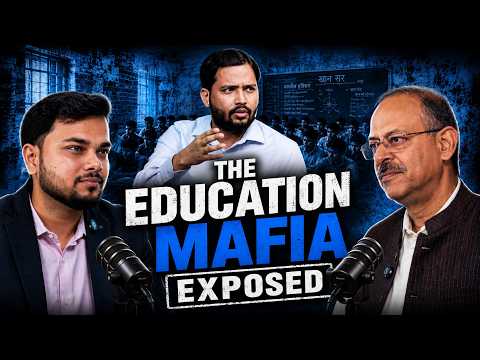
There is a sentence in our podcast with Anil Swarup that I have not been able to stop thinking about.
“I gathered the detail and found that schools and colleges were given on contract for facilitating cheating.”
Read that twice. The institutions that exist to educate India’s young people were being leased out, in his account, for the express purpose of helping students cheat on board exams. This is not folklore. This is testimony from a 38-year IAS officer who served as Education Secretary, who saw it personally as a young SDM in 1985, and who has written about it in his book.
This is the kind of fact that should rearrange how an informed Indian thinks about the country’s education system.
Let me walk you through what he told us.
The Window-Jumping Story
The segment opened with a story from his first posting. Kushinagar district, 1985.
“My driver came to me one morning and said, ‘sir, come with me, I will show you a sight today.’ I asked what was happening. He said, ‘just come, sir.’”
They drove to a board exam centre. As they pulled up, people started jumping out of the windows.
“I asked what was happening. The driver said, ‘sir, these are the people who came to facilitate cheating. They are running because they saw your car.’”
This is the kind of visual that makes the abstract concrete. The cheating infrastructure was not a few rogue actors. It was a coordinated system, complete with personnel deployed at exam centres for the specific purpose of helping candidates cheat, and a counter-intelligence sensitivity good enough to evacuate within seconds of an SDM’s car being spotted.
The Mango Orchard
The next day’s story was worse.
“My driver said, ‘sir, today we will go a little earlier. I will show you another sight.’ We went to a different centre. It was peaceful. I said, this one looks fine. He said, ‘no sir, it is not fine. They have just opened the paper. The people you see sitting in the mango orchard are solving it. When they finish, they will come to facilitate cheating.’”
The system was even more sophisticated than the first centre suggested. A team of solvers was working through the paper in real time, in a mango orchard near the exam centre, before the answers would be delivered to the candidates inside.
This is the operation of a serious criminal enterprise, not a few bad actors.
The Contract System
The structural finding was the part that should haunt anyone who cares about Indian institutions.
“I gathered the detail. You will not believe it. Schools and colleges were given on contract for facilitating cheating.”
The infrastructure of education itself, in his account, was being monetised by being leased out as cheating venues during exam periods. The school principal would not be running the cheating. They would be selling the building, the access, the cover, to organised actors who would.
The economics make sense once you see them. A school that earns small operating margins from its educational function can earn far more during exam periods by becoming the venue for facilitated cheating.
If this was the situation in 1985 Uttar Pradesh, it is reasonable to ask whether the underlying market has actually been dismantled, or whether it has simply become harder to observe.
The B.Ed College Mafia
The same pattern, scaled up, manifested in the B.Ed and D.El.Ed college mafia that Anil Swarup tried to clean up as Education Secretary.
“There were 16,000 B.Ed colleges at that time. Of those, I was told 4,000 existed only on paper. One room. They would give you a degree.”
Four thousand colleges. One room each. Producing the teaching credentials of people who would then be hired into India’s school system to teach children. The downstream consequences for educational quality are vast.
His attempt to clean it up illustrates the political economy of educational corruption.
“When the National Council for Teacher Education chairman issued them a notice, there was commotion. The notice simply asked them to provide information on affidavit. On affidavit, because if they gave wrong information, they would go to jail. Now they realised they would be caught, because they were operating from one room.”
The mafia went to 17 courts. Three High Courts granted stay.
The Political Consensus That Failed
The most striking part of this section was the political consensus Anil Swarup had built before the courts intervened.
“I met all the chief ministers. I told them this is a problem. They all agreed. Across parties. Mamata Banerjee, Yogi Adityanath, leaders from every party, all agreed with me that this was a problem.”
This is rare. Indian political parties rarely agree on anything. The fact that chief ministers across the spectrum recognised the B.Ed college mafia as a problem suggests the rot was visible to anyone willing to look.
The plan failed at the court stage. The chairman of the NCT was personally arguing the case. The judges were so frustrated with the petitioners that they sent a message to Anil Swarup asking how the petitioners could be removed.
“At this stage, our minister was a very good minister. Prakash Javadekar’s praise cannot be enough. But on this issue, he laid down arms. He said, ‘Anil, where will we fight with the court?’ So we withdrew. When we withdrew, the NCT chairman, who was a very fine officer, resigned. I could not stop him. This is one of the biggest failures of my life.”
The minister was good. The case was strong. The political consensus was there. The courts were sympathetic. The system still backed off when the litigation became inconvenient. The honest officer who had taken the fight personally resigned.
This is how institutional reform fails in India. Not because the people are bad. Because the political will to hold the line evaporates at the first sign of legal complication.
The Political Will Problem
The closing argument of the segment generalised from the education mafia case to the broader pattern.
“Politicians think about next year. They do not think about ten years from now. They have vision, but they think later is later. Win the elections first.”
This is the structural problem behind educational underinvestment. The benefits of educational reform compound over decades. The costs are felt immediately. The political incentive structure rewards immediate visible spending and punishes long-horizon investment.
His specific budget critique was sharp.
“We give 30,000 crore rupees for distributing 10,000 each as freebies. We do not give that much for education. The National Education Policy says 6 percent of GDP for education. The actual allocation is much less than 6 percent.”
The 30,000 crore figure he cited refers to direct cash transfer schemes that have proliferated across Indian states. The political logic is clear. A 10,000 rupee transfer creates an immediate political relationship between the recipient and the dispensing government. A 10,000 rupee investment in education produces a teacher quality improvement that nobody may notice for 15 years.
His own data was the most damning. “When I became Education Secretary in 2016, I looked at the numbers. From 2014 to 2016, three years, the allocation to education was continuously declining. I flagged this. You are bringing in a new education policy, and you are simultaneously reducing the budget. In 2017, the budget went up. But I am surprised that this year, it has gone down again.”
A national education policy that is not matched by sustained budgetary investment is an aspiration, not a reform.
The Statue Critique
The most pointed political observation in the segment was about how subsidy and project decisions actually get made in Indian politics.
“These are not bureaucratic decisions. These are political decisions. The budget allocation, the subsidies, how big a statue will be built. Bureaucrats have no role. These big decisions are political because politics is affected by them.”
The reference to “how big a statue will be built” is the most cutting line, even though Anil Swarup did not name any specific project. The implication is that resources that could fund educational reform are being allocated to high-visibility political projects whose primary benefit is electoral rather than developmental.
This is not a partisan critique. It is a critique of the underlying political logic that shapes how Indian governments at every level allocate scarce resources. The political class chooses visible short-term wins over invisible long-term investments. Education is the largest victim.
What I Took Away
Three things from this segment will stay with me.
The contract system finding. The fact that schools and colleges were being given on contract for facilitating cheating is the kind of institutional fact that should rearrange Indian public conversation about education. It explains why the headline reforms keep producing disappointing outcomes.
The 4,000 ghost colleges story. The B.Ed college mafia is a perfect illustration of how Indian institutional fraud actually works. Notices that simply ask for affidavits. Mafia owners who immediately go to 17 courts. Three High Courts granting stay. Ministers backing off at the first legal complication. Honest officers resigning. The system has trained itself to wear down institutional cleanups.
The political will diagnosis. The 30,000 crore freebies versus the declining education budget is the most compact illustration of why Indian governance underperforms its own potential. Politicians who think about next year cannot fund the institutions whose returns will materialise in 15 years.
You may agree with Anil Swarup. You may disagree. The eyewitness reporting alone is worth your attention.
Watch the full episode here:
More from the blog



Subscribe to our newsletter
The best new roles, resources and must-watch episodes — in your inbox every week. No spam, unsubscribe anytime.