
Jobs Are Ending. Work Is Just Beginning. 🚨 - Saurabh Mukherjea
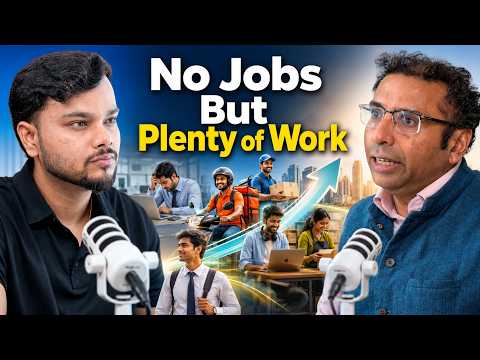
Very few jobs, Saurabh said, but plenty of work.
The Founder of Marcellus Investment Managers was quoting Anand Deshpande, the founder of Persistent Systems, who had told him this two years earlier. The distinction between jobs and work is the framework that reorients the whole discussion.
The Deshpande Insight
Saurabh was initially puzzled when Deshpande first said this to him.
When Deshpande said it two years ago, Saurabh said, I was a little stunned. What is he saying - very few jobs, but plenty of work? Then slowly, as I kept thinking, it started to make sense.
The unlock is in the definition. A job is a specific role posted by a company, with a vacancy, an interview process, and a paycheck. Work is the actual activity that produces value for someone willing to pay. The two used to be the same. They are drifting apart.
The Dog Walker Case
Saurabh grounded the framework in a specific case from his own building.
In Mumbai, he said, I live in a 27-storey building. Many older people live there. During COVID, obviously, the older people were afraid to go out. There were government restrictions. Their pets needed walking. The building’s car washers’ sons took the job.
The kids were 14-15 years old.
They said - we will walk the dogs, Saurabh said. Morning and evening. This went on for 18 months during COVID. Residents got so used to it that even after COVID, the kids stayed on as dog walkers. Now every Mumbai building has professional dog walkers.
The critical detail is what did not happen.
There was no vacancy, Saurabh said. No employment classified website said ‘dog walker wanted’. The enterprising kid understood - people struggle to take their dogs out morning and evening. I will take them out. Forty dogs a day. Rs 3-4 lakh a year. Livelihood earned.
The unfilled market need was there all along. What was missing was someone willing to notice it and provide the service.
The Car Washer Case
Saurabh gave a second example from the same building.
The same building’s car wash guy is very enterprising, he said. He charges Rs 500 to Rs 1000 per wash. And now he has 15-20 people working under him.
The layered enterprise is the point.
He is not just washing cars. He is employing others. From washing cars. That is the mental mindset of the gig economy king. Very different from the rote-learning child who dominates the exam system.
The Rote Vs Enterprising Divide
Saurabh then offered the sharpest editorial framing of the segment.
The rote people who did really well in the exam system, he said, will have difficulties in this gig world. And the business-minded, hardworking, enterprising people - the world is becoming very good for them. Because the gig ecosystem is being built. Different companies are creating gig setups.
The Indian education system has been optimized for one specific outcome. Passing exams. Getting into IITs, NITs, medical colleges. The exam-topper becomes the professional. The professional gets the salaried job.
The gig economy inverts the requirements. What matters is not memorization or test performance. What matters is the ability to notice unfilled needs, package a service, market it, deliver it consistently, and scale it if possible.
Saurabh pointed to Gen Z as the leading edge.
In Gen Z, he said, I see a lot of enterprising people. They are picking up different things from US and other foreign countries. Thumbnail design. All kinds of work. And here, the people who are not enterprising, who are not thinking creatively, they are struggling for ends meet.
The Geographic Rebalance
Saurabh then extended the argument to a specific real estate thesis.
What was the reason to live in big cities, he said. People would live in Gurgaon or Bangalore for opportunity. Because big companies had multi-storey offices, and everyone had to go there. In Bangalore or Gurgaon’s crazy traffic, people ground themselves down commuting.
The gig economy changes this.
If you are doing global gig work, Saurabh said, if you are sitting in Mumbai making an MIS for a Tanzania restaurant chain, or sitting in Bangalore making a CRM for a Latvia hospital - you do not have to go to a large glass-fronted office in a business park. You can sit in Coorg, Mussoorie, Nainital. You can sit in your bedroom and do gig work.
The real estate implication follows.
The big city office and residential real estate story will face a big hit, Saurabh said. Hyderabad, Bangalore, Gurgaon - both residential and commercial real estate. And I think small cities will boom. In fact it is already visible. Indore, Nagpur, Coimbatore - real estate is rising.
The infrastructure has caught up.
Road connectivity is good in small cities, he said. Airports are there. Both from a lifestyle perspective and from a cost of living perspective, India is going through a big rebalance. Big city real estate is showing cracks. Small city real estate is rising.
Saurabh added a sharp observation about big city sustainability.
Big city real estate has run away to a level that is not sustainable, he said. You cannot charge the rates for office space that currently exist in suburban Mumbai and suburban Bangalore.
The Great Churning
Saurabh then offered the closing frame.
In multiple ways, he said, India’s story is changing. We are going through a great churning. The old is about to end. A new beginning is happening. And I am quite excited about this.
The traditional job market is dying. The traditional big-city career is dying. The traditional real estate assumption is dying. Each of these changes creates pain for someone. But the aggregate is a new economic architecture.
If you see the world as saying jobs are gone but opportunity is plenty, Saurabh said, work is plenty, then the whole thing starts to look quite exciting.
The mindset shift is the essence.
What This Reveals
Three things from this segment will stay with me.
The jobs versus work distinction. This is the reframe that unlocks the entire discussion. Jobs are declining. Work is not. The people who spot unfilled needs and provide services will find work. The people who wait for vacancies to be posted will not.
The dog walker case as proof. This is not a theoretical possibility. It is a completed transition that has already happened in Mumbai. Fifteen-year-olds noticed a need, provided a service, and built livelihoods. Nobody posted a vacancy.
The geographic rebalance. The big-city premium in Indian real estate depended on physical office attendance. That justification is disappearing. Small cities with good connectivity and lower cost of living are becoming viable alternatives.
The Investment Implications
Saurabh’s real estate thesis is worth extracting because it points to actionable observations that his fund likely considers.
If big city commercial real estate rates are unsustainable, then the equity of REITs and real estate developers heavily concentrated in Gurgaon, Bangalore, and Hyderabad may be overvalued relative to their long-run economics. The rents that support current valuations depend on continued office demand at current rates.
If small city real estate is rising, then developers with pipelines in Indore, Nagpur, Coimbatore, and other tier-2 cities may be positioned for growth that the market has not yet priced in.
If gig work is distributing income geographically, then consumption patterns in small cities will grow relative to big cities. Retail, education, healthcare, and infrastructure investment in these cities may compound at rates faster than the big-city equivalents.
The Universal Insight
The Saurabh reframing has implications beyond India.
Every developed and developing economy is in the same transition. Employment structures optimized for the industrial era are dissolving. Employment structures optimized for the digital and AI era are emerging. The winners are the entrepreneurial. The losers are those who assume the old structure will continue.
What is specific to India is the combination of scale and speed. 15-20 million tech-adjacent workers exposed to AI displacement. 80 lakh graduates per year needing new pathways. Big city real estate ripe for disruption. Small cities ready to absorb the migration. Every factor is at maximum intensity in India simultaneously.
The Real Question For Readers
The uncomfortable question the segment raises is whether you are in job mode or work mode.
If you are waiting for the right vacancy to open, updating your resume, going through recruiter cycles - you are in job mode. This mode will produce diminishing returns.
If you are scanning your environment for unfilled needs, testing services with real customers, building distribution through whatever channels work - you are in work mode. This mode is where the growth is now.
The transition from one mode to the other is not easy. Every rote-learning muscle you built for the exam system fights against the work-mode instincts. The transition is worth making anyway.
Watch the full episode here:
More from the blog



Subscribe to our newsletter
The best new roles, resources and must-watch episodes — in your inbox every week. No spam, unsubscribe anytime.