
What Happened to Modi After 2 Years? - Anil Swarup
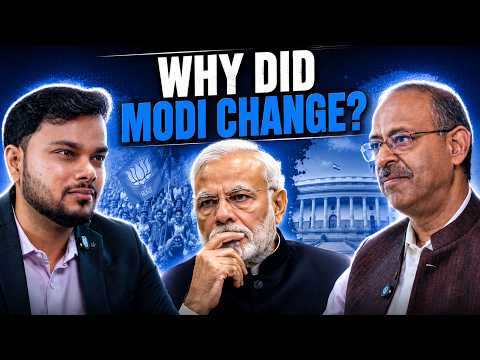
There is a particular kind of credibility that comes from someone who has loved something and is now disappointed by it. It is different from the credibility of a critic who never liked it. It is different from the credibility of a defender who still loves it. It is harder-won than either, because it requires the willingness to update publicly on a position that was once held strongly.
Anil Swarup came on our podcast and offered exactly that kind of assessment of Narendra Modi.
“In the first two years, I was amazed. I wondered if such a leader could even exist. I was so impressed. After that, I do not know what happened. I am pained.”
This is not a partisan critic talking. Anil Swarup wrote eight pages of praise about Modi in his book. He has been openly admiring of the Prime Minister’s leadership qualities in other segments of this same conversation. He has nothing to gain politically by saying this now. He has, in fact, something to lose.
He said it anyway. Because, in his account, it is what he has observed.
The First Two Years
The praise that began the segment was unqualified and specific.
“You have read my book. You will have seen the eight pages I wrote on Modi. In the first two years, I was amazed. I wondered if such a leader could even exist.”
The specificity of “first two years” is important. He is not making a sweeping endorsement or a sweeping critique. He is describing a particular window of observation, defined by particular conduct, that ended at a particular point.
The conduct in that window, in his account, was distinctive. The decision-making clarity. The willingness to push. The encouragement of capable people. The discouragement of corrupt ones. The signals from the top.
“He wanted to do things. He promoted good people. He encouraged people. A corrupt person did not have the courage to approach him.”
This last sentence is the highest possible praise for any leader, in Anil Swarup’s framework. It is about whether the leader’s presence shapes the behaviour of the people around them. Whether the corrupt and the incompetent feel welcome to approach the centre of power.
In the first two years, in his observation, they did not.
The Kalyan Singh Comparison
The deepest praise was the comparison to his former boss.
“When I first met Modi, I saw Kalyan Singh’s image in him.”
Kalyan Singh is the leader Anil Swarup has held up as his model throughout this podcast. The leader who taught him the most. The leader he still describes as “so honest” decades after working under him.
To say that Modi reminded him of Kalyan Singh in 2014-2016 is to say that Modi was, in that period, operating at the highest standard of leadership Anil Swarup has seen in his career.
It is also to set up the contrast that came next.
What Changed
“After that, I do not know what happened. I am pained.”
The Hindi word he used was “dukh” - pain, sorrow, hurt. This is not the language of political critique. It is the language of someone watching something they admired become something they cannot fully recognise.
He was careful not to overclaim about causes. “Why? I do not know why. But this is what I am observing. Many people ask me why. I tell them, I do not know the reason. But I can tell you what is happening.”
This kind of epistemic humility is rare in Indian political commentary. The standard mode is confident causal attribution. Anil Swarup refused to do that. He observed a change. He could not explain it. He said so.
The Deputy CM Example
The specific example he offered was the most pointed moment of the segment, even though he did not name any individuals.
“If I am branding someone as corrupt and making him Deputy Chief Minister, what does that do to my reputation?”
This is a reference any politically aware Indian listener can connect to. The pattern of opposition politicians who were publicly described as corrupt during their opposition years, who were then accommodated into government as coalition partners or defectors, is a verifiable feature of recent Indian politics.
Anil Swarup did not name names. He did not need to. The pattern is what he was critiquing.
His framing was about leadership reputation, not about policy outcomes. The argument was not that coalitions are wrong. The argument was that publicly branding someone as corrupt and then elevating them to high office sends a signal about the leader’s own standards. The signal is incoherent. The reputation cost is real.
“I do not understand why someone with such a personality, such a great person, needs to do this.”
The Power Corrupts Pushback
The host offered the obvious framing. Power corrupts. Maybe that is what happened.
Anil Swarup rejected it.
“No, not like that. I still consider him great. I am still impressed with Modi. But I am bewildered.”
This is the part that establishes the credibility of the segment. Anil Swarup is not interested in the easy partisan explanation. He is not interested in the cliche. He has watched something specific happen and he is willing to describe what he saw without reaching for a convenient theory.
The bewilderment is genuine. The continuing admiration is genuine. The disappointment is genuine. All three can coexist because the world is complicated and Anil Swarup is being honest about what he sees.
The Career Parallel
The most useful framing in the segment was his own career parallel.
“In the first 10 years of my 38-year career, people sometimes came to me with wrong work. In the second half, nobody had the courage to approach me with wrong work. The same system. The difference was the reputation I had built.”
This is a beautiful illustration of the leadership signaling principle. The system around a leader does not change. The signals the leader sends change. Once the leader has established that wrong work will not be tolerated, the wrong work stops being proposed. The institutional weight of the leader’s reputation does the filtering, without the leader needing to expend energy on every individual case.
The implication for Modi was implicit but clear. In the first two years, the reputation was being built in the direction of “no wrong work approaches this office.” In the years since, in Anil Swarup’s reading, the reputation has shifted. The filtering has loosened. The signals have changed.
He extended the principle structurally. “As the leader, you cannot blame the system. The common man who is suffering can blame the system. But the leader has to do something. I was Coal Secretary. I had to fix coal. I could not say the system is bad.”
This is the most rigorous formulation of leadership accountability I have heard. The system is not an excuse for the person at the top. The person at the top is the one who shapes what the system does.
The Reputation Principle
The closing framing of the segment was a principle every leader at every level should internalise.
“A leader’s authority depends on his conduct. The qualities have to be there. Then the power follows.”
This connects to the broader leadership principle Anil Swarup articulated elsewhere in our conversation. Conduct creates power. The reputation a leader builds is the actual lever they exercise, more than any formal authority.
The implication for the second-half-of-Modi-government question is direct. The reputation that was being built in 2014-2016, with the encouragement of good people and the discouragement of corrupt ones, was producing one kind of leader. The reputation that is being built now, with whatever decisions Anil Swarup is observing, is producing a different kind.
The same office. The same person. Different conduct. Different reputation. Different effective leadership.
The Honest Assessment
The most useful sentence in the segment, for anyone trying to think about how to assess any public figure honestly, was this.
“I still consider him great. I am still impressed. But I am bewildered.”
These three positions, simultaneously held, are what honesty about a complicated reality requires. The temptation to collapse into one of them, to settle on either “he is great” or “he has changed” as the final word, is what makes most political commentary so unsatisfying. Anil Swarup refused to collapse. He held all three.
This is the model for how citizens of any democracy should engage with the leaders they once admired and now find themselves uncertain about. Not partisan binary. Not cynical dismissal. Honest, bewildered, ongoing observation.
What I Took Away
Three things from this segment will stay with me.
The credibility of disappointed admirers. Anil Swarup’s assessment is more credible than either confident defenders or confident critics because he has been both. That kind of honest update is rare in Indian public discourse.
The Kalyan Singh standard. The leader Anil Swarup uses as his benchmark is someone almost nobody outside Indian political history knows about. The fact that he compared Modi to Kalyan Singh in the first two years, and stopped doing so after, is the most precise possible critique from inside his own value system.
The reputation principle. The framework that leaders build reputations through their conduct, and those reputations then do the filtering of what reaches them, is the most underrated principle of executive leadership. If your office is approached by corrupt people seeking wrong work, you have signaled, somewhere, that this is acceptable.
You may agree with Anil Swarup. You may disagree. The segment is the kind of honest, balanced, credible assessment Indian public discourse desperately needs more of.
Watch the full episode here:
More from the blog


Subscribe to our newsletter
The best new roles, resources and must-watch episodes — in your inbox every week. No spam, unsubscribe anytime.