
The Only Real Encounter of 26/11 - Ex MARCOS
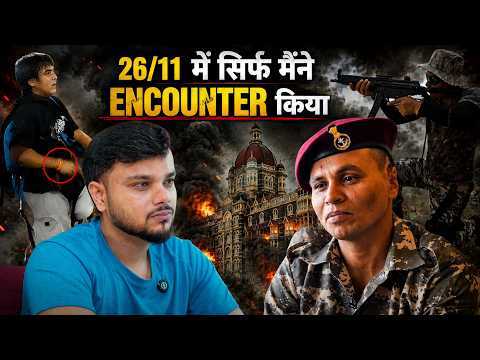
In all of 26/11, the only face-to-face firing exchange was mine. In the rest, no one had an encounter. Most died burnt in fire.
The Shaurya Chakra recipient, former MARCOS commando, and author of “26/11 Braveheart” was making the single most significant historical correction to the public record of the Mumbai attacks.
The standard narrative treats 26/11 as a series of encounters between Indian security forces and ten Pakistani terrorists. Teotia is saying that was never what happened.
The Trident
The first correction concerned the Trident terrorists.
The room at the Trident caught fire. The terrorists died burnt. There was no encounter.
The standard public memory of the Trident operation involves security forces moving floor to floor, clearing rooms. The operational reality, in Teotia’s account, was that the terrorists died in the fire.
The Nariman House
The second correction concerned Nariman House.
In Nariman House, they fell from height.
The Nariman House operation is in public memory because of the NSG personnel who lost their lives there. The terrorists themselves were not killed in encounter. They fell.
The Taj
The third correction concerned the Taj.
The Taj caught fire. The terrorists died that way.
Anyone who lived through the 26/11 news cycle will remember the image of the Taj burning. What that fire actually did, in Teotia’s account, was kill the terrorists. The hotel fire was the operational mechanism that ended the operation.
The CST Encounter Question
The fourth correction concerned the CST shootout that ended with Kasab’s capture.
The terrorist with Kasab was beaten to death.
The Mumbai police did not have the guns to shoot. They had only lathis.
This is the institutional detail that has not been part of the public memory. The Mumbai police that engaged Kasab and his partner at CST did not have the firepower for an encounter. They had wooden sticks. The terrorist with Kasab was beaten to death with sticks. Kasab himself was beaten unconscious. He survived because he passed out before the beating could kill him.
Kasab was saved by going unconscious. The same beating that killed his partner left Kasab in a state from which he could be revived in the hospital.
The NSG Operations
They died burnt. There were no encounters of that kind.
“Backfoot mein phenk diya tha NSG ko to unhone bahut buri tarah se.”
The NSG was pushed onto the back foot.
They took casualties. What their story is and how they represent it is their account. But the operational reality, in his stated knowledge, is that the terrorists were not killed in NSG encounters. They died when fire consumed them.
The Only Encounter
Only one actual encounter happened. One encounter in the entire 26/11.
That encounter was Teotia’s.
The terrorist he injured was the only terrorist in all of 26/11 to die from an Indian soldier’s bullet in a face-to-face firing exchange. The other three terrorists carried the injured one away through the kitchen route to the Old Heritage building. He died later from Teotia’s round.
The Supply Bag
The interviewer asked what was recovered from the room.
“501 AK47 ke round the, 16 hand grenade the, dry fruits the, currency thi.”
501 AK47 rounds. 16 hand grenades. Dry fruits. Currency.
“Wo to tikne ke liye aaye the na. Kam se kam teen-chaar se paanch din.”
They had come to stay. Three, four, five days minimum.
This is the part of the planning that the public record has underemphasised. The terrorists did not come to attack and die quickly. They came to occupy. They had the food, the ammunition, and the currency for a multi-day siege.
Each terrorist had their own supply bag.
The 8:30 AM Claim
The claim about timing is what recasts the entire operation in Teotia’s account.
“Subah saadhe aath baje jab janta so ke uthti hai hamari is desh ki tab tak to operation khatam ho chuka hota. Charon terrorists mere haathon mare ja chuke hote.”
By the time the country woke up at 8:30 in the morning, the operation would have been over. All four terrorists would have been killed by me.
The implication is that if Teotia had not been wounded and disabled, the chamber hall operation would have ended in the early hours of the morning. The version of 26/11 that India remembers, with the multi-day siege and the burning Taj and the global media coverage, was the version that happened because Teotia was wounded.
“Lekin Ishwar ko kuch aur manzoor tha.”
God wanted something else.
The Bounce Back
The closing of the segment turned to Teotia’s own life since 26/11.
“Aaj tak ke Bharatiya sena ke itihas mein bounce back kisi ne nahi kiya mere alawa.”
In Indian military history, no one has bounced back the way I have.
The injury list was catastrophic. Lungs ruptured. One ear gone. Bullet wounds across his chest. Most soldiers with this injury profile do not survive. Most who survive do not recover function.
Teotia ran marathons. He completed an Ironman. He became the first differently abled Ironman of India. Then he went to law school.
“Main desh ka pehla gallantry awardee advocate hoon. Aaj tak koi bhi gallantry awardee advocate nahi.”
I am India’s first gallantry-awardee advocate. To this day, no other gallantry-awardee has become an advocate.
The discipline that built the bounce back was simple.
“Maine kabhi na education ko chhoda, na maine apni strength ko chhoda, na physical strength ko chhoda, na mental strength ko.”
I never gave up on education. Never gave up on my strength. Never gave up on physical strength. Never gave up on mental strength.
“Din par din aur mazbooti.”
Stronger every day.
What This Reveals
Three things from this segment will sit with anyone who reads it.
The historical correction is significant. The public memory of 26/11 involves combat outcomes that, in Teotia’s account, did not happen as combat. The Trident terrorists died in fire. The Nariman House terrorists fell from height. The Taj terrorists died when fire consumed the hotel. The Mumbai police had lathis, not guns, when they engaged Kasab and his partner. The only aamne-saamne firing exchange in all of 26/11 was Teotia’s.
The supply preparation detail is also significant. 501 rounds, 16 grenades, and dry fruits in a single backpack tell us this was not a suicide-attack operation. The terrorists came for a multi-day occupation. The hostage plan in the chamber hall fits with this preparation. The siege was the strategic objective. The mass casualties were the leverage.
The bounce back is the human story. The man who almost died in the Taj has become India’s first gallantry-awardee advocate, the first differently abled Ironman, and a marathon runner with one functioning lung. The story of survival has become the story of compounding strength.
The Universal Lesson
The historical correction matters beyond the specific events of 26/11.
Public memory of any major operation is shaped by media coverage at the time, official records after the fact, and the institutional incentives of the agencies involved. The combination tends to produce a polished narrative that emphasises the successful elements and underemphasises the chaotic, accidental, or institutionally embarrassing ones.
The fire that killed the Taj terrorists was not a designed outcome. It was what happened. The lathis the Mumbai police used at CST were not a tactical choice. They were the equipment they had. The buddy abandonment Teotia described in earlier segments was not standard procedure. It was an individual breakdown.
The official record tends to absorb these details into the polished narrative. The first-person accounts of the people who were there often correct them. Teotia is doing the correcting.
Watch the full episode here:
More from the blog
Subscribe to our newsletter
The best new roles, resources and must-watch episodes — in your inbox every week. No spam, unsubscribe anytime.