
This Is Shameful: Sonam Wangchuk Taken by Delhi Police | NEET Leak & CJP Protest
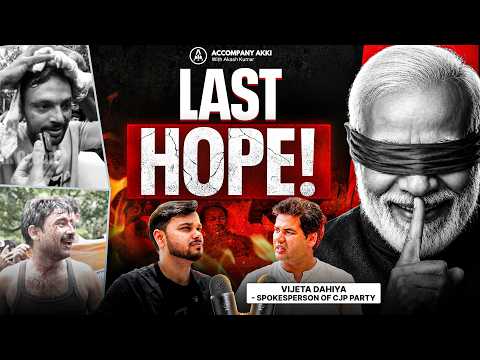
What a CJP spokesperson at the heart of the NEET paper leak protest taught me about broken media, the cost of silence, and why apathy is the most dangerous political choice you can make
A conversation with Vijeta Dahiya, spokesperson for Citizens for Justice and Peace, recorded live at Jantar Mantar during Sonam Wangchuk’s hunger strike.
The afternoon I spoke to Vijeta Dahiya, the temperature at Jantar Mantar was brutal.
Behind her, Sonam Wangchuk sat without food. Forty people had taken turns fasting alongside him over the preceding weeks. Some for five days. Some for eight. Six or seven were still going.
No government representative had called. No minister had sent a message. No acknowledgment that anything unusual was happening at one of India’s most historically significant protest grounds.
On national television at that same moment: jhalmuri recipes and celebrity gossip.
Vijeta was not surprised. She was angry in the measured, practiced way of someone who has been angry about the same things for a long time and has decided to do something about it rather than just feel it.
“Agar media cover nahi kar raha, toh hamara kartavya banta hai ki hum awaaz aage badhayein. That is why we came. Decentralized media, independent voices, YouTube journalists. This is what the solution looks like.”
Part 1: What Started This and Why It Matters Beyond NEET
The immediate trigger for the movement Vijeta represents was the NEET paper leak of 2024, which compromised one of the most consequential examinations in Indian education, the national medical entrance test that determines who becomes a doctor in this country.
But the deeper origin was a comment from the Chief Justice of India that many young people felt dismissed the seriousness of their situation. That remark, combined with the leak itself, became a flashpoint.
“Paper leak hote hi rehte hain, hum jaante hain. But is baar hum chahte the ki koi ek cheez to pehle solve karein. Koi toh starting point ho.”
What the NEET leak did was crystallize a broader reality that has accumulated over years. Students whose families cut meals to fund coaching center fees, whose parents said chalo beta tujhe coaching dilunga, you prepare for the paper, the paper that would change everything. And then the paper leaked.
Twenty-two students died in the aftermath. Several by suicide. The Nagpur case Vijeta described stopped the conversation entirely: a girl who scored 650, who called her father the night results came and said aapki beti doctor ban gayi aur chhote bhai ki padhai ka main hi dekh lungi, your struggle is over now. She went to her room after lunch. Her parents found her there. She had not been able to carry the weight of what happened to her score.
“Woh apne desh ke log the yaar. Unhein doctor banna tha. Lakho logon ka ilaaj karna tha. Unke kuch sapne the. Woh sab khatam ho gaya. PM Modi ki ek bhi statement nahi aayi. Tweet karte hain Dharmendra Pradhan, tujhe janamdin mubarak. That is what we got.”
Part 2: The Media Problem Is Not a Coincidence
Vijeta is precise and deliberately fair in how she describes the anchors and editors who run India’s major news channels. She does not call them evil. She calls them puppets with a choice.
“Main unki majboori bhi samajhta hoon ki corporate owned hain, unke haath mein kuch nahi hai. Anjana ho ya Chitra ho ya Gullu ho, ye saarey katputli hain. Lekin main keh raha hoon ki aise naukri ko laat maaro yaar.”
Her argument is about personal accountability within a system of institutional capture. The journalists who work for corporate-owned channels that take editorial direction from above are not individually free. But they retain the freedom to leave.
Manipur burned for months. The national channels largely did not cover it. A state that is constitutionally part of India, where the Constitution’s promises apply equally, where fellow citizens were dying in ethnic violence, did not fit the editorial mandate.
“Jab hum Jay Hind bolte hain toh us Jay Hind mein Manipur bhi aata hoga. Woh hamare hi desh ka ek state hai. Inhone cover tak nahi kiya.”
She made a parallel that landed hard. In Portugal, an Indian tourist died in a healthcare situation. The health minister resigned. In the UK, the Prime Minister went on national television to say he believed he was not doing his job well enough.
“Aur Bharat, jisey hum kehte hain sabhyata ki bhoomi. Kahan hai aapki sabhyata? Logon ki laashon pe aapne apni kursi bichhaa rakhi hai.”
Her prescription for the media problem is structural, not individual. Decentralize. Every constituency needs an independent YouTuber who covers that constituency’s actual problems. Not national ideology battles, but the specific broken road, the specific crime pattern, the specific corruption at the municipal level. Local problems covered by local people who cannot be pressured by national corporate interests.
“Agar log pay karenge toh logon ke mudde uthenge. Abhi toh corporate control kar rahe hain. Public ko independent media ko support karna chahiye. Comments mein full support full support likhna kaam nahi karta. Woh support dikhao.”
Part 3: The Wealth Inequality India Is Not Talking About
Vijeta invoked Gandhi’s talisman, which appeared in old NCERT textbooks but has since been removed. The passage asks every decision-maker to consider: will this help the person who is furthest behind? Will the last man benefit?
By that measure, she said, the last decade fails the test entirely.
“Jo inequality hai woh pichle 100 saal mein, even British ke time pe jitni thi, utni wealth inequality abhi humein dekhne ko mil rahi hai. Kehne ko GDP badh raha hai, but kya hai? Jobless growth.”
The cycle she describes runs something like this. A poor family sacrifices to send their child to coaching. The child prepares for a competitive exam that represents their only realistic path to a stable professional life. The paper leaks. The child loses. Some cannot survive the loss. The family starts a small stall to survive instead. The bulldozer comes.
“Woh apne bachchon ko yeh umeed dete hain ki chal beta paper ki taiyari kar. Paper leak ho jaata hai. Kahan jaaye? Baad mein khud ka kuch start karte hain, uske upar bulldozer chala dete hain. Government ease of doing business ki baat karti hai. Ek baar toh ease of doing business garib aadmi ke liye bhi karo yaar.”
She described a video that circulated of a physically disabled woman who was not begging but selling handmade clay pots. Her pots were smashed by authorities. A pani puri vendor in Gurgaon had his cart destroyed on camera by a man calling himself Singham. A Noida worker who labored twelve hours a day received a salary increase after three years of Rs 29.
“Ek insan is desh mein paida hua hai. Is mitti pe itna toh haq uska bhi hoga ki apna ek stall khada karke apna kuch kamai kar le. Yeh kya hai?”
Part 4: The Celebrity Silence and Its Real Cost
Vijeta reserved some of her sharpest words for India’s entertainment industry, not as a whole but as a specific culture of calculated silence in exchange for continued commercial opportunity.
Her argument is not that celebrities must be activists. It is that they cannot claim apoliticism while simultaneously doing surrogate advertising for tobacco products, promoting betting apps, and accepting contracts that arrive on foreign political visits.
“Tum artist ho, tumhara kaam art hai. Toh fir yaar tum gutkha kaise bech lete ho? Ilaaychi keh ke tum gutkha bechte ho, surrogate ad karte ho ki nahi? Tum ye betting apps kaise karte ho? Aur fir ye jab hai art tab aapki kya hai jab aapko desh duniya ki kisi cheez se matlab hi nahi?”
The Netflix-and-Gaza contrast she raised: some of the same names that declined to comment on the NEET suicides or Manipur had taken selfies with Netanyahu. She did not say this to make a partisan point about foreign policy. She said it to demonstrate that the apoliticism is selective.
Swara Bhasker came to Jantar Mantar. Prakash Raj came. A surprise appearance created genuine energy. Shekhar Suman raised his voice and a raid was conducted on an associate of his show the next day. He did not stop.
“Itna bhi kya darte hain yaar? Darr toh hai, lekin inका laalach bahut zyada hai. Pata nahi kahan le ke jaenge itne pairon ko. Kya inhe chahiye? Kabhi yeh bhi dekho na ki zindagi kuch aur bhi toh hai na.”
She quoted the Punjabi revolutionary poet Pash to describe the psychology of indifference: the most dangerous is the moon that rises in your courtyard after every massacre and does not sting your eyes like red chili. People whose comfortable lives continue untouched by catastrophe around them, for whom every atrocity becomes background noise.
Part 5: Why Mainstream Parties Are Not Showing Up
Several opposition political figures visited Jantar Mantar during the movement. Chandra Shekhar Azad of Azad Samaj Party. Priya Saroj from Samajwadi Party. A few others from different factions.
But Vijeta was direct about what she wanted and had not yet seen: the major opposition leadership coming in full force. Rahul Gandhi. Arvind Kejriwal. Akhilesh Yadav. M.K. Stalin. Tejashwi Yadav.
“Opposition party ka kaam kya hota hai? Yahi toh hota hai ki dekho sarkaar kaam kar rahi hai ya nahi. Aur nahi kar rahi hai toh aandolan karo. Yahaan par already yuva aandolan kar rahe hain. Hum chahte hain ki woh aayein, judein. Isse bal milega.”
Her frustration was not partisan. She made the same point about the ruling party: the things she was demanding, clean exams, farmer support, women’s safety, accountability for paper leaks, would actually increase the BJP’s credibility if implemented. These are not ideological positions. They are basic governance.
“Sab kehte hain tum BJP virodhi ho. Kahe ka BJP virodhi? Jo main baatein keh raha hoon inhe implement karein toh unki bhi toh izzat badhegi. Women safety ki koun isme aapko rok raha hai? Itni si toh baat hai.”
Part 6: The Banality of Small Corruptions
One of the more striking moments in the conversation was Vijeta’s discussion of how corruption begins not at the top but in small daily choices that eventually hollow out the moral architecture of institutions and individuals.
He cited Hannah Arendt’s concept of the banality of evil, developed from her study of Nazi officer Adolf Eichmann, who turned out to be not a monster but an ordinary man who had normalized following orders until ordinary human feeling was simply absent. The observation: evil at scale requires ordinary people choosing not to feel.
“Jis din cheat nahi padhne doge na us din aapka sahi hoga. Chhoti chhoti jhooth jo hai na aadat ban jaati hai. Waise hi chhota corruption, chhoti chori pehle karte hain. Wahan se chahlu hota hai.”
He told the story of an honest police officer friend whose personal integrity was being materially punished by the system. The friend was not taking bribes. But when he needed to get a postmortem done, the norm at the facility was Rs 200 per case. He ended up paying from his own salary because the system expected it. Honesty had been structurally disincentivized.
“Oopar wala agar imaandaar ho na toh neeche wale ki kabhi himmat nahi ho. Oopar tak jaata hai. System aisa bana diya hai.”
The same logic extends to media workers he mentioned by name. They can say they have orders. But they also have the option to recognize their own power and use it differently.
Part 7: Three Things India Needs Now
Near the end of the conversation, Vijeta offered three principles, not policies, but orientations he believes would change what is possible.
The first is political and civic awareness as a citizenship obligation rather than an optional hobby. He invoked Bertolt Brecht’s line that the apolitical person is the greatest fool, because everything around you, the potholes in your road, the crime in your neighborhood, the price of your groceries, is dictated by political decisions. Not knowing your own MLA’s name is not neutrality. It is abdication.
“At least thoda akhbaar padh lo. Insta pe kuch aise pages ko bhi follow kar lo jo ke sahi baatein karein. Thoda pata toh hona chahiye.”
The second is the deliberate choice to remain happy, which he distinguished from denial or passivity. His point was psychological and tactical: a person consumed by competitive misery, by the endless comparison of whose suffering is greater, cannot be effective. Happiness is not a reward that comes after problems are solved. It is a discipline that makes solving problems possible.
“Be happy, try to be happy. Agar aapke andar woh nahi hogi toh aap logon ko kaise motivate kar paoge? Jab aap doosron ke liye kuch kar paoge you will feel a different kind of power.”
The third is sincerity in every task regardless of passion. This surprised me because the book he has written is literally titled Bhaad Mein Jaye Woh Naukri, which translates roughly as To Hell With That Job. But his point was not that the job should be abandoned for passion. It was that sincerity is what elevates the quality of any work, whatever that work is.
“Jo bhi aap kaam karo usme aapko sincere hona chahiye. Jo tumhari sincerity hai woh us kaam ka level badhati hai. Passion ke baare mein mat socho pehle. Jo kaam hai karo us pe poori sincerity se.”
Part 8: The Question Nobody at Jantar Mantar Could Stop Asking
The question hovering over the entire conversation, the one that connected the NEET suicides to the media silence to the wealth inequality to the celebrity indifference, was one of accountability.
A man was fasting at Jantar Mantar. His body was failing. And the government had sent no signal that it was watching, listening, or prepared to engage.
Lal Bahadur Shastri resigned over a train accident. The Portuguese health minister resigned over a tourist death. The British Prime Minister publicly questioned his own performance.
“Humein woh motivation chahiye ki yaar sarkaar sunta hai. Janta jitna zyada aage badh ke aayegi utna zyada pressure bhi aayega warna toh hoga nahi.”
The movement was planning a July 20 march. The petition was circulating. A missed call number had been issued so that even people who could not come physically could register their presence in a countable way. The goal was to give Sonam Wangchuk a number large enough that ending his fast would not feel like surrender.
Vijeta’s message for those watching from home was blunt.
“Sab log bolte hain mujhe kuch nahi karna political se. Lekin Brecht sahi kehte hain, jo apolitical hai woh sabse bada mooorkh hai. Aap vacuum mein nahi ji rahe. Sab kuch politics se hi dictate hota hai. Apni zindagi mein toh interest laao yaar.”
The One Thing
If there is a single idea connecting everything Vijeta Dahiya said on a sweltering afternoon at Jantar Mantar, it is this:
Silence is always a choice. And every person who makes that choice, the journalist who covers jhalmuri instead of student deaths, the celebrity who promotes betting apps and calls it staying out of politics, the citizen who knows the movement is happening but does not sign the petition, everyone who looks away is making an active decision that has consequences for the people who cannot afford to look away.
The girl from Nagpur scored 650. She called her father to say his struggle was over. She believed the system had worked for her. Then it collapsed. And the people with the power to acknowledge what happened stayed silent.
That silence has a cost. Vijeta was at Jantar Mantar trying to make that cost visible.
Whether enough people were watching was, on that afternoon, still an open question.
Watch the full conversation with Vijeta Dahiya Here:
More from the blog
Subscribe to our newsletter
The best new roles, resources and must-watch episodes — in your inbox every week. No spam, unsubscribe anytime.