
The Reality Of 26/11 Was More Brutal Than the Films - Former MARCOS
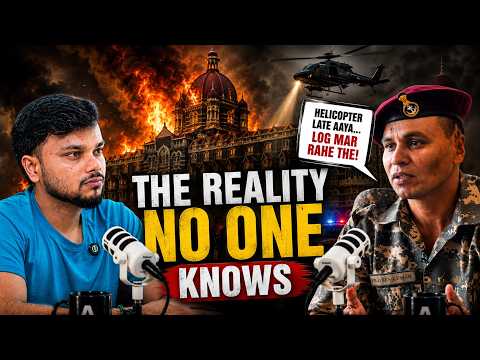
There is a moment in our podcast with Praveen Kumar Teotia where the Shaurya Chakra recipient and former MARCOS commando offered a framing that recasts every film ever made about 26/11.
That day the cinema ran brilliantly, he said. Live. Bollywood shows it wrong.
The claim is deliberate. It is also technical. Cinema is our cultural shorthand for spectacle - staged, choreographed, safe to watch. Teotia is inverting the term. The spectacle at 26/11 was not the Bollywood version that has since been produced. The spectacle was the real one.
Before he arrived at this framing, he walked us through the four hours that most 26/11 accounts skip. The naval station. The armoury. The helmet. The vest. The absent helicopter. The tug boat.
The Armoury Reveal
The first operational shock came when the team assembled at the armoury. The proper weapons were not there. The proper armour was not there. The proper helmets were not there. Whatever was available, they took as it was.
The MARCOS team responding to the deadliest urban attack in modern Indian history walked into an armoury that could not properly equip them. This is the specific operational reality that no film or news reconstruction has ever captured. The Indian navy maintains a MARCOS unit precisely for scenarios like this. On the day of the deadliest urban engagement the unit had ever faced, the equipment on standby was not there.
What Teotia Carried
An AK-47. Five magazines total. One hand grenade. One stun grenade. An ordinary helmet.
For an operation against four trained terrorists inside a hotel, this was the loadout of a single soldier. Five magazines. One grenade. One stun grenade. That was the total offensive capability he carried into the deadliest urban engagement in Indian history.
The Helmet
That helmet could not stop a bullet. It rattled like a tin box. Many soldiers, he said, still wear it. It has not been replaced.
The equipment failure identified 17 years ago has not, according to Teotia, been remedied. The helmet that could not protect a MARCOS team at 26/11 is still, in his stated observation, standard issue. It was meant to look like a helmet. It was not meant to work like one.
The Armour
The vest could stop a 9mm round only at 50 meters. At 10 meters, even that round penetrates.
Who fires from 50 meters, the interviewer asked. Most engagements happen much closer. An AK is fired from far closer. An AK rips through the vest completely.
The bulletproof vest, in Teotia’s account, was rated for a caliber and a distance that no urban terror engagement would ever involve. It provided the appearance of protection without the substance of it.
The Helicopter That Never Came
The equipment failure was compounded by a transport failure. The team expected a helicopter. Five minutes to reach the Taj. It never came.
The Tug Boat
They took a boat to Mumbai. Not a speed boat. A tug. The kind of boat that pulls ships. Forty-five minutes by boat. Then a car came. Then equipment was loaded. Then they went to the Taj.
Every one of those forty-five minutes, in Teotia’s account, was a minute in which people were dying inside the Taj.
The mathematics of that delay are worth sitting with. A five-minute helicopter ride became a forty-five-minute tug boat journey. Forty additional minutes of response time. In those forty minutes, the terrorists inside the Taj had time to consolidate their positions, take hostages, set fires. The multi-day siege that followed was made possible in part by the delay in the first counter-response reaching the site.
The Cinema Framing
That is when Teotia arrived at the framing. The whole event was happening, he said. Every second. The actual cinema was that. The Bollywood people show it wrong.
That day the cinema ran brilliantly. Live. People saw others dying live. Live dead bodies. Live blood. Whatever you see in films - that was live.
What The Bollywood Version Gets Wrong
There have been multiple films about 26/11 since it happened. Each of them, in the years since, has taken the events and shaped them into narrative structures suitable for cinema. Beginning, middle, end. Heroes. Villains. Moments of glory. Moments of loss. Musical scoring. Cinematic choreography.
What Teotia is telling us is that the real 26/11 had none of that structure. It was live. It was continuous. It did not have narrative shape. It did not have musical scoring. It had dead bodies falling in real time. It had blood spreading in real space. It had actual dying that no cut, no fade, no score, no dramatic pause could ever transmit.
The cinema that ran that day was the real one. Bollywood’s cinema is the polished, ordered, watchable version. Teotia is saying they are not the same product. Bollywood’s version is not what the event was.
The Universal Lesson
There is a general lesson here that applies far beyond 26/11.
Any major event in public memory gets processed through a narrative apparatus. News anchors summarise it. Journalists frame it. Filmmakers structure it. Politicians appropriate it. Textbooks synthesise it. What comes out at the other end of this apparatus is a polished version of the event that is easier to consume than the event itself.
The polished version has value. It allows the country to remember, to memorialise, to draw meaning. But it has a cost. The cost is that the actual texture of the event gets lost. The chaotic, disorganised, undignified, embarrassing, and painful parts get smoothed over. What remains is a version that flatters everyone involved.
Teotia’s account is a corrective. The MARCOS response to 26/11 was not equipped with what it needed. The transport was not what it should have been. The armoury did not have what it should have had. The soldiers went in with equipment that was not designed for the engagement they were facing.
None of this shows up in the Bollywood version.
The Institutional Question
There is a specific institutional question that Teotia’s account raises.
If the helmet that failed at 26/11 is still standard issue today, someone in the Indian defence procurement establishment has not done their job. If the armour rated for 9mm at 50 meters is still what soldiers wear into close-quarter counter-terror engagements, someone has not addressed the specifications. If the transport plans for special forces to reach urban terror sites still involve tug boats and no helicopters, someone has not fixed the logistics.
The question is not whether Teotia is right about each specific claim. The question is whether the Indian defence establishment has systematically audited the equipment and logistics failures of 26/11 and remedied them. Teotia’s testimony suggests the answer is no.
Every counter-terror engagement India will face in the future will benefit from the equipment upgrades made after 26/11. If those upgrades have not happened, the next engagement will see the same failures. That is the specific stakes of the question.
The Reader’s Question
If you have watched Hotel Mumbai or Attacks of 26/11 or any of the other films about the attack, the images you carry are the cinematic images. The polished ones. The Bollywood ones.
Teotia is telling us those images are not the event. The event was the live one. The one with the actual bodies falling. The one with the actual blood. The one without the score.
The uncomfortable question the segment raises is whether India’s public memory of 26/11 has been shaped by the Bollywood version rather than the real one. If so, the lessons the country draws will be the wrong ones.
Watch the full episode here:
More from the blog

Subscribe to our newsletter
The best new roles, resources and must-watch episodes — in your inbox every week. No spam, unsubscribe anytime.