
Why Indians Don't Follow Traffic Rules? - Thirumal Govindraj
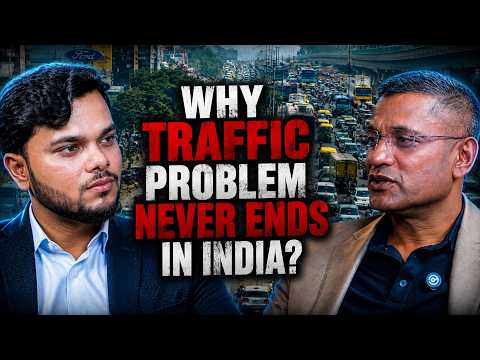
“Hyderabad did a decent and a very good job. They built the infrastructure and then development came. I think Noida also did very good. Bangalore did not.”
The CEO of RMZ Office and RMZ NXT was answering a question about what frustrates him most as a real estate developer when he looks at Indian urban infrastructure. The answer was structural. It named cities that got it right and named the city that did not.
Let me walk you through what he said.
The Two Models Of Indian City Growth
The framework Thirumal used to organise the conversation is the cleanest summary of Indian urban planning I have heard.
“I think the development rules should decide how the developments happen. Hyderabad did a decent and a very good job. They built the infrastructure and then development came. Noida also did very good.”
This is the two-model framework. Model One is infrastructure-first. The roads, the metro, the water, the electricity, the sewage are built before the development happens. Once the infrastructure is in place, the development follows along the corridors that the infrastructure has defined.
Model Two is development-first. The development happens wherever land is available and demand is strong. The infrastructure tries to catch up. The city grows around the lack rather than around the plan.
Hyderabad and Noida are, in Thirumal’s account, the Indian cities that have done Model One reasonably well. The HITEC City corridor in Hyderabad was planned with the infrastructure ahead of the development. The Noida and Greater Noida master plans established the road grid and the basic utilities before the urban density built up.
Bangalore is the example of Model Two. The development happened. The infrastructure came later. The city has been chasing its own growth for two decades.
The 3X Catch-Up Math
The quantitative framing of the problem is the part that should make every urban planner stop.
“Today the speed of growth is so high that infrastructure is still catching up. Every time infrastructure catches up, the city has grown 3X.”
This is the math that explains why Bangalore feels worse every year despite real infrastructure investments. The Outer Ring Road, when it was conceived, was designed for the Bangalore of its time. By the time it was built, Bangalore had grown well beyond what the ORR could handle.
“By the time the outer ring road came up, Bangalore needs another two outer ring roads. You know, it has become that big.”
This is the structural critique. The city is moving faster than the planning process. The new infrastructure helps, but it does not catch up, because the growth that drove the demand for it has continued during the construction period.
This is why Bangalore’s traffic feels permanent. It is not a backlog that will eventually be cleared. It is a structural property of a city that grows faster than it can be planned.
The Old Bangalore Story
The most evocative part of the segment was the Old Bangalore story.
“When I moved to Bangalore in the early ‘90s, in a three, four kilometre radius you could finish Bangalore. With MG Road being the centre point, you go either way six, seven kilometres and that was the end of it.”
For anyone who lived in Bangalore before 2000, this is a precise description. The city had a compact geography. The drive from one end to the other could be done in 30 minutes. MG Road was where you went on a Saturday night because it was where everyone else also went. The horizon of the city was visible from inside it.
The shopping geography was equally compact.
“In the ‘90s, if you wanted to go shopping, you had to go to Commercial Street, or you had to go to Brigade Road, or you went to Jayanagar, which was in the south.”
Three shopping districts for the entire city. Commercial Street for the bargaining street market experience. Brigade Road for the brand stores. Jayanagar for the more traditional middle-class shopping. If you needed something, you went to one of these three.
The contrast with today is dramatic.
“Today Bangalore is self-sufficient by area. Every part of the city has its own retail, its own FNB, its own community.”
This is what successful urban growth looks like. Whitefield, Indiranagar, Koramangala, HSR, Sarjapur, Hebbal, each of these is now a self-contained city within the city. Each has its own restaurants, its own gyms, its own coworking spaces, its own residential identity. You can spend a year in one of these neighbourhoods and not need to leave it.
The Catch That Comes With It
The catch, as Thirumal noted, is that the same area-specific self-sufficiency that has made Bangalore feel like multiple cities has also made commuting between those cities essentially impossible.
“But people cannot commute here really freely because of the congestion.”
This is the trade-off that Bangalore has implicitly accepted. The city is a collection of livable neighbourhoods connected by an increasingly dysfunctional road network. If your job is in your neighbourhood, life is fine. If your job is 10 kilometres away from where you live, you are paying a real cost every day in commute time.
The Peak Hour Universality
The host pushed back at this point. Peak hours in Bangalore are different from peak hours elsewhere.
“If you go to any city in the world, peak hours are peak hours there also. But here peak hours are very different.”
Thirumal’s response was honest.
“Peak hours are peak hours everywhere. But here, peak hours are different.”
The implicit acknowledgment is that Bangalore’s peak hours are worse not because traffic exists, but because the structural mismatch between growth and infrastructure means peak-hour flow is fundamentally below what the city would need to function. Every other major global city has peak hour congestion. Bangalore has peak hour gridlock. The distinction is real.
The Personal Experience
The most relatable part of the segment was Thirumal’s own traffic story.
“I have got stuck during bad weather. We have got stuck for three hours on the road also.”
This is the CEO of a 150,000 crore real estate empire. Three hours stuck in traffic during bad weather is something he has personally experienced. The infrastructure problem is not abstract for him.
His coping philosophy was the most useful framing.
“You do get frustrated. But what do you do? Frustration only is going to give you heartburn. It is not going to give anybody else the heartburn. And then you will end up doing something which you should not be doing.”
This is the operational version of mature traffic citizenship. The frustration is real. The frustration produces no useful outcome. The frustration often produces worse outcomes because frustrated drivers make worse decisions, which makes the traffic worse for everyone.
The mature response is to accept the situation and use the time as best you can.
“Growth of the city is going to put pressure on commute times. The only way you can reduce commute time is if everybody is able to follow the system correctly.”
The civic responsibility argument returns at the end. The infrastructure cannot deliver good commute times on its own. The system requires everyone to follow it for it to work.
What This Means For Other Indian Cities
The implications go beyond Bangalore.
If you are planning the growth of Hyderabad or Noida further, the lesson is to keep the infrastructure-first discipline. The model has worked. Departing from it would risk the same trap Bangalore has fallen into.
If you are planning the growth of newer corridors like the Bangalore-Mysore corridor, the Hyderabad-Vijayawada corridor, the Delhi-Meerut corridor, or any of the new airport-led growth corridors across India, the principle should be infrastructure first. Build the roads, the water, the metro, the power, before the buildings come up. The buildings will follow. The infrastructure cannot.
If you are planning the next Indian city, the lesson is even more direct. Do not let development happen ahead of the infrastructure. The cost of catching up is much higher than the cost of building ahead.
The Investor Implications
For real estate investors, the segment provides a framework for evaluating future corridors.
A corridor where infrastructure is being built ahead of development is, all else equal, a better long-term bet than a corridor where development is happening ahead of infrastructure. The first model produces sustainable property values. The second produces speculative price spikes that may or may not hold.
The Navi Mumbai opportunity, with the new airport coming up, is in many ways an infrastructure-first play. The airport is being built. The metro is being extended. The development is following. This is why Thirumal’s earlier comment that “you build in Navi Mumbai now with the new airport coming up” makes structural sense. Navi Mumbai is following the Hyderabad model.
The cautionary cases are the corridors where the development is racing ahead of the infrastructure plan. These tend to be the most exciting markets in the short term and the most disappointing in the long term.
What I Took Away
Three things from this segment will stay with me.
The infrastructure-first principle. The reason Bangalore feels worse every year is not that the planning has failed. It is that the planning is always trying to catch up to growth that has already happened.
The 3X catch-up math. Every piece of new infrastructure in Bangalore is designed for a city that no longer exists by the time it opens.
The Old Bangalore evocation. The 3 to 4 kilometre radius city of the early ‘90s is gone. The area-self-sufficient city that has replaced it is the natural evolution. The problem is the inter-neighbourhood movement that the new model still requires has not been planned for.
Watch the full episode here:
More from the blog



Subscribe to our newsletter
The best new roles, resources and must-watch episodes — in your inbox every week. No spam, unsubscribe anytime.