
The White Ambassador Is Dead: Jayant Mundhra On What India Has Lost In Its Politicians
There used to be an unwritten rule in Indian politics. No matter how much wealth a politician had accumulated, when they appeared in public, they had to dress like a peasant.
White cotton kurta. Worn slippers. A white Ambassador car. The performance of poverty was so well established that it became invisible. We saw it as a part of how Indian politicians simply were, not as the deliberate stagecraft it actually was.
Jayant Mundhra reminded me, on our podcast, that this performance had a function. It was a fiction. But it was a useful fiction. It signalled that the politician understood they owed the public something. That they could not appear before the people in their actual wealth, because their wealth, on display, would be obscene.
Then he said the thing that has been bothering me for a week.
“Ab show show bhi ho gaya hai. Kam ho gaya hai sir.”
Translation: “Now even the showing-off has become open. The performance has reduced.”
This is the framework I want to walk you through. Because once you see it, you cannot unsee it.
The Dhol Movie Image
The conversation started somewhere else entirely.
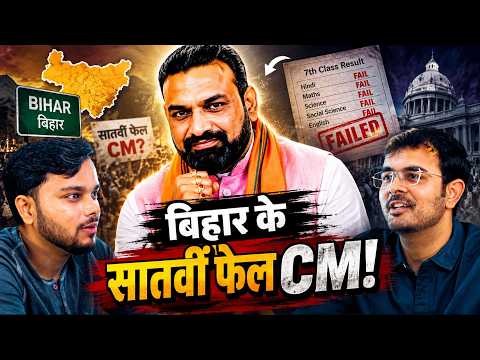
We were talking about Bihar’s new Chief Minister. Jayant did not want to name him. He asked anyone from Bihar listening to please not file a case against him. He said it half-laughing, half-serious. The half-serious part is the part that mattered.
Then he pulled up a film reference. The 2007 Priyadarshan comedy Dhol. There is a scene in it where Rajpal Yadav’s character, completely uneducated, sits in front of a laptop for the first time. He does not know what it is. So he spreads roasted chana on the keyboard and starts eating them.
Behind him, in a suit, is an educated character patiently explaining: “press this button, then this one, then this one.”
That, Jayant said, is the exact visual you should hold in your head when you think about Indian state politics in 2026.
The Bihar specifics that he laid out included a 7th-grade educated CM with multiple murder cases on record. The kind of biographical detail that would prevent any of us from being hired as a delivery driver, let alone as the chief executive of a state with crores of citizens.
And yet, that is who occupies the chair.
The IAS officers around him, the people who topped one of the toughest exams in the world, who spent years preparing and decades training, are essentially serving the function of the educated character in Dhol. “Sir, press here. Sir, sign here. Sir, file goes there.”
The country, meanwhile, is talking about AI. About 2047. About being a global superpower.
The cognitive dissonance is the country.
The Argument That Hurts
I asked Jayant where he placed the blame. The BJP for fielding such candidates? The opposition for failing to provide alternatives? The system itself?
His answer was the most uncomfortable thing I have heard a podcast guest say in a long time.
“Problem Indian voter ki hai sir.”
Translation: “The problem is with the Indian voter.”
Not the parties. Not the apparatus. The voter who walks into the polling booth and presses the button next to a 7th-grade educated murder accused, because the symbol next to their name is the right one for their caste, or because the pamphlet they got mentioned their religion, or because they were promised a cycle, or because they were just used to the family name.
I tried the obvious defence. The voter did not have a better option. The party gave them this candidate.
Jayant did not accept it.
“You can stand,” he said. “I can stand. In the end, the people who elect this person to the assembly are the people. People can say BJP did not give us another option. Fine. But you should stand.”
And then he implicated himself. He said he himself uses the TINA argument. “I do not like Rahul Gandhi, so I have to vote for Modi ji.” But he called it what it is. An excuse. A way of feeling like you have done your part while staying inside your comfort zone.
If you genuinely believed your country was being damaged, he said, you would stand up. You would organise. You would contest. Most of us, including him, do not.
That admission, more than the analysis, is what made the segment honest.
The 500 Crore Door
I asked him about the apparatus question. What about the system that keeps decent people out?
He acknowledged it instantly.
“An MLA election now costs 500 crore,” he said.
The figure is contested. Election Commission limits are nowhere near that. But the unofficial spending, hoardings, convoys, “gifts,” workers, rallies, alleged cash distribution, all of it adds up to numbers in that range for serious seats.
And the cost is the design.
If the cost of entry is 500 crore, then only people willing to spend 500 crore can enter. Those people then need to recover 500 crore. The way they recover it is the politics we get.
This is not a story about individual corruption. This is a story about market design. The system was set up, deliberately or by accident, to filter for a particular kind of person. That filter is now doing its job.
The Helicopter And The Sword
Jayant gave me a concrete example.
The MLA from his constituency, who is a minister in the current government, recently had his birthday. The photos went viral. Huge crowd. The MLA in a pagdi, cutting a cake with an actual sword. And then, the helicopter.
A helicopter appeared overhead at the celebration and showered rose petals on the crowd.
When questions were asked, the official line was that some “follower” had arranged the helicopter spontaneously. The MLA “had no idea.”
Jayant did not bother engaging with the explanation. His point was that the helicopter happened. The mythical “follower” was beside the point.
Earlier, he said, this would have been impossible. Not because politicians did not have the means, but because they would have felt embarrassed. There was a sense of public shame around displaying wealth. The white kurta was the symbol of that shame.
Now the helicopter is the symbol of its absence.
The Public Is Also To Blame
This is where the segment ended for me.
“Hamari janta bhi gayi guzri hai sir. Kaafi hadd tak.”
Translation: “Our public is also worthless, sir. To a large extent.”
He apologised before saying it. He knew it would not land well. But he stood by it.
The Indian voter, in his analysis, has been too willing to accept too little for too long. We have voted on caste arithmetic. On religion arithmetic. On freebies. On slogans. We have not voted on competence. We have not voted on integrity. We have not voted on policy substance.
When the leaders we elect turn out to be venal, uneducated, or criminal, we act surprised. But we are the ones who elected them.
The Indian leader class, his argument went, is a mirror of the Indian voter class. We get what we incentivise. The system is producing exactly the kind of leaders we have signalled we are willing to accept.
What Sits With Me
This is hard to write. I have spent most of my adult life giving the Indian voter the benefit of the doubt. The voter is poor. The voter is bombarded. The voter has limited information. The voter is doing the best they can in a difficult system.
All of that is true.
But Jayant is also right that none of it is exculpatory. At the end of the day, the assembly is filled by the voter. The CM is chosen indirectly by the voter. The MLA is sent there by the voter. When the voter accepts an unacceptable candidate, the voter is part of the problem.
This is not a comfortable conclusion. It is meant to be uncomfortable.
There are three things from this segment that I will not stop thinking about.
The Dhol movie analogy. It is the cleanest possible image of what is wrong. Highly trained civil servants spending their careers translating instructions to political leaders who could not pass class 8.
The TINA self-implication. Most middle-class Indians I know use this argument. Including me. Jayant named it as the excuse it is.
The death of the white Ambassador. Even hypocritical humility was a kind of accountability. The new openness about wealth is the absence of accountability.
These observations are above party. They apply to the BJP. They apply to Congress. They apply to regional parties. They apply to the voter who keeps the whole system running.
You do not have to agree with Jayant Mundhra to sit uncomfortably with what he said.
Watch the full episode here:
More from the blog

Subscribe to our newsletter
The best new roles, resources and must-watch episodes — in your inbox every week. No spam, unsubscribe anytime.