
Pizza Shop Worker to Startup CEO: You can do it too | Incredible Gig Job Story
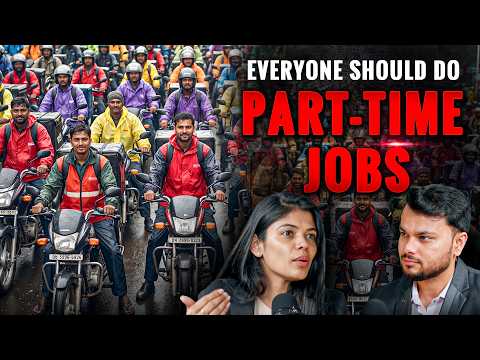
She Found Out Her Brother Was a Delivery Boy. That Night, She Built a Company.
What a serial founder taught me about gig work, dignity of labor, and why 25 crore Indian college students are leaving money on the table every semester
A conversation with Mythri Kumar, Co-Founder and CEO of Timbuckdo, the platform revolutionizing how India's college students earn money through legitimate, flexible gig work.
There is a specific kind of embarrassment that only an older sibling understands.
Mythri Kumar had given her younger brother everything he needed. A comfortable home in Bangalore. Financial support. A good life. She had worked her way up through pizza shops, SIM card sales on Bangalore's streets, and event management gigs across the country at nineteen. She had built companies, exited one, and was now consulting comfortably.
Her brother had a shiny new bike. And he was out on it all day.
So she did what every older sister does. She checked his phone.
He was not seeing someone. He was doing delivery runs. Quietly saving up Rs 15,000 to 16,000 to invest in an IPO he believed in.
"I felt terrible," she told me. "I thought, I can give you that money. Why are you doing this?"
His answer stopped her cold.
"It is not just about the money."
She sat with that for a moment. Then she sat with him that same night and built the blueprint for Timbuckdo. A platform that would let college students across India find real, verified, paid part-time work that matched their skills, not just their desperation.
That was 2022. Today Timbuckdo works with more than 3,500 companies, has raised Rs 5.5 crore, appeared on national television, and has Prateek Gandhi from Scam 1992 as an endorser whose one line brought their ad cost down to eleven paise per view.
Here is everything I learned from Mythri's story.
Part 1: She Was Always the Part-Timer
Before she built a platform for part-timers, Mythri was one.
She came to Bangalore with no safety net and no intention of calling her father every week to ask for pocket money. She worked at a pizza shop. She sold Tata Docomo SIMs on the street. At nineteen, she joined an event management company and started traveling across the country.
"I am not saying this for hero points," she told me. "Life was genuinely tough at that time."
But something important happened in those early years. She got exposure that most of her peers never received. She saw how the real world worked. She made decisions under pressure. She failed at things and recovered quickly because she had to.
When she eventually did her B.Tech in Computer Science followed by an MBA, she brought something into those classrooms that most of her classmates did not have: the lived experience of having to figure things out with no cushion underneath her.
Part 2: The Problem That Had Been Sitting There for 15 Years
Here is what struck me most in our entire conversation.
The problem Timbuckdo is solving was the same problem Mythri faced as a student fifteen years ago. College students who want to earn money while studying have no clean, trustworthy, skill-matched way to do it. They either ask parents for pocket money or take whatever random work comes their way or go entirely unnoticed by employers who would be glad to hire them.
"Nothing has changed," she said. "Nobody has sorted this in fifteen years."
That sentence is the entire founding thesis of Timbuckdo. Not an observation about a new trend. An observation about a persistent, ignored gap that an entire industry decided was not worth solving.
The gig economy is not new. But in India, the word gig has been reduced to mean delivery work. The category of educated, skilled, time-rich college students doing structured, verified part-time work has never been properly built out. Mythri is building it now.
Part 3: What Timbuckdo Actually Is
Timbuckdo is a platform exclusively for college students. Not fresh graduates. Not working professionals. Students only.
The idea is clean. Students have skills and time but no structured way to monetize either. Employers have tasks they need done but cannot justify hiring full-time employees for them. Timbuckdo connects both sides, verifies identities, checks backgrounds, and handles the trust layer that makes the whole thing work.
The range of gigs available is wider than most people expect.
Can you code? There are coding projects waiting. Are you good with people? Customer support roles are constantly in demand. Do you love animals? Pet sitting is a growing category. Are you free on weekends? Events need people consistently. Can you shoot and edit videos? Small business owners and homepreneurs are actively looking for students who can manage their social media and basic digital presence.
There is also a rising category Mythri mentioned that I had not thought about before. Elder support. If you need to take your father to a laboratory for tests but your driver is not qualified to navigate the registration desk and coordinate with doctors, you can hire a verified Timbuckdo student for those few hours. Someone educated, background-checked, and capable of actually helping.
The average student working twenty hours a week earns between Rs 9,500 and Rs 11,000 a month. That is meaningful money for someone whose financial independence otherwise depends on asking a parent before a Friday movie or a plate of street food.
Part 4: The Burger Shop MBA
At one point Mythri gave an example that I have not stopped thinking about.
Imagine you are a student working part-time at a burger shop. One day you run out of cheese. The stock did not come in. Customers are still arriving. Someone asks for a cheeseburger. You cannot close the shop. You cannot just say there is no cheese and send them away.
What do you do?
You say, I am so sorry. Can I offer you a Coke? A softie? Let me see how I can make this right.
"What are you learning in that moment?" she asked.
Inventory management. You should have anticipated this yesterday. Customer behavior and how to handle a difficult person with grace. Resource management under pressure. Critical thinking in a real situation with real consequences.
"That is the full MBA syllabus," she said. "And you are learning it on the ground, in real time, with stakes."
This is her core argument for why part-time work during college is not a distraction from education. It is the fastest form of practical education available, and it is free.
Part 5: The Dignity of Labor Problem Nobody Wants to Name
Here is where the conversation got genuinely honest.
India has a deep cultural problem with the dignity of labor. Mythri named it directly and without any softening.
"In India, nobody respects any kind of work. We insult ambulance drivers. We insult the Prime Minister. We insult everyone equally. Nothing has dignity here."
The resistance she faces most often is not from students. It is from parents. Middle-class and upper-middle-class families do not want their children doing what they consider beneath their status. The fear is social, not economic. What will happen if someone from the family sees my child doing this kind of work?
Her response is disarmingly simple.
"Your child is not doing drugs. They are not drinking. They are not smoking. They are earning money, thinking for themselves, doing something constructive. What exactly is your complaint?"
She acknowledged that she had the exact same reaction when she discovered her own brother doing delivery work. She was a person who had herself sold SIMs and worked in a pizza shop. The instinct is natural. But the question every parent needs to ask themselves, she says, is this: take one step back and look at what your child is actually doing before you react to how it looks to other people.
Part 6: In the US, Even Millionaire Children Wait Tables
Mythri made a comparison that cuts through a lot of noise very quickly.
In the US and UK, seventy-three percent of people already work in some form of gig economy. Students move out of their family homes at sixteen. And in wealthy families, including millionaire families, children are not stopped from taking waiting jobs or part-time retail work.
Because those families understand something that Indian middle-class culture has not fully accepted.
It is not about the money. It is about the exposure. It is about the muscle memory of working, of managing your time, of dealing with real people who have real expectations. You cannot replicate that in a protected environment, no matter how prestigious the school.
She pointed to a recent conversation between Nvidia's Jensen Huang and Mukesh Ambani where Huang spoke about having tried every kind of experience in his life. The message was the same. Let children experiment. Let them discover what they are actually good at by doing real things in the real world.
"The reason children do not know what they want," Mythri said, "is because you have not exposed them to enough of the world to figure it out."
Part 7: The IDEA Baas Moment
Let us talk about television.
Timbuckdo appeared on IDEA Baas, a national investment show that aired on Zee TV and in regional languages including Kannada and Marathi. All four investor titans offered deals. The regional episodes drove extraordinary numbers, with the Kannada and Marathi airings bringing in over thirty thousand downloads each on the day they went live. One particular day saw approximately ninety-four thousand sign-ups.
But here is the part that impressed me most as a strategic move.
Prateek Gandhi, the actor famous for Scam 1992, committed to endorsing Timbuckdo on the show. His one line was this: in my time, if Timbuckdo had existed, imagine how many scams I could have avoided.
That single line brought Mythri's visibility cost down to eleven paise per impression.
"Where else does a startup get that?" she said. "Half an hour on national television, regional language reach, and one line from one of the most recognizable faces in Indian streaming. That would have cost thirty to forty crore in a direct marketing budget."
She did not go on the show only to raise money. She is a marketer at heart and she understood the distribution value of the platform before the cameras turned on. That is a different kind of intelligence than most founders bring to fundraising.
Part 8: AI Is Not the Threat Students Think It Is
A fair concern about gig work for students is that AI is already replacing many of the tasks students used to get paid for. Content writing, data entry, basic research. These categories have been significantly affected.
Mythri does not deny this. But her framing is different from the panic you read about on LinkedIn.
"AI cannot make your coffee. AI is not working as a barista. AI is not physically present with a customer in the way a real human is."
Her point is that AI has affected the most mechanical and easily replicable gig categories. The gigs that remain and are actually growing require physical presence, human judgment, or genuine relationship-building. Events. Customer support beyond the first automated level. Elder support. Pet care. Shooting and editing video content for local businesses. These cannot be replaced by a ChatGPT subscription.
And then she said something that reframes the entire AI-versus-jobs conversation.
"AI is a weapon for students. It is a tool. The students who learn to use it and then actually implement it will be irreplaceable. The ones who think their graduation certificate is enough will absolutely be replaced."
The threat is not AI. The threat is the attitude that learning is enough without implementation. That a degree is a destination rather than a starting point.
Part 9: How She Sold Her First Company in 7 Months
Before Timbuckdo, Mythri had already built and sold a company.
In 2016, she registered Pelican Solar on October 20th. On November 8th, demonetization happened. The solar sector relied heavily on investors who wanted white-money returns and tax-free income. That class of investor suddenly became very cautious. She had to shut Pelican Solar down.
She started a second company in 2017, this time focused on making solar installations smart. They added an IoT predictive analytics device to solar setups that could forecast next-day power generation, monitor battery charge, and estimate remaining battery life. In 2017, that was genuinely early-stage technology.
A warehousing company reached out via LinkedIn looking for a solution to power their security cameras twenty-four hours a day without interruption. Their warehouses were in rural areas with irregular electricity supply. Mythri bundled her solar solution with an IoT device from a company that shared her co-working space and pitched it as one integrated product.
The warehousing company sent a letter of intent for two thousand sites.
She sold the company for Rs 20 lakh. She had invested Rs 2 lakh. She walked away with Rs 30 lakh in seven to eight months.
"I was a first-time founder," she said. "I did not know what a board was, what quorum meant, why you hold board meetings. I did not know who I was meeting with when I went to talk to the investor. Someone just told me to go meet an investor who was in town."
What she did know was how to pick the right product, how to build a story around it, and how to sell it. That is the skill set she has carried into every venture since.
Part 10: Women Are Born Founders. Most Just Have Not Been Told.
I asked Mythri about her experience building companies as a woman in India. Her answer was immediate.
"Women are born leaders. There is no debate here."
Her evidence is practical. Give a woman Rs 500 and ask her to run a household. She will do it. Give her Rs 50,000. She will manage that too. The skill of handling scarce resources, making tradeoffs, keeping multiple things moving simultaneously: that is exactly the skill set a founding CEO needs at the early stage of a startup.
"What is building a startup? It is the same thing. What is your runway? What do you prioritize? How do you do more with what you have?"
The reason more women do not become founders, she said, is not ability. It is a prescribed life formula handed to them early and never questioned. Graduate. Work for a few years. Get married. Have children. The formula is comfortable. It is familiar. And it quietly closes the door on questions that were never asked.
"Women are already founder material," she said. "Most of them just have not been told."
Part 11: The First Earning You Never Forget
Near the end of our conversation Mythri told me about a girl from Kerala studying in Bangalore who got her first earning through Timbuckdo.
She took her parents out to dinner. She ordered her mother's favorite dessert. She wrote a long post on LinkedIn about it, completely on her own, without anyone asking her to.
Mythri read me a line from that post and then said something that I think is the real thesis underneath everything she is building.
"You can forget your first crush. Maybe you forget your first love when you find someone better. You can forget many firsts. But the first money you earn yourself, that is a different kind of feeling. That is a different level. And that is what Timbuckdo is giving to students."
That is the product. Not a platform. Not an app. The irreplaceable feeling of self-sufficiency that most Indian college students have never been allowed to experience.
The One Thing
If there is a single idea that runs through everything Mythri said, it is this:
The gap between what Indian college students are capable of and what they are actually allowed to do is enormous. And nobody has taken it seriously enough to fix it for fifteen years.
Part-time work is not a distraction from education. It is an accelerator of it. The student who completes twenty gigs before graduation will outperform the student who has done two internships. Not because they worked more hours but because they encountered real problems, real customers, and real consequences.
Timbuckdo is not trying to make students into delivery workers. It is trying to make them into people who understand how the world actually runs before they are asked to lead it.
That is a different thing entirely.
Watch the full conversation with Mythri Kumar on YouTube: https://youtu.be/4uWmhLKNuhc
More from the blog



Subscribe to our newsletter
The best new roles, resources and must-watch episodes — in your inbox every week. No spam, unsubscribe anytime.