
CEO Without MBA Reveals The MBA Truth - Thirumal Govindraj
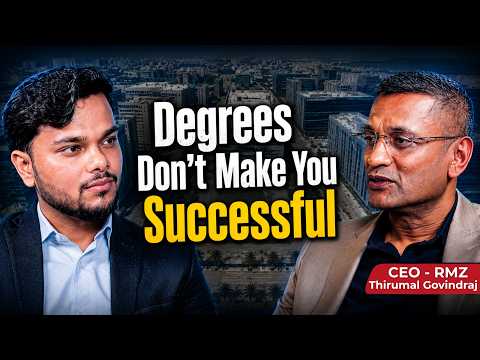
The setup was natural. Thirumal is the CEO of RMZ Office and RMZ NXT, the office vertical of one of India’s most powerful commercial real estate empires worth approximately 150,000 crore. He did a BA. No MBA. 14 years at CBRE. Career built entirely on the job. By every conventional metric, he is the case study for the “MBA is dead” narrative that has been gaining ground over the last few years.
When I asked him directly, citing his own trajectory and the 25 to 30 lakh fees at top Indian schools, why anyone should still do an MBA, I expected him to validate the skeptics.
He did not.
What he did instead is what makes this segment worth thinking about carefully.
The Credibility For The Answer
Let me set up his credibility first, because the rest of this only matters if you take his perspective seriously.
“CBRE, I would say, taught me what an MBA would have taught me in two years. CBRE taught me in the first two, three years of working.”
This is the working professional’s argument against the MBA, articulated by someone who actually lived it. The first 2 to 3 years of work at a serious global firm, in a serious functional role, with serious mentors, gives you most of what a B-school education provides in concentrated form. The case studies are real. The financial models are deployed against actual deals.
If you can get into that environment without the MBA, the MBA becomes redundant. Thirumal got into that environment. He spent 14 years there. He used that platform to move into the operating role he holds today.
The Easy Answer He Refused To Give
The easy answer for someone in his position is to tell young professionals to skip the MBA. The market for that answer is large and growing. Every founder who skipped business school, every operator who learned on the job, every engineer who moved into finance without a graduate degree, is part of a chorus that has been telling people for the last decade that the MBA is overrated.
Thirumal did not join that chorus.
“What an MBA does for you is basically put things in perspective. It gives you the opportunity to be agnostic to industry.”
This is the formulation I have not heard before, and it is the one that should be at the centre of any honest MBA discussion.
The MBA, in Thirumal’s framing, is not a credential that gets you a specific job. It is an option-creating asset that gives you the ability to move across industries.
“Today I can do real estate. Tomorrow I can do finance. Day after I can do something else. That is what an MBA gives you upfront. It gives you the perspective of what is out there, then you decide what you become good at.”
This is the case that the MBA’s defenders rarely articulate this clearly. The degree’s value is not the salary bump on the first job. It is the breadth of post-graduation options across industries, sectors, and functions, which compounds over a career.
The IIT-To-Banking Example
The cleanest illustration came from Indian financial services.
“You take some of the top financial bankers, or you take some of the top investment bankers. They are all engineers by profession. They have studied engineering. They have gone to IIT. But today are not doing engineering as a field. They are doing finance.”
This is a pattern any senior Indian recruiter recognises. The top of Indian finance is disproportionately populated by people who did engineering undergrads and then transitioned, often through an MBA, into finance. The MBA was the bridge that allowed them to translate their analytical capability into a different industry.
The point Thirumal was making is that without the MBA bridge, those engineers would have stayed in engineering. The credential opened the door to a different industry.
This is the optionality argument. The MBA buys you the right to be in a room you would not otherwise be in. What you do once you are in that room is up to you.
The Dependency Trap
The most important line in the segment was the one that critiqued how most students approach MBAs.
“You see a lot of MBAs today are not very successful. Because eventually your dependencies, because I am educated I should get somewhere, is not going to take you anywhere.”
This is the trap that Indian education in general, and Indian MBA programs in particular, often produce. The student is told that the credential is the achievement. The credential is supposed to deliver the outcome. The student arrives at the workforce expecting the degree to do the work that only the person can do.
Thirumal’s diagnosis is that this expectation is precisely why so many MBAs fail to convert their education into careers.
“The MBA gives you a good foot in the door. But the personality and the person you become is what makes you successful. I don’t think the MBA makes you successful. The MBA is a tool which you can use to open doors for you.”
The metaphor is precise. A tool is something you use. A destination is something you arrive at. The MBA is the former, not the latter.
The IIM Kozhikode Conversation
I told Thirumal about an earlier podcast conversation I had with the longest-serving IIM director.
“Why should anybody be doing an MBA now? Two years, you will charge them 25, 30 lakh rupees fees, and what are they learning which they cannot find while doing a startup or directly starting work?”
I asked Thirumal the same question, with his own trajectory as the implicit pressure.
“You have not done MBA. You have done so well. You manage a 150,000 crore company empire. So why should anybody right now be doing MBA?”
His answer was the formulation about industry-agnostic optionality. He did not pretend his own path was replicable for everyone. He acknowledged that he had done informal training to get the breadth that an MBA would have given him directly. He did not say “you do not need an MBA.” He said “the MBA gives you something specific, and if you want that specific thing, do it.”
The School Matters
A point Thirumal made in passing, but which is critical, is that the school matters.
“MBA is also, you know, it matters on which school you have done it, who is your mentor, who do you follow.”
The MBA at a top tier Indian or global school is a different product from the MBA at a tier two institution. The peer network, the recruiter relationships, the alumni access, the faculty mentorship, are dramatically different. The 25 to 30 lakh fee at a top tier IIM is a different investment from the same fee at a less prestigious school.
The optionality argument applies most strongly at the top of the distribution. The MBA from a top tier school does buy industry-agnostic optionality. The MBA from a tier two school may not buy the same optionality.
The Alternative Path
The closing argument was the most important for younger professionals to internalise.
“Unless you are very focused from day one, you are saying, no, I want to do this and I will follow it, and if I succeed, I succeed. If I do not succeed, I will fail. That is a different way of looking at it.”
This is the path he himself took. From day one in his career, real estate. From day one at CBRE, the institutional grounding. From day one at RMZ, the operating role.
The conviction of “this is what I do” was clear from the start. The MBA would not have changed it.
“If you believe in something, follow it, go through with it. If you succeed, fantastic. If you do not succeed, your education is going to take you back to doing something else.”
The closing line is the safety net argument. Education, of any kind, including the BA he himself has, is the fallback that gets you back into the labour market if your conviction-led career does not work out. The MBA, in this framing, is one of several possible safety nets, not the only one.
The Decision Framework
If you take the segment seriously, you end up with a decision framework rather than a one-line answer on MBAs.
If you have already developed conviction about a specific industry and you can access it without an MBA, the degree is probably redundant. Get into the industry. Compound your learning on the job. The 14 years that Thirumal spent at CBRE will teach you what 2 years at IIM would teach, plus everything that an MBA cannot teach.
If you do not yet have that conviction and you want optionality across industries, the MBA at a top tier school is a tool worth its cost. The breadth of post-graduation options will compound over the career in ways that justify the investment.
If you are doing the MBA because you assume the credential will deliver your career to you, you are walking into the dependency trap. The MBA will be a wasted investment.
What I Took Away
Three things from this segment will stay with me.
The optionality framing. The MBA as an industry-agnostic option creator, rather than as a credential for a specific job.
The dependency trap. The single biggest predictor of MBA failure is the student who treats the degree as the destination.
The conviction alternative. The path of “I know what I want to do from day one and I will pursue it without the credential” is real, but it requires unusual focus and accepts unusual risk.
You may agree with Thirumal Govindraj. You may push back. The structural answer is more useful than the easy one.
Watch the full episode here:
More from the blog



Subscribe to our newsletter
The best new roles, resources and must-watch episodes — in your inbox every week. No spam, unsubscribe anytime.