
26/11 Mein Sabse Pehle NSG Nahi Aayi Thi! - Praveen Kumar Teotia
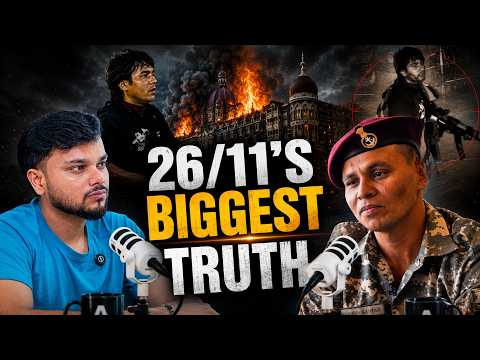
There is a moment in our podcast with Praveen Kumar Teotia that everyone who lived through the news cycle of November 2008 should sit with.
Who went first? They do not know. They were just woken up that morning to television showing only NSG.
The Shaurya Chakra recipient, former MARCOS commando, and author of “26/11 Braveheart” was correcting the historical record on the operations that defined modern Indian counter-terror.
The 26/11 attack on Mumbai is associated in public memory with the National Security Guard. The Black Cats arrived. The cameras followed. The TV coverage shaped what India remembers.
Praveen Teotia is here to tell us what the public memory missed.
The Morning Of 26/11
The level of personal detail in Teotia’s recollection is what gives the segment its weight.
“Us din match tha. Main to chhat par jaakar so gaya. Main us din reservation karwane gaya tha. Chhutti jaane wala tha do din baad mein.”
That day was a cricket match. He had gone to get his train reservation, planning to go home on leave in two days.
But the most haunting detail came next.
“Main 7:45 baje wahin par tha main. Jis Leopold Cafe ki baat hai na, jis Leopold Cafe mein baithkar unhone beer aur daaru pi hai, usi jagah par main tha 7:45 baje.”
I was at the Leopold Cafe at 7:45 in the morning. The same Leopold Cafe where the terrorists later sat and drank, I was there at 7:45 AM that day.
He had a vada pav. He drank a glass of sugarcane juice. Then he walked back.
The Cricket Match
When he reached the unit room around 9:15 AM, the unit was watching cricket. India versus England. He picked up his bedding and went to the roof to sleep. His next duty was at noon.
The country was watching cricket. The Navy commandos were watching cricket. The terrorists had not yet landed.
The Wake-Up Call
He woke at 11:45 AM. He took his cycle. He went to his guard duty post.
“Pahuncha to wahan pe jab news chal rahi thi to wahi tha ki Mumbai ke top police officials ko terrorists ne maar diya hai.”
The news running. Mumbai’s top police officials had been killed by terrorists.
He was 23 years old.
The Golden Opportunity Line
The officer of the day was his Kashmir buddy-incharge.
“Bola ki Teotia, aaj to golden opportunity hai hamare liye ki jinko hum jangalon mein dhoond rahe the, wo hamare ghar mein aa gaye hain abhi.”
Teotia, today is a golden opportunity. The ones we were searching for in the jungles have come to our home.
Teotia’s response was immediate.
“Maine kaha ye to baat sahi hai sir. Chalo chalte hain.”
That is true sir. Let us go.
This is the soldier’s mind. Not fear. The framing of opportunity. The men who had been fighting an asymmetric war in Kashmir were being given a direct shot at the same enemy on their own ground.
The Deployment
The instructions came fast. Two MARCOS teams were already at the Taj and the Trident. Two more would go. Teotia’s job was to call his colleagues, get them to the armoury, draw armour and weapons.
The interviewer clarified.
“Jo do team gayi thi wo MARCOS ki thi?”
The two teams that had gone were MARCOS?
“MARCOS ki.”
MARCOS.
This is the historical correction. The first responders to 26/11 in the Taj and the Trident were not NSG. They were MARCOS.
The Phone Call That Sent Them
The mechanism of deployment is where the story becomes administratively shocking.
“Police se control nahi hua to wahan ke jo RR Patil the, jo Home Minister the Maharashtra ke, unhone phir Navy ko phone kiya. To unhone unko request ki ki MARCOS chahiye hamko. To tab MARCOS gaye the phir.”
The police could not control the situation. The Maharashtra Home Minister called the Navy directly. He requested MARCOS. That is how MARCOS deployed.
The interviewer pressed on the procedure.
“Bina kisi kagaz patra ke, kisi... To sirf request pe gaye?”
Without any paperwork, on just a request?
“Request pe. Koi official nahi tha. PMO se koi letter wetter nahi aaya tha apne liye. Random tha ki chalo bhai ye desh ki raksha ka sawal hai to sirf ek, ek call pe. Bina kisi permission ke.”
On request. Nothing official. No letter from the PMO. The country’s defence was at stake. So on a single call. Without any permission.
This is the part of 26/11 that does not exist in the official record. The Marine Commandos who went into the Taj and the Trident first had no paperwork authorising them to be there. They went because the procedure would have taken too long.
The Question Of Recognition
The interviewer asked the natural follow-up. Why was this not formally recorded later? The same party was at the centre and in Maharashtra. The formalisation should have been easy.
“Baad mein official bana sakte the na isko?”
Could they not have made it official later?
Teotia’s answer was the line that stopped me.
“Jab kaam ho gaya phir kaam khatam ho jata hai. Kaam ho gaya, kaam khatam ho gaya. Koi kutta nahi poochta aapko who, who are you?”
When the work is done, the work is done. Once it is done, no one asks who you are.
This is the lament of the forgotten first responder. The MARCOS who went without orders, who held the line until NSG arrived, whose presence in the operation was never formally acknowledged in the way the public would remember it.
What This Reveals
Three things from this segment should sit with anyone who lived through the 26/11 news cycle.
The first responders were MARCOS, not NSG. The teams that went into the Taj and the Trident first were Marine Commandos of the Indian Navy. They deployed before the NSG arrived. They held the operation until the formal response could be organised.
The deployment was procedurally informal. There was no PMO letter. No official authorisation. The Maharashtra Home Minister phoned the Navy. The country’s defence was treated as urgent enough to bypass procedure.
The recognition was procedural. Once the operation was over, the official record reflected the procedural reality. The teams that had been formally authorised got the formal credit. The MARCOS who had gone in on a phone call had no document to point to.
The Universal Pattern
The segment reveals something broader about institutions and credit.
In any institution facing a crisis, two parallel things happen. The procedurally authorised response moves through the formal channels. The informal response moves through phone calls and relationships. The crisis is usually contained by the informal response. The formal response usually shapes the public memory.
The mismatch is not malicious. It is structural. Records reflect procedure. Procedure is set up to prevent abuse and ensure accountability. When procedure is bypassed for legitimate operational reasons, the record is silent.
The cost of the structural mismatch is paid by people like Praveen Teotia. The men who held the line in the gap between the phone call and the formal response. Whose work is real. Whose record is partial.
The Soldier Who Spoke
What makes Teotia’s account important is that he is willing to say it publicly. Most senior officers from MARCOS and other special forces units do not speak about operations on the record. The institutional culture is one of silence. The work is done. The credit is institutional. The individuals do not need to be named.
Teotia is speaking now because the public memory of 26/11 is being shaped, finalised, and converted into history. If he and his colleagues do not speak, the official record will continue to omit them. The Shaurya Chakra he wears is the institutional acknowledgment. The public memory needs the corresponding recognition.
What We Owe
Three things should sit with anyone who reads this account.
The MARCOS who went in on a phone call held the Taj and Trident until NSG arrived. That is the historical reality. The TV coverage that followed showed the formal response. Both are part of the story. Only one is in the public memory.
The administrative informality of the deployment is not a scandal. It is what happens when a country’s defence requires action faster than procedure. The system worked because individuals at the Maharashtra Home Ministry, the Navy, and the MARCOS unit treated the request as legitimate and acted on it. The country was defended.
The recognition gap is what we owe to fix. The men who went in without paperwork have earned the formal acknowledgment. The country that they defended owes them the public memory their actions deserve.
Praveen Kumar Teotia is a Shaurya Chakra recipient. The third-highest military gallantry award in India. He has authored “26/11 Braveheart.” He became the first differently abled IRONMAN of India after the injuries he sustained that night.
The man has earned the right to set the record straight. Listening to him is the least we can do.
Watch the full episode here:
More from the blog
Subscribe to our newsletter
The best new roles, resources and must-watch episodes — in your inbox every week. No spam, unsubscribe anytime.