
Jobless Growth: India Ka Sabse Bada Crisis?
They were people, Vijeta said. Your country’s people. They wanted to be doctors. To treat lakhs of people. They had dreams. All of that is finished. They are not coming back. In this, how can anyone disagree that paper leaks should stop?
The CJP spokesperson was making the specific appeal that has resonated across ideological lines.
The Jobless Growth Diagnosis
The conversation began with the specific economic pattern Vijeta was describing.
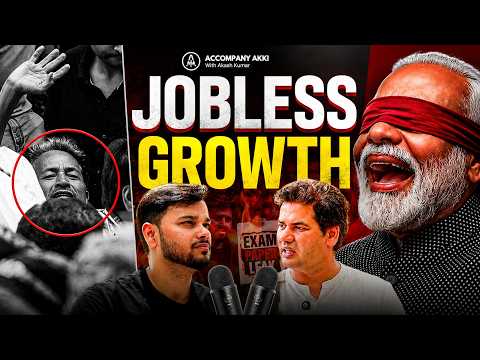
GDP is growing, but it is jobless growth, Vijeta said. Unemployment is very high.
The diagnosis is short but analytically important. Indian GDP growth has consistently exceeded most major economies over the last decade. But employment intensity has fallen. India is producing more economic output with less human labor.
Vijeta then extended the diagnosis to specific policy interactions.
Poor people who start their own thing get bulldozers driven on it, Vijeta said. Parents cut their stomachs to fund children’s coaching. Then paper leaks happen. Where do people go?
The three-part sequence is worth understanding. The formal economy provides few jobs. Informal economic activity is disrupted by policy actions. Educational pathways to formal employment are compromised by examination integrity failures.
Where Do People Go
The specific question Vijeta asked is worth pausing on.
Where do people go?
The question is not rhetorical. If formal employment is scarce, informal employment is disrupted, and educational credentialing is corrupted, then the path from lower-income status to middle-class stability has been closed.
The Anshan Testimony
The interviewer asked whether the movement needed more participants.
During Anna Hazare’s anshan, Vijeta said, many citizens also did anshan. Even now the same is needed.
She then gave specific testimony about who has been fasting.
A ma’am - she is a nuclear physicist but also her village’s sarpanch, Vijeta said. She and about 10-15 villagers, including children, did anshan there. Influencer Arijit Sharma did anshan. Everyone should sit and say - we are with you.
The specific example of the nuclear physicist sarpanch is worth extracting. India has a specific political system where local governance positions are democratically elected. A woman with a nuclear physics PhD serving as village sarpanch represents the specific intersection of high credentialing and local democratic engagement.
Vijeta then gave the specific count.
About 40 of our comrades have done anshan, Vijeta said. Some for 5 days, some for 8 days. I think 6-7 are still sitting now.
The physical courage of extended fasting is worth acknowledging.
This is a matter of great courage, Vijeta said. Without food that many days - you cannot even imagine. You have given up your body.
The Political Support Testimony
Vijeta then named the political leaders who had supported the movement.
Chandrashekhar Azad from Azad Samaj Party came, Vijeta said. Priya Saroj and Pushpendra ji from Samajwadi Party came.
She then named the leaders she wanted to see.
But I want the major party leaders to come too, Vijeta said. Rahul Gandhi from Congress. Arvind Kejriwal. Akhilesh Yadav. Stalin. Vijay. Tejasvi Yadav. Everyone should come. If they come, the movement will get more strength.
The framing is important. Vijeta is not attacking these leaders. She is inviting them.
She then made the specific institutional argument.
What is the opposition party’s job, Vijeta said. Their job is exactly this - to see whether the government is working well or not, and if not, to organize movements. Here the youth are already organizing.
The Philosophy Question
The interviewer asked what philosophy should guide young Indians and politicians today.
Vijeta’s answer reached back into classical Indian philosophy.
The philosophy is the old one, Vijeta said. Sarve bhavantu sukhinah, sarve santu niramaya. May all beings be happy, may all be free of disease. Vasudhaiva Kutumbakam - the world is one family.
The two Sanskrit references represent a specific universalist ethical framework that predates modern political ideologies by millennia.
The Gandhi Talisman
She then referenced the specific Gandhi passage that used to appear in Indian school textbooks.
Look at Gandhi ji’s talisman, Vijeta said. It used to be in old NCERT textbooks.
Vijeta’s summary was faithful.
Gandhi ji says - look at the last man, Vijeta said. See whether the work you are doing will benefit him or not. That was the test.
The observation that this passage used to be in textbooks is a specific claim about how Indian public education has shifted. The specific talisman remains a universally applicable ethical test.
The Wealth Inequality Observation
Vijeta then made the specific historical comparison.
In the last 100 years, Vijeta said, even during British times, we did not have this much wealth inequality.
The claim is specific and worth understanding. Research from the World Inequality Lab has documented that Indian income inequality is now at levels not seen since the colonial era. The top 1% of Indians hold approximately 22.6% of national income.
The observation matters because it inverts a common assumption. Political independence and democratic governance were supposed to reduce inequality.
The Universal Appeal
The interviewer noted the political attacks against the movement.
Vijeta then made the segment’s most morally forceful appeal.
To those who are still trolling, still doing this, Vijeta said, I appeal to their conscience. Ideology - left wing, right wing - what is this? They were people. Your country’s people. They wanted to be doctors. To treat lakhs of people. All of that is finished. They are not coming back.
The specific reference is to Indian students who have died by suicide, particularly in coaching cities like Kota.
In this, how can anyone disagree that paper leaks should stop, Vijeta said.
The framing is worth pausing on. Vijeta is inviting people across the political spectrum to agree on a specific proposition - that examination integrity is important, and that lives lost to its failures represent a systemic failing that transcends politics.
What This Reveals
Three things from this segment will stay with me.
The where-do-people-go question. Vijeta’s diagnostic sequence identifies a specific closure of escape routes from poverty in India.
The Gandhi talisman. The specific ethical test - does your work benefit the last person - remains universally applicable.
The universal appeal. The specific insistence that “they were people, your country’s people” is a moral framing that transcends politics.
The Universal Insight
The Vijeta framework applies beyond the specific Indian moment.
Every economy in transition faces similar questions. GDP growth without employment growth. Formal sector shrinkage combined with informal sector policy pressure. Educational integrity challenges. Widening inequality.
The Sanskrit shlokas Vijeta cited represent a specific ethical framework that most societies have some version of. The idea that all beings should be happy. The idea that humanity is one family. The idea that policy should be tested against its impact on the poorest.
These are not left-wing or right-wing ideas. They are pre-political ethical intuitions that most people share when they slow down enough to consider them.
The Broader Democratic Question
Vijeta’s framing has implications for how citizens engage with policy in any democracy.
Every major policy debate can be framed ideologically or ethically. The ideological framing tends to sort people into camps that then oppose each other. The ethical framing - what does this do to the last person - tends to reveal common ground that ideological framings hide.
The specific practical implication is that public discourse benefits when ethical framings are foregrounded. Not because ideology is unimportant, but because the ethical framings capture what people actually agree on before ideology sorts them.
The Real Question For Readers
The uncomfortable question the segment raises is whether you have applied the Gandhi talisman to your own decisions recently.
For most middle-class Indians, the honest answer is no. The specific ethical test of considering the poorest and weakest person you have seen, and asking whether your work benefits them, is not part of most professional decision-making frameworks.
Vijeta is not asking readers to become activists. She is asking readers to internalize a specific moral test. The test may not change what you do most days. But over years, the specific practice of applying it produces different decisions than not applying it.
The Practice
If you want to try the Gandhi talisman as a personal practice, the specific method is simple.
Before making significant decisions - whether professional, financial, or political - recall a specific person you have encountered who is at the margins of Indian society. A migrant construction worker. A domestic help. A rural farmer. A person on the street.
Then ask whether the decision you are contemplating helps or harms that person’s specific interests.
Most of the time, the answer will be neither. The decision is unrelated to their circumstances.
Sometimes the answer will be that the decision genuinely helps.
Sometimes the answer will be that the decision harms them in ways you had not considered. In those moments, the practice becomes valuable. You have the option to reconsider.
Watch the full episode here:
More from the blog


Subscribe to our newsletter
The best new roles, resources and must-watch episodes — in your inbox every week. No spam, unsubscribe anytime.