Your go-to guide for career, growth, and mentorship. Real insights from founders, Leaders, Industry Experts & CXOs to land dream jobs and win big.
There is a specific kind of power that television journalism holds in India.
It is not the power of a politician, who can be voted out. It is not the power of a businessman, who can be boycotted. It is something more diffuse and more difficult to locate. The power to name things. The power to frame what counts as patriotism and what counts as betrayal. The power to decide, night after night, who sits on the right side of the national interest and who sits on the wrong side. And crucially, the power to exercise all of this with almost no formal mechanism of public accountability.
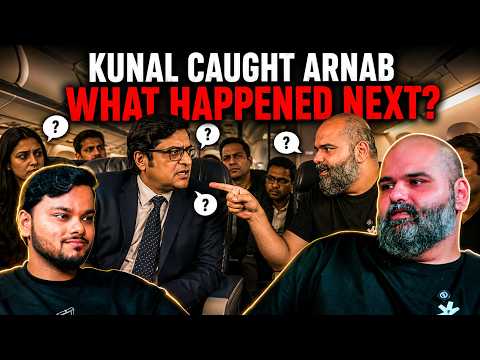
In a recent conversation, Kunal Kamra used a now-famous flight incident as the entry point into a much larger discussion about what Indian television journalism has become, who benefits from its current form, and what it costs a democracy when the institutions meant to hold power accountable become instruments of power themselves.
1. The Flight, and What It Was Really About
The incident itself has been covered widely. Kunal Kamra spotted Arnab Goswami on a commercial flight, approached him, and attempted to have a direct conversation about the things Goswami regularly discusses on national television. The interaction was filmed, circulated, and became a flashpoint for competing narratives about harassment, accountability, and the limits of public confrontation.
Kamra's account of his own reasoning is worth taking seriously on its own terms, separate from whether one agrees with his methods.
His logic was direct: if a journalist spends hours every week on national television speaking about national interest, about who loves the country and who does not, about which positions are acceptable and which are dangerous, then why should that conversation only flow in one direction? Why should the journalist be permanently insulated from the same kind of direct questioning he directs at others?
The line he offers is clean: "If national interest matters so much, then let's discuss what national interest actually means."
What the incident became, symbolically, was something larger than two individuals on a plane. It crystallised a frustration that had been building across a significant portion of the Indian public: the sense that the most powerful voices in Indian media operate in a protected space where they can define the terms of every debate without ever having to participate in one on equal footing.
2. When Journalism Became Performance
The deeper critique in the conversation is not about Arnab Goswami specifically. It is about a transformation in what Indian television journalism rewards and therefore what it produces.
The economics of television news have always created pressure toward the dramatic. Audiences are finite. Attention is competitive. A channel that keeps viewers watching through a slow, careful examination of policy complexity is competing against a channel that keeps viewers watching through emotional escalation, dramatic confrontation, and the sustained feeling that something important and threatening is happening right now.
In that competition, the incentives are not subtle. Loudness gets ratings. Anger generates engagement. Fear creates the kind of audience retention that advertisers and distributors pay for. The result, Kamra argues, is a medium that has structurally optimised itself for emotional reaction rather than informed public understanding.
This is not unique to India. Media ecosystems around the world have been reshaped by similar dynamics, accelerated by social media's amplification of outrage and conflict. But in India, the scale of television's reach, combined with the intensity of existing political polarisation, has created conditions where the consequences of this transformation are particularly acute.
When the most-watched news programmes in the country are essentially structured as emotional experiences rather than informational ones, the cumulative effect on how the public understands politics, identity, and national life is significant. And largely unmeasured.
3. The Label and What It Does
One of the specific mechanisms Kamra identifies in the conversation is the use of particular labels and what those labels accomplish in public discourse.
Anti-national. Urban Naxal. Terror sympathiser. Tukde-tukde gang.
The criticism here is not primarily about the political content of these labels, about whether they accurately describe any particular person or movement. It is about the function they serve in a media environment built around speed and emotional impact.
Labels work by collapsing complexity. They allow a television anchor to communicate an entire judgment about a person in a single phrase, before any evidence is examined, before any context is established, before the person labelled has any opportunity to respond on equal terms. Once the label is attached and repeated across enough prime-time hours, it shapes how a significant portion of the audience perceives that person or movement, often permanently.
Kamra's point is that this is not incidental to how outrage journalism operates. It is central to it. The label is the product. It generates the emotional response that keeps the audience engaged and the ratings high. The question of whether the label is accurate is secondary, sometimes irrelevant, to whether it is effective.
For a democracy that depends on citizens forming views based on reasonably accurate information, this is a serious problem. Not because any individual viewer cannot think critically, but because the sheer volume and repetition of label-driven framing makes critical thinking progressively more difficult to maintain.
4. The Accountability Gap
The question that forms the emotional core of the conversation is one that does not have a comfortable answer.
Who holds powerful journalists accountable?
The accountability structures that exist for other powerful figures in Indian public life are at least theoretically visible. Politicians face elections, however imperfect. Businesses face consumers and, sometimes, regulators. Public officials face parliamentary scrutiny and, occasionally, courts. Celebrities face the audience's willingness to keep paying attention.
Television anchors who reach tens of millions of viewers nightly occupy a different position. Their power is enormous. Their direct accountability to any external mechanism is minimal. They cannot be voted out. They are not subject to the same regulatory scrutiny as, say, a pharmaceutical company or a financial institution. Their primary accountability is to the channel's ownership and, indirectly, to ratings, which as discussed above, often reward exactly the behaviours that most concern critics.
This accountability gap is not unique to India, but it is particularly consequential in a media environment where the line between journalism and political advocacy has become genuinely difficult to locate in some of the country's most-watched programming.
Kamra's frustration, shared by a significant portion of the public regardless of political affiliation, is not simply that journalists hold particular political views. It is that the power to shape national narratives at scale carries no formal obligation of transparency about those views or the interests they might serve.
5. "Extremist Content for Jobless Youth"
The sharpest statement in the conversation is also the most politically charged.
"They are creating extremist content for indoctrinating jobless youth."
Unpacking this requires separating two distinct claims that are bundled together in the phrase.
The first is about content: that outrage-driven, hyper-nationalist television programming functions, in its emotional architecture, similarly to radicalising content regardless of its formal legitimacy as journalism. The second is about audience: that this content finds its most receptive reception among young people facing economic anxiety, unemployment, and the social frustration that accompanies both.
The second claim has some empirical support in research on radicalisation more broadly. Populations experiencing economic precarity and diminished future prospects are consistently more susceptible to identity-based political messaging that offers a clear enemy and a clear cause. Whether Indian television news deliberately targets this demographic or simply benefits from its existence as an audience is a question the conversation does not fully resolve.
What it does assert, provocatively, is that the combination of emotionally manipulative content and a psychologically vulnerable audience is not accidental or incidental. It is, in some respects, a business model.
6. What Television Journalism Was Supposed to Do
Running beneath the entire conversation is an implicit set of assumptions about what journalism in a democracy is supposed to accomplish.
The classic account is familiar: journalism holds power accountable, informs citizens so they can make decisions, surfaces facts that powerful interests would prefer to keep hidden, and creates a shared informational foundation without which democratic deliberation cannot function.
Kamra's argument is that significant portions of Indian television journalism have abandoned this function, not through a single dramatic failure but through a gradual substitution of different values. Investigation replaced by confrontation. Public interest replaced by ratings interest. Truth-seeking replaced by narrative-building. The studio as arena rather than forum.
The consequence is not just bad journalism. It is a weakened democratic infrastructure. Because if the institutions that are supposed to provide citizens with reliable information about how power is being exercised instead provide citizens with emotionally engaging entertainment that serves particular political interests, the downstream effects on political culture, on civic participation, on the quality of public decisions, are real and compounding.
The One Thing
Democracies do not collapse all at once. They erode through the slow degradation of the institutions that make informed self-governance possible. A media ecosystem that has learned to profit from outrage is not a neutral backdrop to political life. It is an active participant in shaping what politics becomes. The question Kunal Kamra is really asking is not about one journalist or one flight. It is about what happens to a democracy when the cameras are pointing in only one direction, and no one with the power to redirect them has any incentive to do so.
Watch the full conversation here:
The best new roles, resources and must-watch episodes — in your inbox every week. No spam, unsubscribe anytime.