
Corruption Khatam Nahi Ho Sakta Hai! - Former IAS
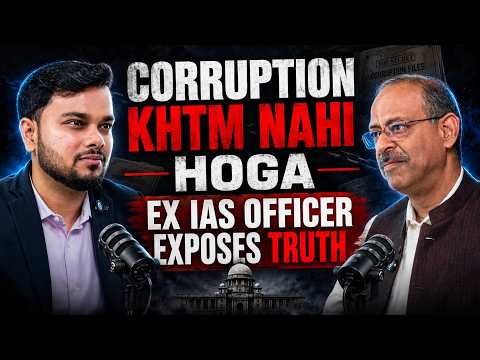
There is a sentence in our podcast with Anil Swarup that should be on the wall of every Indian public servant.
“Honesty alone is not enough. Honesty is a necessary condition but not a sufficient condition. You have to be efficient.”
The 38-year IAS veteran, former Coal Secretary, said this while explaining a chapter from his book Ethical Dilemmas. The argument matters because it disrupts the most common framing of integrity in Indian public service. The framing that says honesty is the goal. Anil Swarup is saying honesty is the floor. The goal is something else.
Let me walk you through what he said.
The Two-Category Distinction
The first useful framing in the segment was the political-versus-bureaucratic corruption distinction.
“Political corruption ki hum baat karte hain. Wo to shayad mere paas uska nuskha nahi hai. Lekin bahut aisa corruption hai jo politics se involved hi nahi hai. Bureaucrats ka corruption bahut zyada rampant hai India mein.”
This is an unusual admission from a senior bureaucrat. Most public discourse on Indian corruption focuses on politicians. Anil Swarup is saying that the corruption that politicians are blamed for is often smaller than the bureaucratic corruption that surrounds it.
The reason bureaucratic corruption is more solvable is that it is largely transactional and procedural. It happens at specific points in the workflow where citizens interact with the state. Those points can be redesigned.
The Three Types Of Corruption
The framework he uses in his book has three categories.
“Teen prakar ke corruption primarily hote hain. Nazrana, Shukrana, Jabrana.”
Nazrana is the offering. Shukrana is gratitude paid after work is done. Jabrana is the forced version.
Most discussion of Indian corruption focuses on jabrana, the forced version. Anil Swarup’s framework is that the more pervasive category is the middle one. Speed money. The work is legitimate. The citizen is entitled to it. The bribe is paid to make the legitimate work happen faster.
The Speed Money Problem
“Adhiktar corruption delays ki vajah se hota hai. Jise hum speed money kehte hain. Kaam jaayaz hai, hona hai, lekin wo paisa maangta hai jaldi karne ke liye. Aadmi deta hai.”
This is the structural diagnosis. Most Indian bureaucratic corruption is about the citizen paying for something they are already entitled to, because the system is slow.
The fix is therefore not moral but operational. Speed up the system. The corruption disappears with the delay.
The 1991 Lakhimpur Kheri Story
The proof-of-concept came from his early career.
“Jab main District Magistrate tha Lakhimpur Kheri mein, har district mein ek record room hota hai jahan revenue record rakha jata hai.”
Citizens needed copies of revenue records. The process required four people in sequence.
“Ek file nikalne wale ki. Ek copy karne wale ki. Ek jaanch karne wale ki. Sign karne wale ki. Aur charon ko phir haath garam aap kijiye.”
Four people. Each one taking a bribe. The legitimate request for a copy of a public record became a multi-step extraction process.
The year was 1991. Photocopying machines existed in Lucknow but not in the districts. Anil Swarup brought one to Lakhimpur Kheri.
“Ek photocopying machine rakh di. File nikalti thi, photocopy hoti thi, usi din mil jaati thi. Corruption khatam ho gaya virtually wahan par.”
The four-person extraction chain was collapsed into a one-machine output. The bribes had nowhere to attach themselves.
The Coal Secretary Scale-Up
The 1991 photocopier story was a small test. The 2014 Coal Secretary story was the same principle at national scale.
“2014 mein Secretary bana. Hamara shayad vibhag pehla vibhag tha jahan file aur paper khatam ho gaye the. Koi vyakti file pe baith hi nahi sakta tha.”
The coal sector in 2014 was considered the peak of Indian bureaucratic corruption. The 2012 coal block allocation scandal was still fresh. The CAG report had estimated losses in the lakhs of crores.
Anil Swarup digitized the department entirely. Files and paper were eliminated. Every transaction left a digital trail. No officer could sit on a file because the system tracked exactly how long each officer had held each item.
“Delays to khatam ho gaye. Mujhe pata hai ki kaun kitni der baith raha hai. Usko bhi pata hai ki mujhe pata hai.”
The 11-Year Track Record
The most powerful piece of evidence in the segment was the durability of the system.
“Maine 2015 mein vyavastha banayi thi. Aaj hum 2026 mein hain. Coal block auction mein jo system us samay banaya tha 11 saal pehle, wo aaj bhi chal raha hai aur koi gadbadi nahi hai usme.”
The coal block auction system designed in 2015 is still running corruption-free in 2026. Eleven years of clean operation. The system has outlasted Anil Swarup himself. The corruption that was structural in 2014 has not returned.
The “Real Intelligence” Reframe
The line that made me stop and write it down was the AI reframe.
“Aajkal har jana artificial intelligence ki baat kar raha hai. Ab bhai real intelligence ki bhi to baat karein. Attitudinal intelligence ki baat karein.”
The AI conversation is consuming Indian discourse. The conversation about how to actually use technology to solve governance problems is much smaller.
Anil Swarup is saying that real intelligence is harder than artificial intelligence. The harder version is the willingness to design systems that eliminate the inefficiencies that create corruption.
The “Make Corruption Difficult” Principle
The framework he offered for system design was deliberately modest.
“Hum vyavastha agar aisi bana dein ki corruption kathin ho jaaye - main nahi kehta samaapt ho jaaye - to corruption apne aap kam hoga.”
He is not promising to eliminate corruption. He is saying that making corruption structurally difficult reduces it on its own. The system design does the work.
This is also a critique of the standard anti-corruption playbook in India.
“Itne saalon se hum jail mein daal rahe hain. Corruption to kam nahi ho raha.”
Catching and jailing corrupt officials has been the default response for decades. The corruption has not decreased. The conclusion is structural.
The Honesty Plus Efficiency Principle
The closing argument of the segment was the most useful for any professional.
“Hum log kya samajhte hain ki khaali honest hona kaafi hai. Honest to hona aavashyak hai. Aapko efficient hona hai. Agar aap efficient honge to aapko dhoondhenge wo log.”
Honesty is the floor. Efficiency is what makes the honest person actually consequential. The career rewards, the promotions, the assignments to important problems, all flow to officers who are honest and efficient.
The case study was M. Sridharan, the Metro Man.
“Sridharan ji ko aaj kyon yaad karte hain? Imandaar the aur efficient the. Agar khaali imandaar hote to unko koi yaad nahi karta.”
The honest officers we remember are the ones who built something. The honest officers we forget are the ones who were honest but achieved nothing.
The Trap Of Cynical Honesty
The deepest critique in the segment was about the failure mode of well-meaning honest officers.
“Kai honest officers samajhte hain bus main imandaar hoon. Baki sab beimaan hain to ho gaya beda gark. Kaam hi nahi karenge aap. Aap sabko beimaan kyon maan ke chalna hai bhai?”
This is the trap. The honest officer who looks around and concludes that everyone else is corrupt has given themselves permission to stop trying. The cynicism justifies the inaction. The integrity becomes a reason for irrelevance.
The Personal Start Argument
The segment also contained a sharp personal accountability moment.
“Aaj tak maine nahi suna ki kisi ne jabardasti kisi ko paisa de diya. Jab tak aap lenge nahi tab tak dega nahi. Kabhi kisi ne nahi kaha ki kisi ne jabardasti meri jeb mein paisa rakh diya.”
The argument is uncomfortable. Bribes require both a taker and a giver. The system continues because takers continue to take. The starting point of any anti-corruption effort is the individual decision to not take.
“Aap nahi lenge to aap lena band kar dijiye.”
The objection that follows is predictable. They will demote you. They will transfer you.
“Wo to baad mein aayega yaar. Tab tak to pahunche nahi.”
The defensive imagination always jumps to the worst consequences before any action has been taken. Anil Swarup’s pushback is that the worst consequences are speculative. The action is concrete. Start with the action.
The Universal Lesson
The principles in this segment apply far beyond Indian bureaucracy.
For corporate executives, the honesty-plus-efficiency principle is the test for whether your integrity actually matters. Honesty without execution produces forgotten careers.
For founders, the speed-money diagnosis applies to any process where customers are paying you to overcome friction you should have removed. The friction is the actual problem. The bribe is the symptom.
For institutional builders, the make-corruption-difficult principle is the right design philosophy. Build systems where the wrong behaviour is structurally hard. Do not rely on the right behaviour being chosen by individuals.
What I Took Away
Three things from this segment will stay with me.
The speed money diagnosis. Most Indian bureaucratic corruption is structural rather than moral.
The honesty plus efficiency principle. Honesty is the necessary condition. Efficiency is the sufficient condition. The combination is what produces remembered careers like M. Sridharan’s.
The 11-year coal block track record. The single most useful piece of evidence that systems can eliminate corruption durably, when designed with discipline and run with patience.
Watch the full episode here:
More from the blog



Subscribe to our newsletter
The best new roles, resources and must-watch episodes — in your inbox every week. No spam, unsubscribe anytime.