
Does Infosys Really Have No Work-Life Balance? - Co-Founder
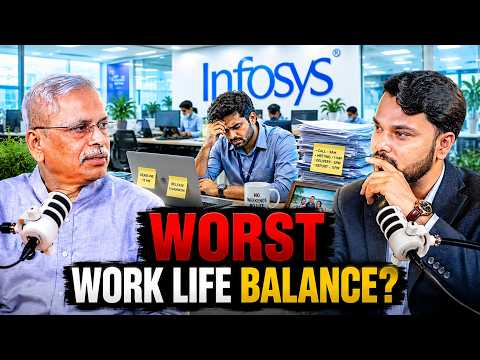
It’s not culture, Kris said. It’s a choice. It’s what senior leadership had to do to create this industry.
The Infosys co-founder was responding to the interviewer’s observation that Infosys was known as a hardworking employer. Kris rejected the framing. The hard-working culture, in his account, was not a passive quality that Infosys developed. It was a deliberate choice that senior leadership made to build the industry.
This is a contested public position. There are alternative views on work-life balance in India today.
The Two Aspects
Kris framed his position through two aspects. First, work-life balance is a mindset issue. Second, building something world-class requires 150% commitment.
The Mindset Argument
The mindset argument begins with the reality of professional learning.
You have to learn to manage your time, Kris said. In today’s world, you have to learn and do. Who makes that investment to learn? You. Nobody else can do that. There is no AI magic where they can inject knowledge into your brain.
The learning burden falls entirely on the individual. There is no shortcut. There is no way to acquire knowledge without spending time acquiring it. This time investment is on top of the work itself.
Learning and doing require additional time commitment, Kris said. And then you have to manage your family life, you have to manage your personal life.
The professional life today has three demands. Doing the work. Learning the new skills the work requires. Managing personal and family life. All three have to fit in the same 168-hour week.
Today, life is a seven by 24 thing, Kris said. In the global scenario where your clients are working when you’re sleeping, it’s possible that your sleep will also get interrupted. Work will flow into your personal life.
This is the operational reality Kris is describing. Not a policy position. A description of how time actually flows in a global industry.
His practical prescription is the give-100%-in-each-moment principle.
When you commit time to family, give it 100%, he said. Next minute you switch to a client call, give it 100%. You live in that moment. Everything you give 100%. That’s all that is possible.
Work-life balance is not about the distribution of hours. It is about the quality of presence in each moment.
The 150% Commitment Argument
The second aspect is more directly contentious.
Building something world-class requires 150% commitment, Kris said.
This is Kris’s version of the argument that his co-founder Narayan Murthy made publicly. World-class is not compatible with work-life balance in the ordinary sense of the term.
The analogy Kris uses is athletic.
Look at somebody competing in Olympics, he said. Somebody wants to become a superstar in tennis or cricket. Look at how much sacrifice they’re doing. You cannot build something world-class if you’re not willing to sacrifice something.
The Olympic athlete does not have a normal work-life balance. The tennis superstar does not have a normal work-life balance. The cricket superstar does not have a normal work-life balance. In Kris’s argument, world-class business achievement is analogous. It requires the same kind of sacrifice.
Kris explicitly aligned with Murthy’s position.
Right now we are at this stage in India as well, he said. We have to work harder. These are choices that you make.
The claim is that India, as a country building world-class capability, is in the phase where the trade-off applies. The choices belong to the individual. But the trade-off is real.
The Global Industry Context
Kris situated the argument in the specific reality of Indian IT.
Infosys has a lot of US-based, Europe-based customers, he said. Their cycle is different from India. Their hours are very different. People are developing or doing their India work at the time which is the working hour, and then they have client calls at the nighttime.
The specific reality of a services business that serves global clients is that the working day extends. India work happens in the day. Client calls happen at night. The two together are longer than a normal day.
Kris acknowledged the flexibility that has to accompany this. People take off during the daytime. They come late into the business. There are structures that companies create to help them. But they also need to be flexible.
It’s a global industry, Kris said. Any global industry today, you will encroach on some personal time.
The Culture Rejection
The most editorially distinct part of Kris’s argument is his rejection of the culture framing.
The interviewer said Infosys was known to be a very hardworking employer, and asked whether that reflected the company’s culture.
It’s not, Kris said. It’s a choice. It’s what senior leadership had to do to create this industry.
This is a reframe worth pausing on. Culture is often treated as something that exists prior to individual choices - a set of practices and expectations that shape how people work. Kris is arguing the opposite. The culture is a downstream artifact of the choices senior leadership made.
The specific implication is that the hard-working culture at Infosys, and across the Indian IT industry, is not a fixed inheritance. It is a set of choices that continue to be made. If different choices were made, the culture would be different.
It’s not just Infosys, Kris said. The entire industry is like that. TCS, Wipro, Infosys, HCL - they’re all same hardworking culture companies.
The industry-wide pattern reinforces the choice-not-culture framing. If it were just Infosys, it could be attributed to individual company culture. Because it is the entire industry, it reflects the collective choices of the founding generation of Indian IT.
The Founder Continuity
Kris closed with a specific observation about the founders.
I know all the founders, and I can tell you that they are some of the smartest people, and they’re some of the hardest working people, and they’re the people who are giving back today, and they’re still working.
The founders of Indian IT are still working. Some through their original companies. Others through philanthropy, education institutions, industry bodies, or investment work. The hard-working posture that built the industry is the posture they continue to maintain.
This is offered as evidence for the underlying position. The people who built the industry chose the hard-working path. They continue to choose it. The results speak.
The Wider Debate
The Kris position sits within a wider public debate.
Narayan Murthy sparked significant public discussion in 2023 with his statement that Indian youth should work 70 hours per week. The reaction split. Some agreed - typically founders and senior leaders of the pre-liberalization generation. Others disagreed - typically younger professionals, mental health advocates, and management thinkers who point to research suggesting long hours produce diminishing returns.
Kris is on the same side as Murthy. That is a reasonable position for him to hold given his own experience building Infosys. It is also a position with which many current Indian professionals do not agree.
The reader will have to decide where they land.
The Counter-Position
There is a coherent counter-position worth naming even if Kris does not engage with it.
The productivity research suggests that after roughly 50 hours per week, marginal returns decline rapidly. Beyond 60 hours, absolute productivity may actually decrease. The finding holds across knowledge work, physical work, and skilled trades. If it holds, the 70-hour target is not efficient. It is just longer.
The mental health research suggests chronic overwork produces measurable psychiatric consequences. Anxiety, depression, and burnout rates increase with hours worked. Family relationships suffer. Children of workaholic parents show measurable developmental effects.
The generational research suggests younger Indian professionals are less willing than their parents to trade their twenties for career advancement. This may reflect different values. It may reflect different economic realities - the current generation faces asset prices their parents did not. It may reflect both.
None of this proves Kris is wrong. It provides the context in which his position is being received. Where a listener stands on the 150% commitment claim will depend partly on whose life stage and career they think about while considering it.
What This Reveals
The Kris position offers three specific claims worth engaging with regardless of where you land.
The mindset claim. Work-life balance may be less about the distribution of hours and more about the quality of presence in each moment. This is testable in your own life. If you struggle with balance despite reasonable hours, it may be that presence, not time, is the actual constraint.
The world-class claim. Building something exceptional may require more than reasonable effort. The comparison to Olympic and sports achievement is worth taking seriously. Not everyone is trying to build something world-class. But those who are may face trade-offs that ordinary work-life balance frameworks do not accommodate.
The choice claim. Culture is not fixed. It reflects the choices leadership makes. If you inherit a hard-working culture and continue it, that is a choice. If you inherit it and change it, that is also a choice. Neither is culture. Both are choices.
Watch the full episode here:
More from the blog



Subscribe to our newsletter
The best new roles, resources and must-watch episodes — in your inbox every week. No spam, unsubscribe anytime.