
How Infosys Became a Billion-Dollar Giant? - Infosys Co-Founder
The first billion dollars in revenue took 23 years. The second billion took 23 months. The third billion took 13 months. Kris called it compounding on a real-life example.
The Infosys co-founder was walking us through the growth curve that took the company from its bootstrapped 1981 founding to its multi-billion-dollar scale in the 2000s. The numbers are worth pausing over. Twenty-three years for the first billion. Twenty-three months for the second billion. Thirteen months for the third billion.
The story of that acceleration is the story of foundation-building.
The Realization Moment
The moment when Kris first knew Infosys could get very big came after the NASDAQ listing in 1999. It was a very successful listing, he said. Infosys valuation briefly exceeded Cisco’s.
This is a piece of business history that most Indian discussions of the dotcom era do not include. Cisco was, at that time, one of the most valuable companies in the world. The infrastructure backbone of the internet itself. Infosys, briefly, was more valuable.
The 2001 crash brought the valuation down significantly. But the growth continued.
Then came the compounding.
The 23/23/13 Math
The numbers are worth saying again because they are so counterintuitive.
The first billion in annual revenue took twenty-three years.
The second billion took twenty-three months.
The third billion took thirteen months.
If you had drawn the growth curve at the twenty-year mark, you would have seen a slow-building line that had not yet crossed a billion. If you had drawn it three years later, you would have seen three billion. The acceleration in that three-year window is what defines the shape of the entire Infosys story.
Kris named the four factors that made the compounding possible.
There was demand. There was brand. There was client capability - they knew how to work with clients now. And there was operational foundation - all the work done to scale the business in the 1990s.
Four factors. Three of the four are external or accumulated. The fourth is the one worth studying.
The Foundational Work
Kris laid out what the foundational work looked like.
Recruitment infrastructure. Every hire required a system. The system had to source, evaluate, offer, and onboard at scale. Building that system took years. Once built, it could handle whatever volume the growth curve required.
Training infrastructure. Every hire required education. The education had to convert campus graduates into industry-ready engineers. Building the training program took years. Once built, it could deliver whatever volume the growth curve required.
Quality infrastructure. Every project required quality gates. The gates had to prevent defects at scale. Building the quality function took years and produced the CMM Level V certification - the highest level of software quality certification available. Once built, it could ensure quality at whatever volume the growth curve required.
Financial infrastructure. Every dollar required a finance function. The function had to manage cash, taxes, investments, reporting, and audit. Building the finance function took years and produced the 1993 IPO. Once built, it eliminated the funding constraint and allowed the company to invest as needed. Kris said the company had no debt and could invest whatever was required.
Physical infrastructure. The company moved to its own campus, then set up multiple campuses. The campuses gave the company physical space to grow into. Multiple campuses gave operational learnings that made new campuses faster to set up.
All of this happened in the 1990s.
The Payoff Sentence
All the things that were done in the 1990s helped in the 2000s, Kris said. 2000 to 2010 is where the company really scaled up.
That is the sentence.
The 1990s were the foundation. The 2000s were the payoff. The company that spent a decade building infrastructure then spent the next decade compounding on top of it.
This is the pattern that most founders want to skip. Most founders want the 2000s Infosys. They do not want the 1990s Infosys. They want the scale. They do not want the foundation years.
Kris is telling us it does not work that way. The compounding requires the foundation. The foundation requires patience. Twenty-three years of it, in Infosys’s case.
The Global Delivery Model
Before we leave the segment, one specific piece of Infosys’s foundation is worth pulling out. The Global Delivery Model.
Infosys started when computers were starting to be used in industry, Kris said. They saw that all business processes would get automated and made into computer processes. That required a lot of software to be written. They would write that software from India.
The insight was that India could be the site where software for the world was written. Leveraging Indian talent to support clients around the world using data communication links, Kris said. That was the model Infosys pioneered.
Every Indian IT services company today runs on some version of this model. TCS, Wipro, HCL, Cognizant, Tech Mahindra. Every one of them delivers global services from Indian talent centers. The infrastructure of that model - the data communication links, the client engagement patterns, the training pipeline, the quality certifications - was invented at Infosys during the ‘80s and ‘90s.
The Jayanagar Cabin
The other piece worth pulling out is the origin story.
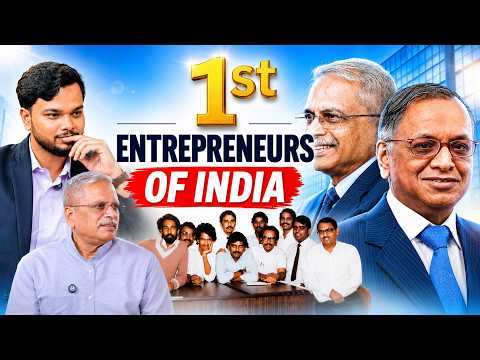
The first office was in Jayanagar. It was just one cabin. Whoever came first got the cabin. The others had to wait.
Startups today talk about how they struggle, Kris said. The Infosys founders went through that too. First generation entrepreneurs. One cabin between seven of them.
This is the same company that would eventually run multiple campuses across India. The distance between one cabin in Jayanagar and the multi-campus operational infrastructure of the 2000s is what the 1990s foundation years were used to close.
The Universal Insight
The pattern applies beyond software services.
Every industry has a foundation phase and a compounding phase. The pharmaceutical company that will scale in 2030 is doing its foundation work now. The manufacturing company that will scale in 2028 is doing its foundation work now. The financial services company that will scale in 2027 is doing its foundation work now.
The founders who understand this build differently. They accept that the first decade is about building systems that can scale. They accept that the returns are not visible in the foundation phase. They accept that the market may reward faster growth in the short term and punish deliberate foundation-building.
They accept all of this because they know what Kris knows. The compounding phase requires the foundation phase. Without the foundation, the compounding does not happen. Without the compounding, the company does not scale.
The Real Question For Founders
The uncomfortable question the segment raises is whether the modern startup ecosystem still allows for foundation-building.
Infosys had twenty-three years to build the foundation. In today’s venture capital environment, a company that took twenty-three years to reach a billion in revenue would have been considered a failure long before. Investors want faster returns. Boards want faster growth. Public markets want faster milestones.
The compression of expected timelines is one of the challenges of scaling in the 2020s. Founders who need decades to build proper foundations are competing with founders who are burning capital to grow faster without foundations. The market often rewards the second group in the short term.
But foundations do eventually matter. The 2001 dotcom crash cleared out a generation of companies that had grown fast without foundations. The 2022 tech correction cleared out another generation. Every cycle has a correction that separates the companies with foundations from the ones without.
The Kris insight is worth holding onto through the corrections. The compounding is real. But only for the companies that did the foundation work first.
What This Reveals
Three things from this segment will stay with me.
The 23/23/13 math. The compounding curve of Infosys is one of the clearest examples of what deliberate foundation-building produces. Twenty-three years of foundation. Then three billion in three years. The shape of the growth curve is the shape of the returns to patience.
The four factors that made compounding possible. Demand. Brand. Client capability. Operational foundation. Three of the four are the results of accumulated work. Only demand is external. The foundation is what allows the founder to capture the demand when it arrives.
The payoff sentence. “All the things that we had done in the ‘90s helped us in the 2000.” This is the operational summary of the entire story. Every founder should be able to write this sentence about their own company at some point. If they cannot, they are not building the foundation. They are just running the day-to-day.
Watch the full episode here:
More from the blog



Subscribe to our newsletter
The best new roles, resources and must-watch episodes — in your inbox every week. No spam, unsubscribe anytime.