
Traction, Narrative, Network: The 3 Levels of Startup Fundraising
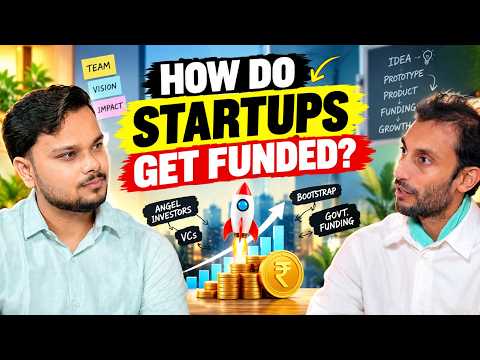
The three things investors actually check before writing you a check
Most founders think fundraising is a numbers game. Show enough revenue, enough growth, enough users, and the money follows. Nikunj Jain, laid out a more honest framework: fundraising runs on three levels, and traction is only the first of them.
Level one: traction
This is the part founders already understand. What have you built in the last six, twelve or eighteen months, and what do the numbers say. Revenue, users, retention, whatever your business runs on.
The instruction here is simple: keep your MIS clean and simple. No dressed-up metrics, no vanity numbers. Just the real picture of what the business has done.
Level two: narrative
This is where founders quietly cost themselves the most money.
Two companies with identical traction can raise at wildly different valuations, purely because one founder can articulate the vision and the other cannot.
Nikunj's framing was blunt: if you raise ten rupees at a hundred rupee valuation instead of six rupees at a sixty rupee valuation, you have effectively cut both your capital and your ownership by 40 percent, for no reason other than weak storytelling.
The work you put in does not change. Only how well you sell it does.
Level three: network
Even with strong traction and a sharp narrative, you still need to be in the right rooms. Good traction plus good articulation in front of the wrong investors gets you nowhere.
This is the piece founders tend to deprioritise, assuming the first two will carry them regardless of who is listening.
The pre-revenue problem
A large part of the conversation focused on a shift happening right now: pre-revenue fundraising has gotten significantly harder.
Most serious funds are simply not deploying capital into companies that have not shipped or sold anything yet.
Part of the reason is structural. Development costs have fallen by roughly a factor of ten, and time to build has shrunk with it.
So when a founder asks for money before building anything, it reads less like ambition and more like either a lack of conviction or a lack of creativity in finding a path forward.
Nikunj's suggested alternatives for founders who are genuinely pre-revenue:
Raise a small friends and family round, use it to build an MVP, and use that MVP to land a first few paying customers.
Build a services offering first instead of a product. Generate revenue from services, then use that revenue to fund product development.
Neither requires waiting for a large institutional check on day one.
Growth versus profitability
On the question of what investors want more, growth or profitability, the answer depends heavily on the sector.
In something like logistics, where there is no strong defensible IP, being loss-making with no path to profitability makes little sense to a serious investor.
For a company trying to clear the bar for a large check, whether from a growth-stage or series round, the question that gets asked is direct: are you growing profitably. A no there closes a lot of doors.
The creator economy exception
One genuinely new pattern came up: content creators raising very large early checks purely on the strength of their distribution.
A US-based creator recently raised fifty million dollars where the top slides of the deck were entirely about audience reach, consumption patterns, spend behaviour and platform-wise demographics. No traditional traction required.
This part of the market is still early. These creator-led companies have not yet matured to the stage of later rounds, so it is too soon to say where the ratios or the exit outcomes will land.
Right now these are largely first checks, some of them unusually large, but still an exception rather than the norm.
The takeaway
Traction gets you in the conversation. Narrative decides how much you keep for what you have already built.
Network decides whether the conversation happens at all. Founders who treat any one of these as optional are the ones who end up cutting their own deal short.
Full Podcast-https://yt.openinapp.co/r95tk
More from the blog



Subscribe to our newsletter
The best new roles, resources and must-watch episodes — in your inbox every week. No spam, unsubscribe anytime.