
Youth vs Politics: India’s Real Crisis, Corruption, IPO & Ola Scams | Jayant Mundhra
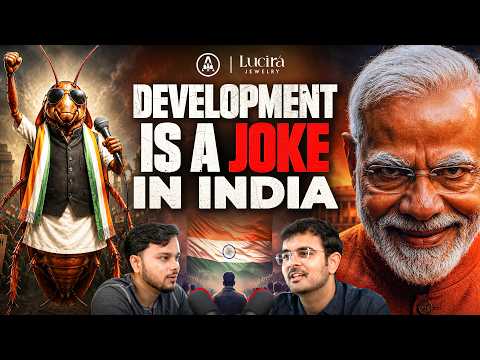
For the past year I have been carrying a vague sense that something is structurally off with the Indian growth story. We are collecting record GST. We are seeing more IPOs than ever. The headline numbers are real.
And yet.
The scooter you saved a year to buy is broken. The CM of your state is a 7th-fail with murder cases. The IPO you bought at the top is trading below your entry. The Mumbai-to-Delhi flight costs three times what a Middle East passenger pays for twice the distance.
None of these are random. Jayant connected them for me into something I am still processing.
He never used this phrase, but I am going to use it. India has three invisible taxes that nobody charges you for officially, but everybody pays.
Invisible Tax One: The Concentration Tax
In India, five cement companies control 75 percent of the total installed and under-construction capacity. In China, you need 26 cement companies to add up to the same 75 percent.
That delta is not historical accident. It is policy choice.
In China, every industry has a uniform set of rules. If you meet criteria X, you get incentive Y. No negotiation, no special tender, no carved-out provisions. The system runs without lobbying.
In India, every major incentive requires a discussion. A tender with forty criteria that conveniently match three or four pre-decided bidders. A PLI released to one company despite consumer evidence saying it should not be. A regulation that adapts itself to the size of the room.
When five players dominate, prices are not competed. They are coordinated. Every flyover you drive over costs more than it should. Every new metro line, every airport expansion, every government building. The concentration tax is hidden inside every infrastructure bill in this country.
And it works in the other direction too. Indigo flies 66 percent of India’s routes as the only airline. The next time Akasa announces a new route, watch what happens. Indigo will launch five flights between thirty minutes before and thirty minutes after the Akasa flight, each Rs 500 cheaper, for as long as it takes to make Akasa exit. Then Indigo will collapse back to two flights and reassign the rest of the planes.
This is industrial warfare disguised as competition. You pay for it every time you book a flight from Patna to Muzaffarpur and find one option. You pay for it every time the bill for the new metro line comes in 30 percent over budget.
Invisible Tax Two: The Politician Tax
Jayant said one thing I am going to be repeating for a long time.
To even contest as a single MLA in India, you need a war chest of around Rs 500 crore.
I want you to sit with that number. Five hundred crore is not the cost of winning. That is just the cost of being a credible candidate before you have asked a single person for a vote.
That number is the entire reason India cannot have honest politicians. The entry barrier is not legal. It is economic. A genuinely independent person, however talented, cannot raise Rs 500 crore. So the only people who enter politics are either born into political families or take that money from someone who will demand returns.
This is where the cement story and the politician story connect. The cement cartel and the cement-friendly politician are not separate problems. They are two ends of the same closed loop. The cartel funds the politicians. The politicians protect the cartel from competition. The loop is the system.
Once you see this loop, you cannot unsee it.
What used to puzzle me is why Indian voters keep returning the same kind of leader. Bihar has just appointed a CM who is 7th-fail and has multiple murder cases. Jayant himself is from Bihar. He has been attacked by his own state for saying this out loud. He explained the dynamic better than anyone I have heard explain it.
The issue is not that voters are stupid. The issue is that the survival economics of large parts of India make votes purchasable for a meal, a bottle, or a small one-time payment. When the voter cannot survive the week without that payment, they cannot afford to think about who their grandchildren’s CM should be. The vote is bought before the issues are even discussed.
This is harder than the corruption story. The corruption story has villains you can point at. The survival economics story has no villains. Just a long, expensive, generational policy fix that no election cycle in India can afford to begin.
The middle class often blames the voter. The voter is not the problem. The voter is what the system produces when survival comes first.
Invisible Tax Three: The Trust Tax
This is the one that hurt to talk about.
A retail investor in India is treated very differently from a retail investor in the United States. The regulator runs an honest IPO process. The exchanges work. The grievance mechanisms exist. On paper, India’s capital markets infrastructure is world-class.
In practice, the disclosure structure has gaps wide enough to drive a truck through.
The Urban Company example Jayant gave was the cleanest illustration. Their DRHP did not list Pronto or Snapdeal as competitors. The IPO went through. The very next quarter, Urban Company’s InstaHelp business reported a massive loss specifically because of competitive pressure from those two players. The competition did not appear overnight. It existed at the time of the DRHP. The disclosure structure simply did not require it to be named in time for retail investors to factor it in.
The retail investor who bought at the listing has lost money on information that should have been public.
Now apply the same lens to Ola Electric. Bhavish Aggarwal’s company spent Rs 365 crore on legal and professional fees in the last four years. Rs 111 crore in FY25 alone. The R&D spend has dropped year on year from Rs 580 crore to Rs 380 crore to Rs 320 crore. The government just released Rs 380 crore in PLI subsidies. Meanwhile, 80,000 scooters land in their service centres every single month, out of a fleet of around eight lakh.
Bhavish responded to Kunal Kamra’s expose by announcing that 99.1 percent of complaint tickets had been resolved. What he did not mention was how. The tickets were closed and then re-opened as new tickets. Same problem. Different ticket number. Same broken scooter sitting in the basement of a service centre with three more stacked on top of it.
The trust tax is what you pay when the official mechanisms exist but quietly look the other way. You pay it in your IPO subscription that loses 40 percent in a quarter. You pay it in the EMI for the scooter rusting in a service centre basement. You pay it in the news headline that tells you everything is fine.
Who actually pays these three taxes
The cruel part of the arithmetic is who carries the burden.
The Concentration Tax shows up in your home loan. When your municipal corporation pays 30 percent more for a flyover than it should, that cost is recovered through property taxes, road taxes, fuel cess. None of these are itemised. You pay them every year without noticing.
It also shows up on your flight tickets to small towns. Patna to Muzaffarpur. Indore to Khajuraho. The routes where one airline flies and the fare is whatever the airline decides. The delta between an Indian small-town ticket and a similar-distance international ticket is the Concentration Tax made visible.
The Politician Tax shows up indirectly. In the quality of your municipal water. In the speed at which a school admission gets approved depending on whose nephew is asking. In the building permission that takes three years for you and three weeks for a developer with the right phone number. It shapes the daily life of anyone trying to build anything in this country.
The Trust Tax is the easiest to count. Every Indian retail investor who bought a recent high-profile IPO at the listing price and is now sitting on losses is paying it. The Ola Electric retail buyer is paying it now. The gap between the listing price and the eventual trough is the dollar value of disclosures that should have been honest and were not.
This is not abstract. It is your salary. It is your savings. It is your scooter.
There is a fourth pattern worth naming, though it is not a tax in the same way. Jayant pointed out something casual in the middle of the recording that I have kept thinking about. The Tatas, the Birlas and the Ambanis cannot have their money stuck by the government because the system needs their participation. But the ITR refund for an ordinary salaried person can take nine months. The GST penalty for a small business that filed one day late kicks in within forty-eight hours. The asymmetry is not a bug. It is the price you and I pay for not being large enough to negotiate.
Why this matters more than the daily news cycle
The reason I am dwelling on this conversation longer than usual is that the three taxes connect.
The concentration tax produces the cement cartel. The cement cartel funds the politicians. The politicians are protected by the entry barrier of the politician tax. The politicians then deliver favourable regulations and disclosure leniency, which is the trust tax that retail investors pay.
It is not three separate problems. It is one ecosystem in three colours.
This is why incremental fixes do not work. You can clean up one IPO disclosure. You can clean up one PLI scheme. You can put one CM in jail. But unless you address the underlying loop, the next IPO, the next PLI, the next CM will arrive on schedule.
So what do you actually do
I came out of this conversation with one practical lesson and one uncomfortable one.
The practical lesson is Jayant’s twelve-month IPO rule. Every Indian IPO is engineered to look its best in the twelve months before listing. Cost cuts get applied. Competition gets hidden. Marketing spend gets front-loaded. Once the IPO closes, those decisions reverse. Wait twelve months. Watch what actually happens to the business. Then decide.
The uncomfortable lesson is harder. India is not failing for the reasons most of us were taught. The voters are not stupid. The startups are not lazy. The Modi government is not uniquely bad and the previous governments were not uniquely clean.
The system is structurally captured. By design. And the only thing that breaks structural capture is sustained political will from voters who have stopped being purchasable.
That voter does not yet exist in large enough numbers.
But the conversation about whether they should exist is starting. This podcast is one tiny corner of that conversation. Jayant’s work at Biz News Plus, Decoding the Dragon and BharatNama is another. Kunal Kamra blowing the whistle on Ola is another.
If you have read this far, you are now another.
More from the blog

Subscribe to our newsletter
The best new roles, resources and must-watch episodes — in your inbox every week. No spam, unsubscribe anytime.