
Why Infosys Co-Founder Donated ₹225 Crore?
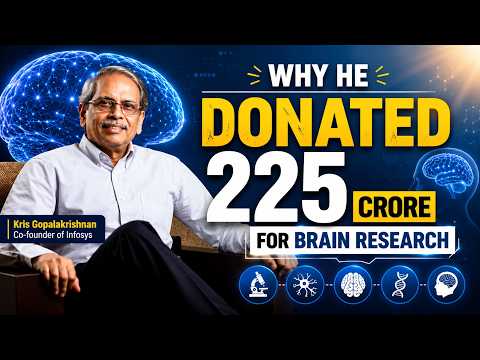
Looking at the total size of the wealth, Kris said, it was not that much.
The Infosys co-founder was responding to a question about the Rs 225 crore he had personally donated to the Indian Institute of Science - the largest cheque from an individual in IISc’s 100-plus-year history. His response was not modest false humility. It was a specific framework about how wealth relates to what it can enable.
The Donation
The interviewer laid out the specifics.
You personally donated 225 crore to IISc, right, the interviewer said. It was the biggest cheque in the 100-plus years of history of IISc from an individual. Other institutions like Tata Trust have also given money to IISc. But as an individual, yes.
The distinction between institutional and individual philanthropy matters. Tata Trust and other endowment-scale institutions have supported IISc for decades. But a Rs 225 crore individual donation is different. It is a single person’s private capital being redirected to public research.
The interviewer asked the natural follow-up.
Was it natural to you, the interviewer asked. Because it is a very large cheque, sir.
Kris’s response was unhurried.
Looking at the total size of the wealth, Kris said, it was not that much.
The framing is worth pausing on. Kris is not claiming the donation was small. He is saying that when placed against the accumulated wealth built over decades of Infosys, the donation was proportionate. This is the specific mental model of the ultra-high-net-worth philanthropist.
Plus, Kris said, it was for a very important project - which is to understand the brain.
The Mission
Kris then walked through what the money was funding.
Can we create a cure for neurodegenerative diseases like Alzheimer’s, Parkinson’s, and Dementia, Kris said, which is a problem for India and the world. So can we find a solution? That is the reason why we set up the Center for Brain Research at the Indian Institute of Science.
The Center for Brain Research is the specific institutional home for the Rs 225 crore. It exists to study neurodegenerative diseases at the intersection of biology, imaging, computation, and clinical medicine.
The research approach is worth understanding.
It is a long-term project, Kris said. They are doing a longitudinal study to look at how people age. If they develop some neurodegenerative diseases, could we have identified the problem much earlier? What are called biomarkers of incidence of a disease. And what can we do to prevent it or slow down the progression.
Longitudinal studies are the gold standard for aging research. You take a large cohort of participants, follow them over years or decades, measure biomarkers regularly, and track who develops disease. The findings tell you what early signals predict later disease.
This kind of research is expensive. It takes decades to produce results. It does not translate to a product easily. Which is exactly why philanthropic capital is the right funding source.
The R&D Gap
Kris then extended the personal donation to a national argument.
Actually, Kris said, there should be a lot more donation, and even the capital coming into research and development, which is very much lacking in India. It is around 0.7% of the GDP.
The 0.7% figure is well documented. India’s gross expenditure on R&D as a percentage of GDP has hovered around this level for years.
The interviewer offered the international comparison.
Largely the worlds, and China and the US, they do even 3-4% and plus, right, the interviewer asked.
Kris confirmed.
Yes, he said.
The gap is not marginal. If India were spending 3% of GDP on R&D, it would be spending roughly four times what it does today.
The IP Crisis
Kris then reframed the R&D gap as a specific strategic problem.
India does not own many of the technologies that we use, Kris said. IPs are not ours.
This is the sentence that captures the entire argument. India, despite being the world’s third-largest economy by GDP, does not own the intellectual property of most of the technology its citizens use every day.
Look at everything we use on a daily basis, Kris said. The phones, the watches, everything we use. If you look at the equipment that you are using to record this podcast, and the components inside - those will also be imported.
The point is worth sitting with. India runs on foreign IP. The mobile phone, the laptop, the operating system, the semiconductor, the video codec, the display panel - each of these depends on IP owned by companies in the US, Korea, Japan, China, Taiwan, or Europe. India’s role is often assembly, service delivery, or software customization.
Kris named the solution.
So we need to own IPs, Kris said. That will happen only through technologies that are created from research. Which then we patent or which we protect. So we have to invest in research.
The chain is straightforward. Research produces inventions. Inventions become patents. Patents become protected IP. Protected IP becomes strategic and commercial power. India has skipped the first step.
The Strategic Reality
Kris then added the geopolitical dimension.
It is also becoming very strategic for the country, Kris said, because denial of technology is a reality today.
The reference is specific. Technology export controls have become a mainstream instrument of geopolitical strategy over the last decade. Countries are increasingly willing to deny each other access to specific technologies as a form of leverage.
Kris gave two examples where India successfully responded to denial.
For example, ISRO suffered, Kris said. They were denied access to many of the space technologies that are required. So we had to domestically build those capabilities. But then ISRO succeeded. That gives us confidence. Same thing in nuclear energy also. We had to build our own domestic capabilities.
Both examples are historically accurate. India’s space program was denied access to cryogenic engine technology and various other components at critical points. Rather than accepting this as permanent, India built the capabilities domestically. ISRO now conducts missions that few countries can match, at a fraction of the cost.
The Proactive Call
Kris then made the constructive argument.
So why don’t we proactively build the next generation of technologies, Kris said, which will then make sure that the situation we are in today is not continued in the future.
The word “proactively” is the specific reframe. India has historically responded to technology denial after it happened. Kris is arguing for building the next generation of critical technologies before denial happens.
What This Reveals
Three things from this segment will stay with me.
The wealth-to-cause ratio. Kris’s framing that Rs 225 crore was “not that much” relative to his wealth is a specific mental model for large philanthropy. Donations are evaluated as fractions of total accumulated capital, not as absolute amounts.
The research funding argument. India’s 0.7% GDP on R&D is a structural constraint on every downstream ambition the country has. Without more capital committed to research, the downstream ambitions cannot be sustained.
The IP self-critique. “IPs are not ours” is a direct statement from one of India’s most successful technology entrepreneurs. It captures a specific truth about India’s technology consumption relative to its production.
The Universal Insight
The Kris framework has implications beyond India.
Every country that aspires to technology sovereignty faces the same equation. Sovereignty is downstream of IP ownership. IP ownership is downstream of research capability. Research capability is downstream of sustained funding.
The Investment And Policy Implications
Kris’s framework points to specific opportunities.
Areas where India has strong indigenous IP creation - space technology, pharmaceuticals, certain segments of software - are exactly the domains where global competitiveness has followed. These are proof-of-concept cases for what happens when domestic research is sustained.
Areas where India has almost no indigenous IP - semiconductors, display technology, advanced materials, most consumer electronics IP - are exactly the domains where the country runs a large import bill.
The policy prescription that follows is straightforward. Increased R&D spending, protected research funding across political cycles, and incentives for domestic patent generation. The Kris donation is one philanthropic example. What is needed is a systemic shift in how research is funded and protected.
The Real Question For Readers
The uncomfortable question the segment raises is what you would do with your accumulated capital if you were operating with the same framework.
If you are an entrepreneur who has built wealth in the Indian technology ecosystem, the Kris model suggests that a meaningful percentage of that wealth belongs to research funding for the next generation. Not because it is required. Because it is what makes the next generation of Indian entrepreneurs possible.
Watch the full episode here:
More from the blog



Subscribe to our newsletter
The best new roles, resources and must-watch episodes — in your inbox every week. No spam, unsubscribe anytime.