
Ola Par Blind Trust Kyu: Jayant Mundhra
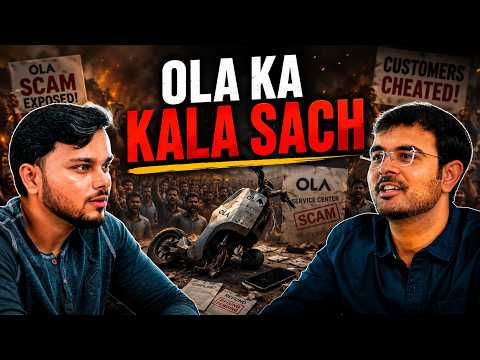
Jayant Mundhra is openly biased against Ola Electric. He says so himself, at the start of this segment of our podcast. “You can say I am biased. I myself say I am biased. Do not believe me. If my arguments have weight, ask your own questions.”
I want to keep that framing intact because it matters. What follows is his analysis of Ola Electric, sourced from the company’s own annual reports. It is presented for your scrutiny. You should verify the numbers. You should make up your own mind.
What I can say is that I have not heard a more numbers-driven independent critique of an Indian listed startup in the past year. The clip itself is worth watching. This piece is my attempt to walk through what Jayant is actually saying, separated from the heat.
The Setup
Jayant has been one of the most sustained independent voices analysing Ola Electric. He has been doing this for over a year now, through videos, WhatsApp insights to his 45,000 daily readers, and podcast appearances like this one.
His core claim is that the gap between Ola’s public narrative and the financial reality in its filings is widening. He uses the word “scandal” repeatedly. He is direct about what he believes is happening.
I want to walk through five specific claims he made on the podcast. Each one is testable. Each one is sourced. Together, they form the case he is making to the public.
Claim One: The R&D Narrative
Ola has positioned itself, publicly, as an R&D-driven company. Bhavish Aggarwal regularly speaks about cells, batteries, motors, indigenous technology, and the deep capabilities Ola is supposedly building.
Jayant’s claim is that the R&D narrative does not match the spending.
“818 patents have been filed. Only about 25% have been granted. And of the ones that were granted, many of the meaningful ones came from Ettergo.”
Ettergo is the Dutch electric scooter company Ola acquired. Patents that already existed in that portfolio transferred through the acquisition. Jayant’s argument is that some of the patents being counted in Ola’s portfolio are not original R&D output. They are inherited intellectual property.
The harder number is the spending trajectory.
“Three years in a row, the R&D spend has been falling. Around 580 crore. Then 380 crore. Then in FY25, around 320 crore. The number of announced projects keeps growing. The money keeps shrinking.”
A declining R&D spend, in an industry where every comparable player is increasing R&D investment, is unusual.
The harder claim is about the IPO.
“In the IPO, they raised money. Around 800 or 1200 crore was earmarked for R&D. Then they changed it. Now they are using it for debt payment.”
This is a specific, testable claim. It is in the IPO documents. The use-of-funds statement is a regulatory disclosure. Any reader can verify whether the original allocation was changed and where the funds were redirected.
Claim Two: The Service Crisis
The second claim is about the consumer service infrastructure.
“Last year, when I started raising this issue, the numbers were 80,000 scooters per month going into Ola service centres. Out of around 8 lakh scooters sold.”
Eighty thousand divided by eight lakh is ten percent. By Jayant’s read, a tenth of the active fleet was in service every month.
When the Consumer Protection Authority of India (CCPA) eventually intervened, Bhavish Aggarwal responded by claiming 99.1% of service complaints had been cleared overnight.
Jayant’s analysis of that claim is structural.
“When you complain, the company raises a ticket. The ticket stays active until the problem is resolved. They closed the old tickets and opened new ones. So 99.1% of the closed tickets were closed. The underlying problems were not solved.”
This is a specific operational claim. Either the tickets were closed without underlying resolution, or they were not. The CCPA would have access to the data. The public claim of 99.1% resolution is the version the consumer sees on press releases.
Claim Three: The Moti Nagar Centre
The most visceral part of the segment was the description of the physical service centres.
“Go to any Ola service centre. Scooters are stacked on top of scooters. Go to the Moti Nagar centre in Delhi. Ground floor and basement. In the basement, scooter on top of scooter, on top of another scooter.”
He challenged the listener directly.
“Would you accept that from Maruti? If you took your car in and saw another Alto stacked on top of it, would that be okay? It is not a maintenance setup. They have nowhere to put them. They are piled up. What would you call this?”
This is not a number. It is an observation. But it is observable. Anyone can go to the Moti Nagar centre. Anyone can document the conditions. There are, by Jayant’s claim, multiple YouTube videos already doing so.
Claim Four: The Consumer Voices
The most emotionally heavy part of the segment was when Jayant pulled out his phone and started reading messages he has received from Ola customers.
“Brother, please raise your voice for me too. I gave my scooter eight months ago. It has not come back. When I went to check, the tyre was missing and some parts have been used in another scooter.”
“Brother, I have filed a complaint with the Consumer Protection Cell. I keep going to the case. Their lawyer never comes. Every time a new date is given.”
“I am calling from Thane. My scooter is sitting at their store. The store has been closed for eight months. Please help. How will I get my scooter back? I bought it with so much hard work.”
Jayant’s broader point about who is being harmed was sharper than any of the financial numbers.
“For most of these people, this is their first two-wheeler. They saved for months. They took EMIs at high interest rates because they are in a risky segment for lenders. They put their full earnings into this scooter, hoping to graduate from cycling to delivery jobs.”
A scooter, for this consumer segment, is not a convenience. It is a livelihood investment. Eight months of a scooter sitting in a closed service centre, for someone who needs it for daily work, is not a customer service failure. It is a livelihood failure.
Claim Five: The 365 Crore Lawyer Bill
The financial claim that hit hardest was about legal spending.
“FY25, they spent 111 crore on legal and professional fees. In the last four years, 365 crore on lawyers.”
This number is in the annual report. It is a line item. Jayant’s analysis is that this scale of legal spending creates an asymmetry between the company and anyone who would take it on.
“People say if the scooters are so bad, why don’t they get sued? Cases are happening. You don’t hear about them because the lawyers are too many.”
The litigation strategy, in his telling, is not just defensive. It functions as a moat. It funds the long-form management of complaints. It allows individual cases to be outlasted. It creates a structural advantage that has nothing to do with product quality.
The Closing Inversion
Jayant ended the segment by inverting the word “anti-national” that some Indian politicians use freely.
“Some leaders use the word anti-national very easily. This is what anti-national looks like. Not serving the country. Making fools of the country’s people and putting their money in your pocket. This is a crime, and the people who should be holding it accountable are sleeping on it.”
This is a strong characterisation. It is also a deliberate one. Jayant is reclaiming a word that is usually weaponised against critics like him and turning it back on the kind of corporate behaviour he believes does more material harm to Indian citizens.
Some readers will find this rhetorical move powerful. Others will find it too far. Either way, it is the closing argument of his case.
A Word On Method
Two things should be said about the segment as a piece of analysis.
Jayant’s transparency about his own bias is unusual. Most commentators do not announce their priors. He opens with his. That gives the listener a frame for the rest of the argument.
His reliance on annual report numbers is verifiable. He is not making claims that require trusting his sources. He is citing public filings. Any listener can pull the same documents and check.
These are the kinds of methodological habits that should be more common in Indian business commentary. Whether or not you accept his conclusions, the way he is making the argument deserves respect.
What I Took Away
The IPO redirection. If money raised for R&D was actually used for debt payment, that is a serious deviation from a public commitment. It deserves regulatory scrutiny.
The 365 crore legal spending. The scale of it is staggering for a company of Ola’s stage. It changes the asymmetry between the company and its critics.
The consumer voices. The people whose scooters are stuck for eight months. The people whose parts have been cannibalised. The people who saved for months to buy their first two-wheeler. These are not edge cases. They are the constituency bearing the cost.
You may agree with Jayant. You may disagree. Either way, the segment deserves engagement on its evidence, not dismissal of its messenger.
Full Episode:
More from the blog


Subscribe to our newsletter
The best new roles, resources and must-watch episodes — in your inbox every week. No spam, unsubscribe anytime.