
Modibhakts Won't Like This: China Won, India's 2% Unemployment & The Hard Truth | Jayant Mundhra
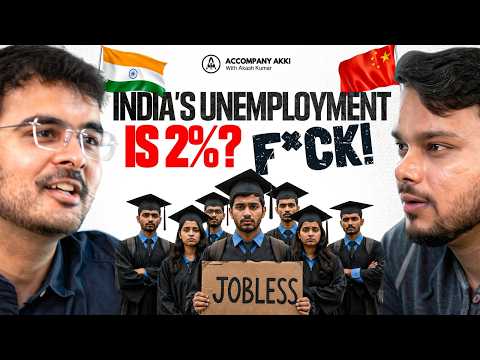
What a China analyst, geopolitics writer, and business builder taught me about India’s benchmarking trap, the unemployment lie, and why boycotting China is the biggest fiction we tell ourselves.
A conversation with Jayant Mundhra, Chief Builder of Biz News+, Decoding the Dragon, and BharatNama.
There is a sentence that makes Jayant Mundhra genuinely angry.
It is not a sentence about poverty or corruption or infrastructure failure. It is a sentence most Indians consider a source of pride.
We are the fastest-growing major economy in the world.
“The moment we started saying that,” he told me, “we stopped thinking about going beyond it. We declared victory. Fastest growing. That is it. Taaliyaan bajao. Story over.”
The problem: at the same time India was celebrating this sentence, China spent an entire decade growing at ten to fifteen percent a year. In one year, eighteen percent.
Did any Chinese official go on television and say we are the fastest growing major economy?
No. They went back to work.
The result: today 65 percent of China’s population is urbanized. 56 percent of their population is middle class or above. Meanwhile, the poorest tier of Chinese citizens that Indian commentators like to point to as evidence of Chinese failure has a per capita income of $2,000. The per capita income of Uttar Pradesh is $1,200.
“So you want to talk about their 600 million poor people? Their 600 million poor people earn more than UP. That is your comparison. Think about that.”
Part 1: The Unemployment Number That Is Not an Unemployment Number
Before we talk about China, Jayant wants to establish something about how India measures itself.
Union Minister Mansukh Mandaviya publicly stated that India’s unemployment rate is 2 percent. The Modi government’s own data puts it at 4 percent. The World Economic Forum agrees with the 2 percent figure. Everyone is citing numbers. Everyone is satisfied.
Here is what those numbers actually measure.
The government surveys a sample population. The question being asked: did you work for even one hour in the last week?
Not one day. One hour.
“So if you are sitting at a tea stall, smoking your bidi, you have been sitting there for a week, and a shopkeeper walks up and says hey can you help me load goods from my warehouse to a truck, one hour’s work, I’ll give you Rs 200. If you do that, you are employed. According to the government of India, you are employed.”
He is not making this up. He is using the government’s own methodology, which tracks the same ILO definition used internationally. The problem is not that the definition is wrong in isolation. The problem is that when a KPI becomes the goal rather than a proxy for the goal, people stop solving the actual problem.
The actual problem, according to NITI Aayog’s own numbers, is this: India needs to grow at 12 percent per year, on average, consistently, for twenty years. Only then will the employment problem be solved. Only then will enough people have meaningful, dignified, sustainable work.
India is not growing at 12 percent.
“But nobody is talking about that. Because the official number says 2 percent unemployment. So there is nothing to solve.”
Part 2: Everything Around You Is Made in China
Jayant did something at the beginning of our conversation that I want to try to recreate in words.
He pointed at the camera recording us. Sony. Made in China.
The Hitachi AC above us. The compressor: China.
The watch on his wrist. Samsung. Made in China.
The tripod holding the camera. China.
The acoustic pads on the walls for soundproofing. China.
“So tell me. How exactly are we going to boycott China? Tell me seriously.”
After the Galwan Valley incident in 2020, boycott China was a massive trend. It felt righteous. It felt patriotic. It was, in his view, largely fiction.
Not because the sentiment was wrong. Because the infrastructure to back the sentiment did not exist. You cannot boycott a supplier when you have no alternative supplier. You cannot replace a supply chain that took thirty years to build by changing your Twitter bio.
The honest version of the boycott China conversation, he argued, is a twenty-year project. Not an announcement. A plan.
China did not announce a boycott Japan and Korea mission. They simply built capability over thirty years to replace Japanese and Korean goods. Today Japan and Korea have been replaced in most product categories. China did it quietly, systematically, by subsidizing industries, by building infrastructure, by training people.
One data point that he finds both humbling and instructive: from 1981 to 2022, China sent 22,000 bureaucrats to Singapore for training. They looked at Singapore, a tiny island with fewer people than Mumbai, and said we can learn from this. We are going to learn from this. We will send our people there until we have absorbed what they know.
“And we say we cannot compare India to Singapore because Singapore is a small island. That same small island taught China how to build a modern state. And we think we are above learning from it.”
Part 3: The BYD Lesson India Has Not Learned
From 2015 to 2020, the Chinese government gave BYD, the electric vehicle manufacturer, approximately 5.5 billion dollars in subsidies.
That is roughly Rs 45,000 crore to a single company over five years.
India’s entire automotive sector PLI scheme is Rs 42,000 crore.
BYD used that support to build technology, scale manufacturing, and develop a supply chain that now makes cars so compelling that even with Indian government restrictions blocking their factory setup, BYD vehicles are selling well in India.
“They gave one company more money than we gave our entire automobile sector. That is what capital allocation at scale looks like.”
The key word for Jayant is allocation. A government’s most important job, like a startup founder’s most important job, is deciding where to put capital such that the capital generates more capital. India spends roughly Rs 5.5 lakh crore a year on subsidies. Some of those subsidies are essential. Many, he argued, are not. They are electoral tools, not economic investments.
“Take the unnecessary ones and put that money into industries. Into startups. The government’s fund of funds for startups is Rs 10,000 crore. It should be Rs 1 to 3 lakh crore. Every year. Put crazy amounts of money into startups. 100 will fail, 4 will survive, those 4 will be engines of growth. At India’s scale, those 4 become 16,000.”
Part 4: The Business Bank Account That Took One and a Half Months to Open
Jayant recently went independent. He needed a current account.
What followed was a process so labyrinthine that it deserves to be described in full.
He started with Kotak. Ten days in, a call comes. Sir, you have not told us where your income will come from. He explains: clients. What kind of work do you do for them? Consulting. Do you have foreign clients? Not currently, but I hope to one day. That is the goal. Bring foreign money into India.
The banker says: then you cannot use this account for foreign receipts.
He asks why. The banker says the government does not allow it through this account type. He asks what account would allow it. The banker says he will find out.
One more week passes.
“People open accounts in foreign countries in four hours. I needed one and a half months for a basic current account in my own country. And I was being told I could not bring foreign money into India through it. The government wants foreign exchange. I am trying to bring foreign exchange. And they are blocking me.”
He then described the GST filing experience.
You generate a challan on the GST portal. You attempt to pay via net banking. If your payment fails for any reason, including an incorrect password entry, the entire challan is voided. You start over.
Once payment succeeds, the GST portal does not automatically record it. You must manually submit proof of payment to the same portal that just received your payment. The portal does not know its own payment went through.
Additionally, if you try to pay from your company’s current account, the portal does not accept corporate net banking. You must pay from a personal account, undermining the entire point of having a business account.
“This is a system designed to require a CA’s involvement. Which means if you are a small business operator without the money or knowledge to hire a CA, you are stuck. And if CA fees are a burden, that is a barrier to formalization. You have just made informal business more attractive.”
The deeper point: every one of these friction points is an opportunity for someone to take something from someone else. The customs officer holding a shipment for six weeks until a company’s announced product launch approaches is not a coincidence. The municipal corporation that demolishes a banquet hall and then allows it to reopen a week later has not discovered it was built legally. Money was paid. The system was used as designed.
“Business people in Tamil Nadu and Gujarat will tell you: yes, you have to pay there too. But you pay once and then you do business in peace. Here you do not know when the next visit is coming and what it will cost.”
Part 5: Corruption Is Not a Government Problem
He made a point that I think most people are unwilling to make about themselves.
Corruption in India is not a failure of government alone. It is a societal condition that runs from the top to the smallest transaction.
A small shopkeeper who offers to skip the receipt for a cash discount is participating. The same person who rails against politicians on social media is doing the same thing at a smaller scale.
“Adani and Ambani are corrupt at their scale. Politicians are corrupt at theirs. The shopkeeper is corrupt at his. And we are corrupt at ours. All of us.”
He brought this home with a clean observation: our patriotism surfaces for cricket matches and military conflicts. The rest of the time, every participant in the Indian economy is extracting from it what they can, as efficiently as they can.
“We are all drinking from this country. Every one of us. Including me. Including you. And then we get angry at whoever is drinking more.”
He was careful to distinguish this from hopelessness. India, he pointed out, is an extraordinary story not of a well-functioning system but of a population that continues to create, build, and sustain lives in spite of a deeply extractive system.
“Taaliyaan honi chahiye har ek value creator ki. Be it the farmer, the daily wage worker, the small business owner. They are doing all of this in a system that is actively working against them. That is not sad. That is extraordinary.”
Part 6: The Human Cost of Leaders Who Are Never in Danger
The conversation moved to geopolitics, and Jayant was unusually blunt.
He described watching the India-Pakistan tensions of recent weeks, receiving daily calls from family in Rajasthan asking if everything was okay, watching people in border regions live with the kind of fear that urban Indians only experience briefly and at a distance.
“How do people in Lebanon live like this every day? How? Imagine waking up every morning not knowing if your building will still be there by night.”
On the Israel-Gaza-Iran situation, he made an observation that transcends geopolitical alignment: the decisions that create civilian casualties are made by people who are never in danger from those decisions. Netanyahu is not in a building when a hundred buildings come down. Trump is not in the room when children are killed.
“Marta aam aadmi hai. Chahe Israel ka ho, Palestine ka ho, Iran ka ho. Decisions le rahe hain wo log jinhe koi chhu nahi sakta.”
He also noted Iran’s surprising military capability, which he said had caught most observers off guard. A country under decades of sanctions, isolated from global technology markets, had built weapon systems capable of directly challenging world-class military powers and destabilizing the economies of its regional neighbors.
“So much to learn from. Not about war. About building capability under constraint. They built this with nothing. With less than nothing. Under sanctions.”
Part 7: 10,000 Hours and a Dead Father
Near the end of our conversation, I asked Jayant how he became the kind of person who thinks about these things at this level of depth.
His answer was personal in a way I did not expect.
When his father died in 2014, Jayant was in college. He did not know how to process it. He started writing. Not writing for an audience or for analysis. Writing as a way of talking to his father. He would write about his day, about a girl in class who wore something pretty, about something a professor said that annoyed him.
“I was telling my father everything. That is how the writing habit started. I did not know it would become this.”
But the deeper answer was about a conviction he has held since before he understood it fully.
“My parents are Sheela and Niranjan. They sacrificed and struggled for decades. I was very clear from early on: I was not born to be average. They did not do all of this for me to be average.”
He did not pursue this conviction through studying hard or following a mapped path. He dropped engineering mentally within weeks of arriving in college. He did not know what he wanted to do. He just knew he was going to do something at an extraordinary level.
His formula, as he articulated it: find the thing you can do at India’s top 0.01 percent. The thing where if you went all in, you would have no real competition. Then put 10,000 hours into it.
“Hours hain sabke paas. Talented nahi ho toh ghabraaiye mat. Hours lagao. Better bante jaaoge.”
He has used this formula multiple times across different domains: writing, business analysis, content creation. Each time the result has been the same. Go deep enough in anything and the returns become extraordinary.
The One Thing
If there is a single insight running through everything Jayant said, it is this:
India’s deepest problem is not corruption or infrastructure or unemployment. It is a benchmarking problem.
We have set our benchmark at the wrong level. We celebrate being the fastest growing major economy and stop there. We compare ourselves to Pakistan and feel satisfaction. We measure employment by whether someone worked for one hour in a week and call it success.
China’s benchmark has always been: what would it take to be the best? Not the best emerging market. Not the fastest growing major economy. The best.
They sent 22,000 bureaucrats to Singapore because Singapore was the best at building a modern state. They subsidized BYD until it was the best at electric vehicles. They built supply chains until they were the best at manufacturing.
The good news, as Jayant sees it, is that this is a mindset change, not a resource constraint. India has the capital. India has the population. India has the entrepreneurs. What India is missing is the willingness to look up instead of sideways.
Look up. Learn from the best. Build toward that standard.
Everything else follows.
More from the blog



Subscribe to our newsletter
The best new roles, resources and must-watch episodes — in your inbox every week. No spam, unsubscribe anytime.