
WhatsApp pe 'You're Fired' - Yahi hai Startup Culture? Controversy ki Full Story - 2.5M Views
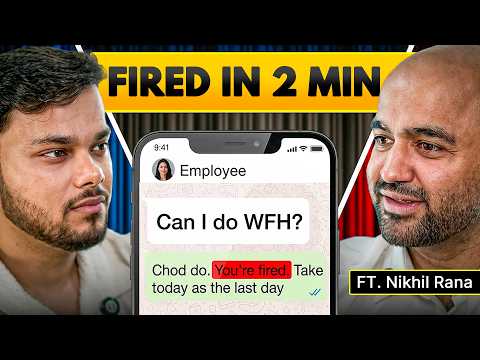
He Fired Someone on WhatsApp 50 Minutes Before an Event. Then the Internet Lost Its Mind.
What the founder behind India's most controversial startup firing taught me about trust, ownership, and why skill is the last thing that gets you hired
A conversation with Nikhil Rana, Founder of The 15, a curated community for India's most ambitious founders.
There is a moment in every founder's life where they do something that looks brutal from the outside and obvious from the inside.
For Nikhil Rana, that moment was a two-line WhatsApp message fired off at 3:10 PM on the day of an event he had invested his reputation in building.
The message told his early team member she was done. No call. No exit interview. No notice period.
Within hours, a commentator named Ravi Handa posted it on LinkedIn. Then someone else picked it up. Then someone posted it on Twitter. Two million impressions in three hours. The Hindu. Hindustan Times. Reddit threads. Comments calling him an idiot, a rich spoiled brat, a bald egomaniac.
Nikhil was not panicking. He was watching his phone with mild amusement.
"I look down upon it," he told me. "What is your existence? That you are writing something without thinking? I was laughing the whole time."
This is that story.
Part 1: The Context Nobody Had
Before the firing, there was a week.
Nikhil had spent 13 to 14 hours over the previous seven days with this person. Not because he had nothing better to do. Because he genuinely believed in her. She was smart, had a hustler background, came with a good story, and had bought into what he was building.
Those 13 hours involved long feedback sessions, analysis of what was holding her back, equity discussions, and patient explanations of how early-stage startups actually work.
On equity: "I told her you can have 5 percent but it will vest. Equity always vests. Mark Zuckerberg vested his equity on his first raise. Any VC will vest your equity. That is how it works."
She agreed. They were aligned. The next day there was an event.
This was not a small event. He described the financial investment as equivalent to what an average Indian earns in a year. More importantly, his reputation was on the line. The entire value proposition of what he was building rested on attendee experience. He personally asks every guest at his events twenty times if they have had a drink, if they have eaten, if they are comfortable.
Her role at the event was not optional. It was essential.
He had told her to arrive at 2:00 or 2:30. The event started at 4:00. She had a pattern of arriving two to three hours late. He had given her the benefit of the doubt, every time.
At 3:10 PM she sent a message: "I tried but I cannot come. Let me know what I can do remotely."
What can you do remotely at a physical event? Make drinks from home on a video call?
He fired her two minutes later.
Part 2: Why He Did Not Call First
The most common critique in the comment section was that he should have called her first. Found out what happened. Given her a chance to explain.
His response is rooted in years of reading people.
"When someone is genuinely sick, they call. They say hey I have a fever, I am not going to make it, here is how we handle it. They are not scared of the phone call."
"When someone is lying, they text. Because acting over text is easy. Acting on a call is hard."
He has managed enough teams to know the difference between someone whose excuse is real and someone who is relieved to have found an exit. The message was not from someone who wanted to fight for her job. It was from someone who had already mentally checked out.
And after the firing, she never replied. Not to contest it. Not to explain. Not to say you are wrong, here is what actually happened.
He sent another message the next morning offering a feedback call. No response.
"What kind of founding team member is offended and then disappears without a word? That tells me she wanted out."
He is not without self-awareness here. He acknowledged in front of me that there is a possibility he was wrong. A genuine emergency could have happened. His point is not that he was certainly right. His point is that based on everything he knew about that person and that week, he made a calibrated decision, not an emotional one.
"There was no ego when I typed that message. There was no anger, no frustration. There was an approval in my own head. I had already thought: if this happens, I am done."
Part 3: Notice Periods Are Theater
The comment section also erupted about the lack of a notice period.
Nikhil had a simple response: notice periods are a compliance exercise for listed companies with public shareholders and regulatory obligations. For an early-stage startup with four people, there is nothing to transfer. There is no institutional knowledge sitting in someone's head that needs weeks to migrate.
"Talk to employees honestly. They brag about notice periods. I'm going to work from home for 20 days, I'll moonlight on the side, I'll chill. Everyone knows it."
He acknowledged that for certain companies at certain stages, knowledge transfer is genuinely necessary and notice periods serve a real purpose. That period should probably be ten to fifteen days maximum.
But using notice period as a shield for inaction or poor performance is something he has zero patience for.
Part 4: The Hierarchy That Actually Determines Who Gets Hired
This is where the conversation moved from the specific incident to something I think is genuinely useful for anyone building a career.
Nikhil has a clear framework for what he values in people, in order.
Will comes first. Does this person actually want to work? Not want the title, not want the equity, not want the lifestyle. Do they want to do the actual work?
He made a comparison to fitness. Everyone knows how to get a six pack. Eat less, exercise more. Almost no one does it. Why? Because it requires doing something. "Doing is the biggest problem for humans."
Ownership comes second. Does this person treat their responsibilities as if the consequences belong to them? His analogy was parenting: the best employee is like the child who becomes independent enough that their parents stop worrying. Not the most talented child. The one who handles their life without needing constant attention.
Accountability comes third. When things go wrong, does this person acknowledge it, explain it, and course-correct? Or do they disappear into excuses?
Skill comes last.
"Skills are commoditized. They have been for fifty years. If you have incredible skills but no will, you are useless to me. If I take you to the Olympics and you do not run, what was the point of your training?"
He spent years in sales and was told by his first manager to quit and do something else. He went on to close Rs 300 to 400 crore in business across his career. The manager was wrong. Nikhil was right about his own potential. He knew because he trusted the compounding effect of consistent hard work over time.
Part 5: What the Internet Actually Revealed
When the post went viral, Nikhil watched the comment section with the detachment of someone who had already made peace with being misunderstood.
What he observed was not outrage about his specific decision. It was the accumulated frustration of people stuck in lives they cannot seem to change, finally finding a target.
Jobs are scarce. The jobs that exist often feel exploitative. AI is replacing roles that used to be entry points. And then a story surfaces about a founder firing someone on WhatsApp and suddenly there is a villain, a narrative, a place to deposit all that frustration.
He does not dismiss the frustration. He thinks it is real. He just thinks the outlet is wrong.
"You are typing long paragraphs in a comment section about me. Your situation is the same as it was before you typed them. Your situation will be the same after. What did you change?"
He was also struck by how nobody in the entire avalanche of commentary asked a simple question: Nikhil, share your full story. We will read it and then decide.
Not one person.
"That is the most telling thing. Not that they judged. That they did not want more information before judging."
He referenced a line he had recently read: the most intelligent person is the one willing to update their opinion in real time based on logic and facts. Strong opinions, yes. But loosely held. If you can give him a rational argument, he will change his view immediately. That is not weakness. That is how thinking actually works.
Part 6: What Founders Owe India and What India Owes Founders
Nikhil made a point near the end of our conversation that I think rarely gets said plainly.
India is currently referred to in global forums not as India but as China Plus One. As a backup option. A contingency plan for when China becomes too complicated.
That is the national starting position. And from there, the path forward runs through people who build businesses, not people who consume content.
"When ten people build businesses and those ten become twenty and thirty, GDP grows. When GDP grows, per capita income grows. When per capita income grows, the person sitting at two dollars a day goes to three, then four, then ten. Everyone benefits."
Calling founders idiots or egomaniacs on the internet is not neutral entertainment. It raises the psychological cost of building something. It makes the next person slightly more afraid to try. And that fear compounds into fewer businesses, a smaller economy, and slower growth for everyone including the person leaving the comment.
His message to anyone watching: if you will not build yourself, at least do not knock down the people who are trying to build. Empathy costs nothing and its effects, at scale, are real.
Part 7: The Thing He Actually Built
This is where the conversation shifted from controversy to creation.
Nikhil noticed something about founders that nobody was solving for: they are profoundly alone.
A founder grows faster than almost anyone in a normal professional track. Every six to eight months they are a different person with different problems. Their old friends are still in the same jobs talking about the same things. Their team cannot see their vulnerability. Their investors want results. Their partner is doing their best but does not fully understand.
The founder has no peer group.
So Nikhil built one. He called it The 15.
The model is simple. Every cohort has fifteen founders. He puts you in a group of fifteen people who are at a similar or slightly more advanced stage than you. For twelve months you do one activity together every month. Some months it is something physical: yoga and brunch, golf, horse riding, go karting. Some months it is intellectual: a session on go to market strategy, a speaker flown in from Silicon Valley on AI, a deep dive on a specific problem.
Every quarter, your group of fifteen meets with the other groups in your city. Every year, all the cohorts across India gather.
The pricing is tiered from Rs 2,000 to Rs 6 lakh annually, depending on the stage of the founder.
"A seed stage founder and a Series A founder have completely different problems and different capacities. We price accordingly."
The first cohort launches in June. Six of the fifteen spots are already filled.
He described a founder who joined the club, went to one gathering, met another founder two years ahead of him on the same journey, had one conversation, and resolved a hiring problem that had been stuck for weeks.
That is the product. Not networking. Not content. A peer group that actually understands what you are going through.
The One Thing
If I had to reduce everything Nikhil said to one idea, it is this:
Context is not a luxury. It is the minimum requirement for a judgment to mean anything.
When you see a WhatsApp firing, you see two minutes. You do not see the thirteen hours. You do not see the equity conversations, the feedback calls, the pattern of lateness, the event investment, or the silence that followed.
The internet runs on the absence of context. It thrives on partial information, because partial information produces the strongest emotions and the most engagement.
Nikhil's firing may have been right or wrong. The people who know enough to say are the people who were in that week. Everyone else is just pointing at a headline.
The same is true in reverse. When you see a founder's public moment of confidence or aggression, you are not seeing their dry eyes from fourteen-hour days, the pressure of investor expectations, the loneliness of being the person everyone else looks to, and the private cost of every public decision.
Seeing the full picture does not mean agreeing with it. It means you have earned the right to an opinion.
More from the blog

Subscribe to our newsletter
The best new roles, resources and must-watch episodes — in your inbox every week. No spam, unsubscribe anytime.