
The Harsh Truth About India's Job Market - Saurabh Mukherjea
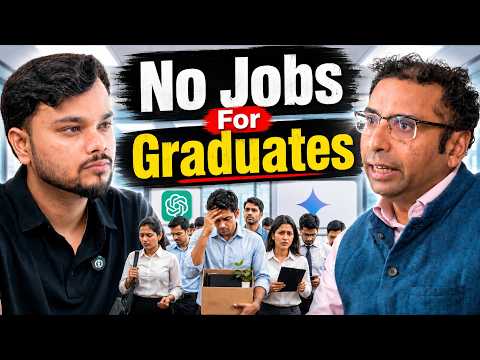
50 is the new 60, Saurabh said. Above 50, the number of people surviving in corporate India is dropping rapidly. And AI has a big role because it is exposing the skill stagnation problem.
The Founder of Marcellus Investment Managers was walking through the second half of his analysis on India’s middle class squeeze. The first half was about the frozen wages between Rs 5 lakh and Rs 1 crore. The second half is about what is causing the freeze to get worse. AI. Graduate oversupply. And the underlying skill stagnation that made both dangerous.
The Scale Of Technology-Dependent Employment
Saurabh started with the numbers on who is actually exposed.
In our country, he said, roughly 8 million or 80 lakh people work in IT or call centers. If you add the IT workers inside banks, in the retail sector, in supply chain, roughly 15 to 20 million people have their livelihoods around technology.
The 15-20 million figure is worth sitting with. This is not just software developers at TCS or Infosys. It includes bank technology employees, retail chain IT teams, logistics coordinators using enterprise software, back-office data workers.
In 2024, Saurabh said, I understood that a massive hit is coming on their livelihoods. AI will hit them very hard.
The Graduate Crisis
The clearest evidence of the crisis is already visible in graduate placement.
White collar job availability in the last three years has become close to zero, Saurabh said. And graduates are coming out of colleges. Annually 80 lakh graduates are coming out. There are no jobs.
The math is worth working through. 80 lakh graduates per year. Zero net new white collar jobs. The gap has to go somewhere.
Saurabh then cited a specific report to validate the finding.
Azim Premji University published a report called State of Working India 2026, he said. They say out of every 100 graduates coming out of college, only 4 are getting a job.
Four out of one hundred. That is the placement ratio for the current graduating cohort in India.
The remaining 96 either find non-graduate work, remain unemployed, or leave the workforce entirely.
The Wage Suppression Dynamic
The graduate oversupply has a specific labor market consequence.
Think from the employer’s perspective, Saurabh said. The industrialist says - a long queue of applicants has formed. Supply-demand game. Suppress the wage. This is showing up in income tax data and in annual report data.
The mechanism is straightforward. When 96 out of 100 candidates cannot get a job, the four who do will accept whatever is offered. The wage compresses toward the lowest number the employer can offer without losing applicants entirely.
The Counterintuitive Bottom
The most surprising part of Saurabh’s analysis is what is happening at the bottom of the distribution.
The government is giving money to those below Rs 5 lakh, Saurabh said. Their income is going up. Minimum wages are being enforced. Direct benefit transfers are reaching them. If you go to any factory in India, you will see a labor shortage picture.
Factory labor is in short supply across India. This inverts the usual narrative about the Indian labor market.
The bottom of the income distribution is being lifted by three forces. Government cash transfers. Minimum wage enforcement. And a factory labor shortage that pushes wages upward through simple supply-demand pressure.
Saurabh gave a striking specific comparison.
In Mumbai where I live, he said, a construction worker earns double what an engineering graduate earns. If someone knows how to operate a JCB, they can earn around 6 lakh a year with overtime. An engineering graduate barely gets 3 lakh.
The JCB operator earns twice the engineering graduate. Because of supply-demand.
Skilled labor at the bottom of the formal distribution is scarce. Engineering graduates are oversupplied. The wage curve reflects the scarcity, not the credential.
The Nifty 50 Wage Data
Saurabh then walked through his own analysis of the middle class wage data.
We took the Nifty 50 companies, he said. Total wage bill. Number of employees. Divided. Got the average wage. And tracked the same companies for 10 years.
The finding is worth quoting.
The typical middle class employee of a Nifty 50 company today earns 10.5 lakh per year, Saurabh said. 10 years ago, roughly the same.
Two independent data sources - Nifty 50 annual reports and income tax data - point to the same reality. The middle class average income has not moved in 10 years.
The Broken Career Ladder
The career progression math is worth understanding.
An entry level graduate earns 3 lakh, Saurabh said. Over 10-20 years, they barely reach 10-15 lakh. That gives you a sense of the supply-demand story.
The traditional Indian middle class narrative was that you start low, work hard, and end up earning multiples of your starting salary by retirement. Saurabh’s data shows the ladder has flattened.
The AI Attack At The Senior End
Then Saurabh introduced the AI dimension.
The biggest AI hit is on people 35 and above, he said. Because they have become expensive. They are senior. The company owner says - I do not need this 40 year old or 50 year old. I will remove him. And I will bring in a younger person whose salary is lower plus AI.
The specific logic is worth understanding. A 45 year old middle manager might earn Rs 40 lakh. A 25 year old plus AI might do 80% of the same work for Rs 15 lakh combined cost. The ROI math for the company owner is clear.
This is the dynamic behind the new corporate India saying.
50 is the new 60, Saurabh said. Above 50, the number of people surviving in corporate India is dropping rapidly.
The retirement age for middle-management corporate professionals is being pulled down. Not because 50 year olds are less capable in absolute terms, but because the AI-enabled alternative is cheap enough.
The Skill Stagnation Root Cause
Saurabh then named the underlying reason AI is landing so hard.
If your skill set has not grown, he said, and after 35 in professional life, skill sets usually stagnate. Most companies do not invest heavily in skill set development. To be fair, most employees also do not invest in themselves after 35. But their salaries kept growing. AI is hitting that really hard.
The dynamic has three parts. Companies stopped investing in employee skill development. Employees stopped investing in themselves. But salaries kept increasing based on tenure, not based on skill growth.
The result was a growing gap between salary and actual productive skill. This was sustainable as long as no cheap alternative existed. AI is the cheap alternative that finally exposed the gap.
The Two-Sided Squeeze
The full picture that emerges from Saurabh’s analysis is a two-sided squeeze on the middle class.
Two stories are happening simultaneously, Saurabh said. At graduate level, companies have almost stopped entry. At the senior level, 35 and above middle management, they are cutting down.
Graduates cannot get in. Seniors cannot stay in. The middle class band is being squeezed from both directions.
What This Reveals
Three things from this segment will stay with me.
The 4-out-of-100 statistic. India’s graduate unemployment crisis is not slow. Ninety-six out of a hundred fresh graduates are not being absorbed by the formal white collar economy.
The JCB versus engineering graduate comparison. The wage curve in India has inverted in specific segments. Skilled physical labor is now paid better than credentialed knowledge workers who are in oversupply.
The 50 is the new 60 reality. The corporate retirement age is being pulled down by AI. Fifty year olds are being cut because the AI-enabled alternative is cheap enough.
The Universal Insight
The Saurabh framework has implications beyond India.
Every economy where AI is being deployed is seeing similar dynamics. Junior-level jobs disappearing. Senior-level jobs being restructured. Middle management being cut. The specific numbers differ by country but the pattern is consistent.
What is specific to India is the scale. 80 lakh graduates per year with almost no absorption. 15-20 million tech-adjacent workers exposed to AI displacement.
The Practical Implications
The Saurabh framework does not prescribe individual solutions. But it does clarify what the middle class person needs to think about.
For a fresh graduate, the credential is not enough. The 96-of-100 rejection rate is the current baseline. Standing out requires something specific - a portfolio, a niche skill, a real project record, or entry through a non-traditional path.
For a mid-career professional, the AI-enabled alternative is quietly forming. The specific skill that AI cannot replicate cheaply is what needs deliberate investment. Judgment. Domain expertise. Relationship networks. Creative problem-solving that requires human context.
For anyone above 40, the corporate ladder that used to guarantee slow progression is broken. The 50-is-the-new-60 reality means that career longevity in corporate India cannot be assumed. The people who continue to thrive are the ones who become genuinely irreplaceable - not because of tenure, but because of specific capability.
The Real Question For Readers
The uncomfortable question the segment raises is what your survival strategy looks like.
If you are a graduate trying to enter, you are competing with 96 others for every 4 available seats. What differentiator are you building?
If you are 35 or above in middle management, the AI-enabled alternative to you is quietly forming. What skill are you building that AI cannot replicate cheaply?
If you have never invested seriously in continuing skill development, this is the moment when that decision is being tested.
Watch the full episode here:
More from the blog



Subscribe to our newsletter
The best new roles, resources and must-watch episodes — in your inbox every week. No spam, unsubscribe anytime.