
Why India Can’t Boycott China Yet? - Jayant Mundhra
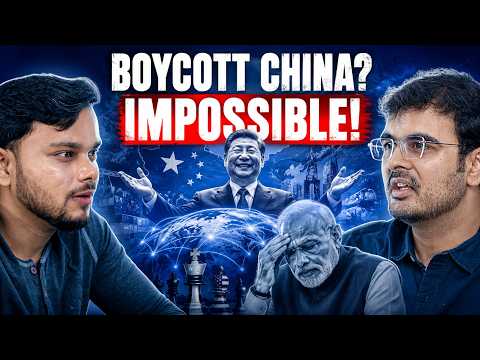
For years, India’s conversation around China has revolved around one question:
How do we reduce our dependence on Chinese imports?
Most people assume the answer is simple.
Export more to China.
But according to Jayant Mundhra, that is the wrong question.
In this thought-provoking conversation, he argues that India’s biggest economic challenge is not exporting more. It is manufacturing more.
The Real Trade Deficit Problem
When people look at India’s trade deficit with China, they often focus on the headline number.
But the real story lies underneath.
India exports:
- Iron ore
- Cotton yarn
- Raw materials
- Intermediate goods
China then processes these inputs into finished products and sells them back to India at significantly higher prices.
In other words, India frequently sells the raw ingredients and buys back the finished product.
That is where much of the value creation happens.
And that is why the trade deficit remains so large.
Why China Became A Manufacturing Giant
China did not become the world’s factory by accident.
According to Jayant, one of the biggest reasons was aggressive industrial support.
He cites the example of BYD, one of China’s largest electric vehicle manufacturers.
Between 2015 and 2020, BYD reportedly received government support worth billions of dollars.
The key lesson is not the amount itself.
The lesson is the willingness to invest heavily in long-term industrial growth.
China viewed manufacturing as a strategic national priority.
And then allocated capital accordingly.
Capital Allocation Is Everything
Jayant makes an interesting comparison between startups and governments.
In startups, one of the founder’s most important responsibilities is capital allocation.
Governments operate the same way.
The biggest question is not how much money exists.
The question is where that money goes.
Should capital be spent on consumption?
Or should it be invested in industries capable of generating future economic value?
The countries that answer this correctly often create globally competitive businesses.
Why India Still Depends On China
One of the most striking moments in the conversation comes when Jayant points out how deeply integrated Chinese manufacturing has become.
Look around any office.
The air conditioner components.
The cameras.
The tripods.
The electronic equipment.
Many critical components originate from China.
This dependency cannot disappear overnight.
India first needs a domestic manufacturing ecosystem capable of producing alternatives at scale.
The Importance Of PLI Schemes
The Production Linked Incentive (PLI) schemes were introduced to encourage manufacturing inside India.
Jayant believes India should continue supporting these programs aggressively.
His argument is straightforward:
If India wants world-class manufacturing, industries need support during the early stages of growth.
That support can come through:
-
Subsidies
-
Incentives
-
Infrastructure
-
Easier access to capital
-
Research funding
China did not build manufacturing dominance through market forces alone.
It combined markets with strategic support.
Why Startups Matter
The conversation extends beyond manufacturing into startups.
Jayant argues that India needs significantly larger pools of capital dedicated to innovation.
Not every startup will succeed.
In fact, most will fail.
But the few winners can create enormous value.
His philosophy is simple:
Fund aggressively.
Experiment widely.
Accept failures.
Scale winners.
That is how ecosystems evolve.
The Cost Of Playing Safe
Many policymakers worry about wasted capital.
But Jayant argues that excessive caution can be even more expensive.
If India underinvests in innovation and manufacturing today, it risks remaining dependent on foreign supply chains for decades.
The cost of missing future champions may be greater than the cost of funding failed experiments.
The Bigger Economic Question
The discussion ultimately raises a larger issue.
What kind of economy does India want to become?
An economy that primarily consumes products created elsewhere?
Or an economy that builds globally competitive companies of its own?
That choice will determine India’s position in the global economy over the next several decades.
Final Thought
Countries do not become manufacturing powerhouses by accident.
They become manufacturing powerhouses because governments, entrepreneurs, investors, and industries work toward the same long-term objective.
India has the talent.
India has the market.
India has the entrepreneurs.
The remaining question is whether the country can allocate enough capital and support to turn that potential into global industrial leadership.
Full Podcast:
More from the blog



Subscribe to our newsletter
The best new roles, resources and must-watch episodes — in your inbox every week. No spam, unsubscribe anytime.