
Why TCS & Infosys Salaries Are Low? - Infosys Co-Founder
When you have money, there is a responsibility to grow it and there is a responsibility to give back, Kris said. Both you have to do.
The Infosys co-founder was explaining the framework he built for himself after retiring in 2014. The wealth was there. The retirement was scheduled. The question was what to do with both.
Kris’s answer had two mechanisms. A family office to grow the money. Himself to give it back. The division of labor is elegant. Neither responsibility gets shortchanged because of the other.
Before we get to the wealth framework, the retirement itself is worth understanding.
The Two Founding Rules
“In the beginning when Infosys was set up, we had all agreed that we will not bring family members into the business, and we will retire at the age of 60.”
Two rules agreed at the founding. No family members. Retire at 60. Both held for 33 years.
This is genuinely rare in Indian business. The default in most Indian family businesses is that the founder’s children eventually take over. The founder stays involved for as long as they physically can. Retirement is a foreign concept.
The Infosys founders chose otherwise. Kris made his exit at 59 in 2014.
“2014, I was 59, and so I said, ‘Okay, that’s it.’”
The exit was not driven by circumstance. It was driven by the agreement.
Why The Rules Held
The interesting question is not whether the rules were made. Many founders make rules like this at the start. The interesting question is why they held for 33 years.
Part of the answer is the founder specialization principle. Each founder had a distinct lane. There was no overlap that would produce friction. When it was time for someone to leave, someone else could cover their function without disruption.
Part of the answer is the collective enforcement. Seven founders agreeing to two rules means that no single founder could bend the rules without the others noticing. Collective agreements between multiple founders are more durable than promises between a founder and himself.
Part of the answer is the reputational stake. Infosys was known publicly for its governance standards. The NASDAQ listing had signaled world-class disclosure. Breaking the founder rules would have damaged the brand the founders had spent their lives building.
All three factors together held the rules in place across three decades. This is what founder discipline looks like when it works.
The Manage-By-Exception System
The management system Kris used to run Infosys at scale was the operational counterpart to the founder discipline.
The interviewer asked how Kris ran the company when it was at 100,000 people.
A unit of work is a project, Kris said. Typically there would be on average 10,000 projects. Every project has a status reporting mechanism which is online.
Ten thousand projects tracked in real time. Each project reporting its own status.
We had a dashboard, Kris said, which allows me to look at any point of time to say that, okay, there are three projects which are critical at this point. There are maybe 10 or 15 projects which are high risk. Then I focus only on those things.
Three critical projects. Ten to fifteen high-risk projects. Out of ten thousand.
So you manage by exception, and you have a team that runs the company, Kris said.
The team runs the company. The CEO handles the exceptions. This is the specific mechanism by which one person can effectively lead a hundred-thousand-person organization.
The Post-Retirement Framework
After 2014, Kris built a specific framework for what he would and would not do.
I’ll not now work for a profit, for-profit entity, he said. I will not have operating roles. Mostly board roles, advisory roles. Even boards only, non-governmental or not-for-profit boards.
Three rules for the post-retirement phase. No for-profit operating roles. Only board and advisory roles. Only non-governmental or not-for-profit boards.
The rules are asymmetric. Kris could have taken lucrative for-profit board seats. He chose not to. He could have taken operating roles at other companies. He chose not to. The post-retirement discipline mirrors the founding discipline.
That’s why I’m on boards of educational institutions, Kris said. I work with governments.
The current portfolio reflects the framework. Educational institutions. Government advisory work. The wealth is being deployed toward institutional strengthening rather than personal accumulation.
The Wealth Philosophy
The interviewer noted that Kris’s net worth is around $3.5 billion.
You have to just put it aside, Kris said. You have built it for you and for your family. So now it’s a time for giving back.
Kris’s framework for wealth is specific.
When you have money, there is a responsibility to grow it and there is a responsibility to give back, he said. Both you have to do.
Two responsibilities. Grow it. Give it back. Neither can be neglected.
This is worth pausing over. The default framing of wealth in most cultures is that accumulation is the primary responsibility. Giving back is optional, and typically deferred until the end of life or the founder’s incapacitation. Kris rejects this framing. Both are mandatory. Both start now.
The mechanism Kris built to execute both is the family office structure.
I’ve created a family office, Kris said. They will do the investments and grow the wealth. I do the spending. That’s what I do, which is giving back.
The division of labor is elegant. The family office grows the money. Kris does the giving back. Each responsibility has a dedicated function. Neither responsibility gets shortchanged because of the other.
The Salary Debate
Before we close, there is one specific piece of the interview worth noting for its editorial honesty.
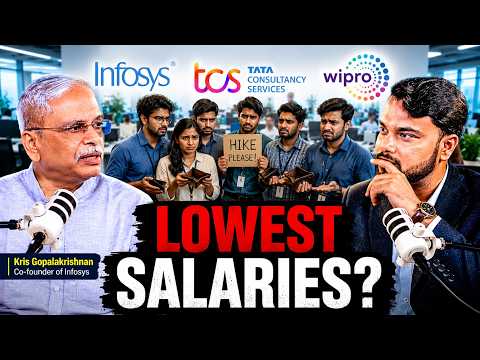
The interviewer raised the critique that entry-level salaries at Infosys are low. Talented developers choose product companies over services companies.
Kris’s defense had two parts.
The first was about the value curve. Entry-level employees are not immediately productive. Salaries reflect the productivity structure. Low at entry, high at mid and senior levels.
The second was a concession worth noting.
Yeah, possible, Kris said, when asked whether top developers were choosing product companies. Not everybody joins Infosys. Not everybody joins TCS. It’s always like that. But you are able to let go, because of the mass scale you’re doing the work. It’s a different model.
Kris does not claim that Infosys retains the top talent. He acknowledges that some talented developers choose product companies. His justification is the mass-scale model. Services companies operate on volume rather than on individual talent optimization. Losing some top developers to product companies is acceptable when the model relies on scale.
This is a contested position in the current Indian tech discussion. Product companies argue the scale-based services model is not building world-class engineers. Services companies argue the model works at the aggregate. Kris is on the services side but honest about the trade-off.
The Universal Insight
The Kris framework has application beyond IT services and beyond billionaire wealth planning.
Every founder eventually faces the succession question. The default is to bring family in and stay involved indefinitely. The alternative is what the Infosys founders did. Rules at the start. Discipline in the middle. Exit on schedule.
Every professional eventually faces the responsibility question. The default is to accumulate personal wealth and treat giving back as optional. The alternative is what Kris did. Two responsibilities. Both mandatory. Both mechanized through dedicated functions.
The framework can be scaled to any income level. A young professional does not need $3.5 billion to apply the same logic. They can allocate a percentage of income to growth and a percentage to giving back. They can create dedicated functions - not a family office, but a specific savings account and a specific charitable commitment - to ensure both responsibilities are executed.
The mechanism is what matters. Wealth grows itself if you set up the system. Giving back requires deliberate action if you want it to actually happen. Kris’s framework acknowledges both realities.
What This Reveals
Three things from this segment will stay with me.
The founder rules. Two rules, agreed at founding, honored for 33 years. No family members in the business. Retire at 60. This is genuinely rare in Indian business. The Infosys founders modeled a discipline that most Indian family businesses do not practice.
The manage-by-exception system. Ten thousand projects tracked. Focus on the three critical and the fifteen high-risk. Team runs the company. The CEO handles the exceptions. This is how one person can lead a hundred-thousand-person organization without micromanaging.
The wealth division of labor. Family office grows the money. Founder does the giving back. Two responsibilities, two dedicated functions. Neither compromised.
The Real Question For Founders
The uncomfortable question the segment raises is whether you would honor a founding agreement 33 years after making it.
Most founders make rules at the start about family involvement, succession, retirement age, and equity dilution. Most founders bend those rules over time as circumstances change. The reasoning is usually that the circumstances have changed enough to justify an exception.
The Infosys founders did not make exceptions. They made the rules and they honored them for three decades. That is what founder discipline looks like at its most durable.
Watch the full episode here:
More from the blog



Subscribe to our newsletter
The best new roles, resources and must-watch episodes — in your inbox every week. No spam, unsubscribe anytime.