
Building Infosys with Narayana Murthy: 33 Years in 38 Minutes | Ex-Infosys Chairman
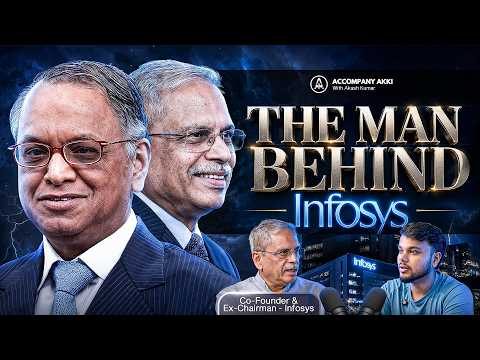
What one of India’s most consequential technologists taught me about bootstrapping without venture capital, why work-life balance is a mindset problem, and the one question that will define India’s next decade
A conversation with Kris Gopalakrishnan, Co-Founder of Infosys, Chairman of Axilor Ventures, Chairman of IISc Council, and one of the architects of modern Indian technology.
In 1989, eight years into building Infosys, the seven co-founders sat down for what may have been the most important meeting in Indian technology history.
They had nothing to show for it. No scale. No brand. One client. Years of hand-to-mouth survival. And someone had just offered them $1 million to make it all go away.
Narayana Murthy said no.
“We all said, okay, if you are continuing, we are also going to continue.”
That decision, made in a small meeting by people who had every rational reason to sell, led to a company that today employs hundreds of thousands of people, trained an entire generation of Indian software engineers, and helped put India permanently on the global technology map.
Kris Gopalakrishnan was one of the seven in that room. Today he is a billionaire, a Padma Bhushan awardee, a co-chair at Davos, and one of the most active philanthropists and institution builders in India. He still works every day, just not for profit.
Part 1: Why $250 Was the Only Option
When Infosys started in 1981, there was no venture capital in India. There were no banks willing to lend against software because software had no collateral. You could not put code against a loan.
The seven founders pooled their family savings. Sudha Murty, Narayana Murthy’s wife, contributed $250. That was the beginning.
“We had to bootstrap with whatever savings our families had. It was hand to mouth. Whatever invoices we generated, we tried to get the money as quickly as possible so we could use it to pay salaries.”
Kris makes the point without bitterness. The constraints were simply the reality. Software was not understood as an industry in India. The global delivery model, the idea that you could write software for American companies from offices in Bangalore, did not yet have a name, let alone a proof of concept. Infosys would create that proof.
What is worth sitting with is what they actually went through for the first eight years. One client. Rented apartments. No brand. Nobody outside the industry knew they existed. By 1989, after nearly a decade of this, the honest question was whether it made sense to continue at all.
The $1 million offer was real. The temptation was real. They said no.
Part 2: The IPO That Changed Everything
After the 1989 meeting, they set a target: IPO by 1992. They missed it by one year and listed in India in 1993. In 1999, they listed on NASDAQ.
The NASDAQ listing was not primarily about capital. Infosys had operating margins of around 20 percent, which meant the business generated substantial cash organically. The listing was about trust, credibility, and brand in the market where their actual clients lived.
“We wanted to show that our standard of disclosure, our standard of financial reporting, is the best in the world.”
For a short period around that time, Infosys’s valuation briefly exceeded Cisco’s, riding the internet boom. The market crashed in 2001 and the valuation came back to earth. But the business kept growing.
Then came the compounding that Kris described in a way that makes the numbers feel almost unbelievable.
The first billion dollars of revenue took 23 years. The second billion happened in 23 months. The third billion happened in the next 13 months.
“We had done all the foundational work required to scale the business in the 1990s. Set up recruitment, HR, education and research to train people, set up the quality department, got the company to CMM Level 5, did the listing, moved to our own campus. Everything we did in the 1990s helped us in the 2000s.”
The decade of 2000 to 2010 was where Infosys truly scaled. The prior decade had been infrastructure. The later decade was harvest.
Part 3: How India’s IT Workforce Was Actually Built
Most people do not realize that the campus-to-company training pipeline that defines Indian IT was not an accident or a government policy. It was a business necessity that Infosys and its peers invented.
When the Y2K problem created massive demand for software engineers in the late 1990s, Infosys was growing over 100 percent annually. They needed engineers by the thousands. But what colleges taught was not what industry needed.
“Typically you would work in COBOL. In the academic institution they teach you C. In industry you’re doing maintenance. In academia they train you to write new software. In industry you have to do a lot of testing. In academia they never teach you testing.”
The most fundamental gap: in academia, the only person who uses the software is the person who writes it. In industry, the entire world uses it. That difference in orientation requires complete retraining.
Infosys built a three-month training program that became the template for the industry. Every major IT company adopted a version of it. The result: India built an engineering workforce at a scale that no other country has replicated, not because of universities, but because companies decided to run their own academies.
Part 4: How He Led 100,000 People Without Losing His Mind
When Kris was CEO, Infosys had roughly 100,000 employees across thousands of simultaneous projects. The question of how you actually lead an organization of that scale is one that most people never think about practically.
His answer is management by exception.
“A unit of work is a project. Typically there would be around 10,000 projects. Every project has a status reporting mechanism which is online. I had a dashboard which allowed me at any point to see that there are three projects critical right now, maybe 10 or 15 which are high risk where flags have been raised. I focus only on those things.”
The CEO does not manage 10,000 projects. The CEO manages the three that need attention and trusts the team to handle the rest. The entire infrastructure of reporting, dashboards, escalation protocols, and team autonomy exists to make that focus possible.
The 2008 global financial crisis was the biggest test of this during his tenure. Projects were canceled or delayed overnight. The bench expanded suddenly. Companies that owed Infosys money were struggling to pay.
“We put people on bench into more training. We made sure that if customers were not able to pay, we still worked on those projects. The goodwill is important.”
The 20 percent operating margin that the industry maintains meant there was a cushion to absorb the shock without layoffs or contract violations. The relationships held. When the market recovered, clients remembered who had stood by them.
Part 5: The Work-Life Balance Question He Refuses to Simplify
Infosys has a reputation for intense work culture. Kris does not deflect this but also does not romanticize it.
“Work-life balance is a mindset issue. You have to learn to manage your time. When you commit time to family, give it 100 percent. Next minute you switch to a client call, give it 100 percent. You live in that moment. That is all that is possible.”
The harder truth he states directly: building something world-class requires 150 percent commitment. You cannot get to the Olympics by training like someone who wants to stay fit. The sacrifice is real and it is chosen.
The additional reality for Indian IT specifically is that serving American and European clients means your workday does not end when India’s workday ends. The overlap is unavoidable. The industry has built structures around it, but anyone pretending the personal cost is zero is not being honest.
“These are choices that you make. It’s not just Infosys. The entire industry is like that. All the founders, I know them all, and they are some of the smartest and hardest working people.”
Part 6: Why They Gave Employees Stock Options When Nobody Else Did
In 1993, when India opened its markets and every major global technology company arrived, IBM, Oracle, Microsoft and others, Infosys was still small. The talent competition was fierce. The question was how to attract and retain people against brands that dwarfed them.
The answer: give every employee stock options.
“Other Indian companies could have also done that, but we said let’s lead that. We said when we build something, let’s share.”
Looking back, Kris calls it clearly the right call, for two reasons. First, the philosophy of the founders, all middle-class people who genuinely believed in sharing what they built. Second, pure strategy. It created a brand and a buzz that money could not buy, and it anchored employees through the difficult years.
Many of those employees became millionaires when Infosys scaled. That outcome in turn became a proof of concept for the entire Indian startup ecosystem. Wealth creation through equity participation was real. Infosys demonstrated it at a scale that changed what engineers believed was possible.
Part 7: The Brain Research Center and What He Is Building Now
Kris donated Rs 225 crore to IISc, the largest individual donation in the institution’s 100-plus year history, to establish the Center for Brain Research. The goal is to understand neurodegeneration: Alzheimer’s, Parkinson’s, dementia.
“Can we identify the problem much earlier? What are called biomarkers of the incidence of a disease, and what can we do to prevent it or slow down the progression? That is what they are doing.”
He describes the work as a long-term longitudinal study tracking how people age and whether early indicators can be detected before disease onset. For India, where the aging population is growing rapidly and healthcare access remains uneven, the potential impact is enormous.
He is also clear about the structural deficit. India spends approximately 0.7 percent of GDP on research and development. China and the US spend three to four percent. The gap is not just financial. It is strategic.
“India does not own many of the technologies we use. Our IPs are not ours. The phones, the watches, the equipment we use, the components inside, those are imported. Denial of technology is a reality today. We need to proactively build the next generation of technologies.”
ISRO, he said, is the template. Denied access to space technologies, India built them domestically. The same model needs to apply across sectors before the need becomes a crisis.
Part 8: AI, Population Decline, and the Two Things Nobody Is Planning For
Kris raised two issues that most conversations about India’s future skip entirely.
On AI: the question is not whether it will displace jobs. It will. The question is what the jobs of the future look like and whether India is building the retraining infrastructure to get people there.
“You have to go after the jobs of the future. How will banking change? How will healthcare change? All healthcare workers need to be trained now to use AI tools. We need massive retraining and re-skilling.”
His analogy is pointed: when cars replaced walking, people stopped exercising and needed gyms. When AI replaces cognitive work, people will need to actively exercise their minds in structured ways. Mental education will become as institutionalized as physical education.
On population: he made a prediction most people are not prepared for. India’s population will begin declining around 2040. It is already declining in Kerala, Tamil Nadu, and Karnataka. As states become middle class, families shrink. The young workforce advantage that India is counting on has a time limit.
“Can we get machines to replace people and do the job? That is what we will be asked.”
The One Thing
If there is a single thread running through everything Kris Gopalakrishnan said, it is this:
The compounding works if you stay.
Twenty-three years for the first billion. Twenty-three months for the second. Thirteen months for the third. That is not a different company at year 23 than at year one. It is the same seven people who refused to sell for $1 million in 1989, who kept building the infrastructure through the 1990s when nobody outside India knew their name, who absorbed the 2001 crash and the 2008 crisis without breaking, and who emerged each time with more trust, more capability, and more of the market than before.
The question for anyone building something today is not whether the environment is perfect. It never is. The question is whether you are willing to do the foundational work now that will only become visible years later.
He is 70 years old, worth $3.5 billion, chairing some of the most important institutions in the country, and still working every day. Not because he needs to. Because the work is not finished.
Watch the full conversation with Kris Gopalakrishnan on YouTube:
More from the blog



Subscribe to our newsletter
The best new roles, resources and must-watch episodes — in your inbox every week. No spam, unsubscribe anytime.